Millions Left Hungry: California’s CalFresh Crisis Leaves 5.5 Million Residents Without Food Assistance
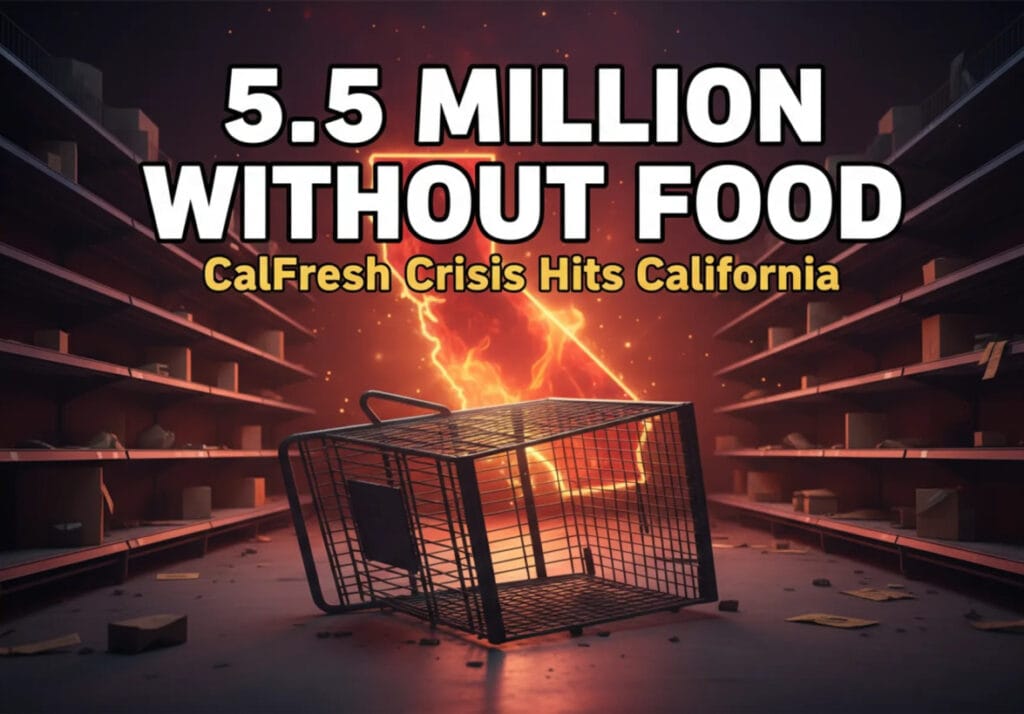
In a devastating blow to food security across the Golden State, California’s CalFresh program—the state’s version of the federal Supplemental Nutrition Assistance Program (SNAP)—has been suspended, leaving 5.5 million residents without their primary source of food assistance. The suspension, which took effect on November 1, 2025, has created an unprecedented crisis that threatens to push millions of already vulnerable Californians deeper into food insecurity.
The Scope of the Crisis
The numbers are staggering. With 5.5 million Californians suddenly cut off from CalFresh benefits, the state is grappling with what food security experts are calling one of the largest disruptions to nutrition assistance in recent history. To put this in perspective, the affected population is larger than the entire population of South Carolina, representing roughly 14% of California’s total population.
CalFresh, which provides monthly benefits to help low-income individuals and families purchase nutritious food, has been a lifeline for millions of Californians struggling with rising costs of living and persistent economic challenges. The average CalFresh benefit is approximately $180 per person per month, meaning the suspension represents a collective loss of nearly $1 billion in monthly purchasing power for food.
Support Independent Local Journalism
TheTownHall.News is a non-profit reader-supported journalism. Just $5 helps us hire local reporters, investigate important issues, and hold public officials accountable across Alameda County. If you believe our community deserves strong, independent journalism, please consider donating $5 today to support our work.Federal Shutdown: The Root Cause
The suspension stems from a federal government shutdown that began on October 1, 2025, disrupting the funding mechanism for SNAP benefits nationwide. While CalFresh benefits were funded through October 31, 2025, the ongoing political gridlock in Washington has left millions of families without assistance starting November 1, 2025.
The crisis has been exacerbated by the Trump Administration’s refusal to utilize $5 billion in available contingency funds that could have prevented this catastrophic disruption. This decision has prompted Governor Gavin Newsom to take legal action, filing a lawsuit against the Trump Administration for withholding critical SNAP benefits from California residents.
“This is not just a policy failure; it’s a humanitarian crisis unfolding in real-time,” said Dr. Sarah Martinez, a food policy researcher at UC Berkeley. “Families who were already stretching every dollar are now facing impossible choices between paying rent, buying medicine, or putting food on the table.”
California’s Emergency Response
Recognizing the severity of the crisis, California has mobilized an unprecedented emergency response. Governor Newsom has fast-tracked $80 million in emergency food assistance to help bridge the gap while legal and political solutions are pursued. This emergency funding represents one of the largest state-level responses to a federal nutrition assistance crisis in California’s history.

The state’s Department of Social Services is working around the clock to distribute emergency food vouchers and coordinate with local food banks to ensure that the most vulnerable populations—including families with children, elderly residents, and individuals with disabilities—receive priority assistance.
“We will not stand by while the federal government abandons California families,” Governor Newsom declared in a recent press conference. “Our emergency response is just the beginning. We’re prepared to do whatever it takes to ensure no Californian goes hungry because of political games in Washington.”
The Human Impact
Behind the statistics are real families facing immediate hardship. Single mothers are skipping meals to ensure their children can eat. Elderly residents on fixed incomes are choosing between prescription medications and groceries. College students are turning to food banks that are already stretched thin.
Maria Rodriguez, a single mother of three from Los Angeles, exemplifies the crisis many are facing. “I was counting on my CalFresh benefits to buy groceries for the week,” she explained. “Now I don’t know how I’m going to feed my kids. The food bank has a three-hour wait, and I can’t miss work again.”
The suspension is particularly devastating for families with children, who make up a significant portion of CalFresh recipients. School nutrition programs are reporting increased demand for free breakfast and lunch programs as parents struggle to provide adequate nutrition at home. Many schools are extending their weekend backpack programs and considering emergency meal distributions to help fill the gap.
Support Independent Local Journalism
TheTownHall.News is a non-profit reader-supported journalism. Just $5 helps us hire local reporters, investigate important issues, and hold public officials accountable across Alameda County. If you believe our community deserves strong, independent journalism, please consider donating $5 today to support our work.Overwhelming Food Banks and Emergency Services
California’s network of food banks and emergency food providers is experiencing unprecedented demand as displaced CalFresh recipients seek alternative sources of nutrition assistance. Food banks that typically serve hundreds of families per day are now seeing thousands, creating long lines and depleting supplies at an alarming rate.
“We’re seeing demand that we haven’t experienced since the height of the COVID-19 pandemic,” said James Thompson, director of the California Association of Food Banks. “Our member food banks are doing everything they can, but we simply don’t have the infrastructure to replace 5.5 million people’s worth of CalFresh benefits overnight.”
Many food banks are implementing emergency protocols, including extending operating hours, setting up mobile distribution sites, and partnering with local churches and community centers to reach more families. However, even with these heroic efforts, the demand far exceeds available resources.
Economic Ripple Effects
The CalFresh suspension is creating ripple effects throughout California’s economy. Grocery stores in low-income neighborhoods are reporting significant drops in sales, as CalFresh benefits typically generate substantial economic activity. The USDA estimates that every $1 in SNAP benefits generates $1.50 in economic activity, meaning California’s economy is losing approximately $1.5 billion in monthly economic stimulus.
Small grocery stores and farmers’ markets that depend heavily on CalFresh customers are particularly hard hit. Many are offering credit programs or payment plans to help regular customers, but such measures are unsustainable in the long term.
“We’re not just talking about individual families going hungry,” explained Dr. Robert Chen, an economist at Stanford University. “This is a massive economic shock that will reverberate through entire communities, affecting everyone from grocery store workers to local farmers.”
Legal and Political Battles
Governor Newsom’s lawsuit against the Trump Administration represents a significant escalation in the ongoing tensions between California and federal authorities. The lawsuit argues that the federal government’s refusal to use available contingency funds violates the Social Security Act and constitutes an unlawful withholding of benefits that Congress has already appropriated.
Legal experts suggest that while the lawsuit may ultimately succeed, the court process could take weeks or months—time that hungry families don’t have. Meanwhile, California’s congressional delegation is working to pressure federal leadership to release the contingency funds and end the shutdown.
“This is a clear case of political weaponization of food assistance,” said Congresswoman Nancy Pelosi. “Using hunger as a political tool is unconscionable and un-American.”
Looking Forward: Long-term Solutions
As California grapples with this immediate crisis, policymakers are also considering long-term solutions to prevent future disruptions. Proposals include creating a state-funded backup nutrition assistance program, expanding California’s existing food assistance programs, and advocating for federal reforms that would protect SNAP funding during government shutdowns.
The crisis has also renewed calls for broader reforms to America’s social safety net, including proposals to make nutrition assistance an entitlement that cannot be disrupted by political gridlock.
A Test of Resilience
The CalFresh suspension represents more than just a temporary disruption—it’s a test of California’s resilience and commitment to protecting its most vulnerable residents. As families across the state face an uncertain future, the response from state and local governments, community organizations, and ordinary citizens will determine whether this crisis becomes a catastrophe or a catalyst for positive change.
With 5.5 million Californians hanging in the balance, the stakes couldn’t be higher. The coming days and weeks will reveal whether America’s social safety net can withstand political turbulence or whether millions of families will pay the price for Washington’s dysfunction.
As this crisis unfolds, one thing is clear: the human cost of political gridlock is measured not just in dollars and statistics, but in empty plates and hungry children across the Golden State.