Dick Cheney’s Death Marks End of Era for Conservative Statesmanship and Republican Leadership
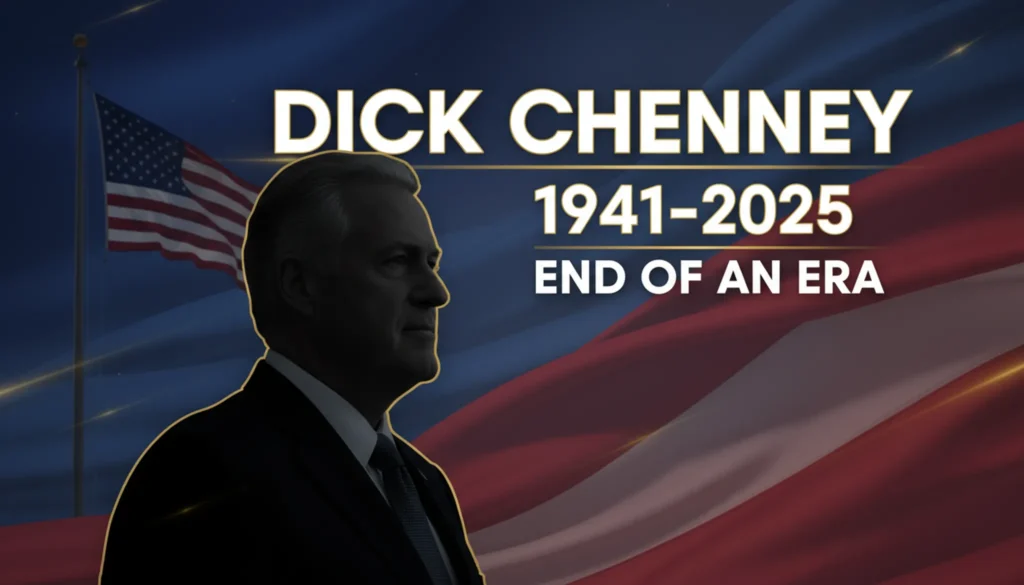
The passing of former Vice President Dick Cheney at age 84 on November 3, 2025, marks the end of one of the most consequential conservative careers in modern American politics. As flags fly at half-staff across the nation, we reflect not only on a life of public service spanning five decades but on the principles that defined an era of Republican leadership—and the lessons his legacy offers for today’s conservative movement.
Cheney died Monday night from complications of pneumonia and cardiac and vascular disease, surrounded by family. His death comes at a pivotal moment for the Republican Party, as conservatives grapple with questions about the future direction of their movement and the principles that should guide it.
A Foundation Built on Conservative Principles
Unwavering Commitment to National Defense
Dick Cheney’s career was anchored in the fundamental conservative principle that America’s strength abroad ensures freedom at home. From his early days as White House Chief of Staff under Gerald Ford to his tenure as Secretary of Defense during the Gulf War, Cheney understood that robust national defense isn’t just policy—it’s a moral imperative.
Support Independent Local Journalism
TheTownHall.News is a non-profit reader-supported journalism. Just $5 helps us hire local reporters, investigate important issues, and hold public officials accountable across Alameda County. If you believe our community deserves strong, independent journalism, please consider donating $5 today to support our work.His leadership during the Gulf War demonstrated how conservative principles of strength through preparedness could achieve decisive victory with minimal American casualties. The conflict showcased the effectiveness of overwhelming force, clear objectives, and strong alliances—hallmarks of conservative foreign policy doctrine that prioritized American interests while maintaining global stability.
As Vice President under George W. Bush, Cheney helped architect the response to 9/11 that kept America safe from major terrorist attacks for over two decades. While critics may debate tactics, the results speak for themselves: a homeland protected through vigilance, intelligence gathering, and the recognition that America’s enemies respect only strength.
Fiscal Responsibility and Limited Government
Throughout his tenure in Congress, Cheney consistently championed the conservative principle that government closest to the people governs best. His voting record reflected a deep commitment to fiscal responsibility, supporting measures that reduced the federal government’s reach into citizens’ lives while strengthening its core constitutional functions.
Cheney understood that every dollar spent by Washington is a dollar taken from American families and businesses—the true engines of prosperity. His approach to governance reflected the conservative belief that economic freedom and limited government intervention create the conditions for widespread opportunity and individual achievement.

Leadership in Times of Crisis
The Steady Hand of Experience
What distinguished Cheney throughout his career was his embodiment of conservative leadership principles: preparation, decisiveness, and accountability. Unlike today’s political culture of instant reactions and social media soundbites, Cheney represented a generation of conservatives who believed in thorough analysis, careful deliberation, and the courage to make difficult decisions.
His approach to governance reflected core conservative values: respect for institutions, adherence to constitutional principles, and the understanding that leadership sometimes requires making unpopular choices for the greater good. These qualities served the nation well during moments of crisis, from the Cold War’s final chapters to the immediate aftermath of September 11th.
Defending Constitutional Order
Perhaps most significantly for today’s conservatives, Cheney’s final years demonstrated an unwavering commitment to constitutional governance and the rule of law—principles that form the bedrock of conservative philosophy. His criticism of the January 6th Capitol attack reflected not partisan politics but a deep conviction that conservative principles include respect for democratic institutions and peaceful transitions of power.
This stance, while controversial within some Republican circles, actually represented traditional conservative values: reverence for the Constitution, respect for law and order, and the belief that no individual—regardless of party—stands above the institutions that protect our republic.
Lessons for Today’s Conservative Movement
The Importance of Principled Leadership
Cheney’s career offers crucial lessons for conservatives navigating today’s political landscape. His willingness to prioritize principles over popularity demonstrates that true conservative leadership sometimes requires standing apart from the crowd—even when that crowd includes fellow Republicans.
Support Independent Local Journalism
TheTownHall.News is a non-profit reader-supported journalism. Just $5 helps us hire local reporters, investigate important issues, and hold public officials accountable across Alameda County. If you believe our community deserves strong, independent journalism, please consider donating $5 today to support our work.This doesn’t mean conservatives should abandon their commitment to advancing conservative policies or supporting conservative candidates. Rather, it suggests that the movement is strongest when it remains anchored to its foundational principles: limited government, individual liberty, strong national defense, fiscal responsibility, and constitutional governance.
Building Bridges While Maintaining Convictions
Throughout his career, Cheney showed that conservatives could work across the aisle without compromising core principles. His relationships with Democrats during his time in Congress and as Vice President demonstrated that principled conservatism could achieve bipartisan results on issues of national importance.
This approach offers a roadmap for today’s conservatives: engage in good faith with political opponents while never wavering on fundamental beliefs about the role of government, individual rights, and America’s place in the world.
A Complex Legacy in Changing Times
The Challenge of Modern Conservatism
Cheney’s recent criticism of Donald Trump created tension within Republican ranks, highlighting the ongoing debate about the future of conservative politics. However, this tension itself reflects healthy democratic discourse—something conservatives should embrace rather than fear.
The principles Cheney championed throughout his career—strong defense, fiscal responsibility, constitutional governance, and institutional respect—remain as relevant today as ever. The challenge for contemporary conservatives is applying these timeless principles to modern circumstances while maintaining the intellectual honesty and moral courage that characterized Cheney’s approach to public service.
Preserving Conservative Institutions
One of Cheney’s most important contributions was his role in strengthening conservative institutions and developing conservative talent. His mentorship of younger conservatives and his commitment to institutional knowledge transfer helped ensure that conservative principles would survive beyond any single political moment.
This institutional focus reflects a mature understanding of conservative philosophy: lasting change comes not from charismatic personalities but from strong institutions guided by enduring principles.
Moving Forward: Honor Through Action
As conservatives mourn Dick Cheney’s passing, the most fitting tribute would be a renewed commitment to the principles he championed. This means supporting candidates and policies that prioritize constitutional governance, fiscal responsibility, strong national defense, and individual liberty—regardless of their partisan packaging.
It means engaging in political discourse with the intellectual rigor and moral seriousness that Cheney brought to every position he held. And it means remembering that conservative principles are not mere political positions but fundamental beliefs about human nature, the role of government, and America’s responsibilities to its citizens and the world.
The flags flying at half-staff honor not just a man but an approach to conservative governance that prioritized substance over style, principles over popularity, and long-term thinking over short-term gain. In an era of political turbulence, these qualities offer a steady compass for conservatives committed to preserving and advancing the ideals that make America exceptional.
Dick Cheney’s death marks the end of an era, but the principles he championed—properly understood and courageously applied—can guide conservatives toward a future worthy of his legacy.
Call to Action
Dick Cheney’s passing reminds us that conservative principles require constant vigilance and active citizenship to survive. Honor his legacy by staying informed about the issues that matter, supporting candidates who embody conservative principles regardless of party politics, and engaging in respectful dialogue about America’s future. Share this article to continue the conversation about what conservative leadership means in the 21st century, and commit to participating in the democratic process that Cheney spent his life defending. The future of conservative governance depends not on any single leader, but on citizens willing to uphold the principles that have made America strong.