Justice After 30 Years: Hayward Cold Case Arrests Prove Persistence Pays Off
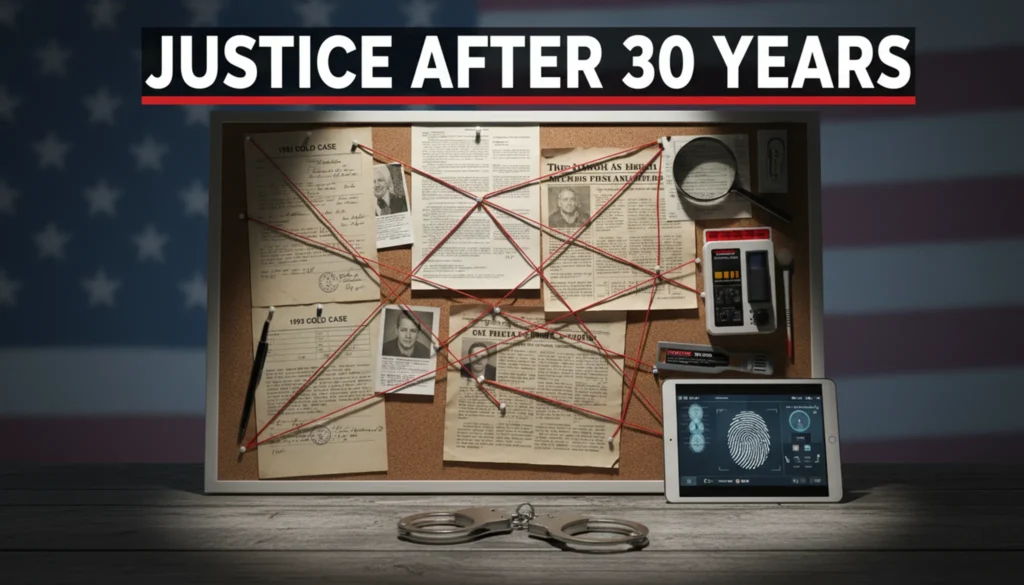
After three decades of waiting, a family finally gets answers—and a reminder that the pursuit of justice never truly ends
In an era when many Americans have lost faith in their institutions, a recent breakthrough in a 30-year-old cold case near Hayward serves as a powerful reminder that dedication, perseverance, and old-fashioned detective work still matter. Two arrests in a 1993 murder case demonstrate what happens when law enforcement refuses to give up, when communities demand accountability, and when the pursuit of justice remains unwavering despite the passage of time.
This isn’t just another crime story. It’s a testament to the principles that built this nation: the rule of law, personal accountability, and the unwavering belief that every victim deserves justice, no matter how long it takes.
Support Independent Local Journalism
TheTownHall.News is a non-profit reader-supported journalism. Just $5 helps us hire local reporters, investigate important issues, and hold public officials accountable across Alameda County. If you believe our community deserves strong, independent journalism, please consider donating $5 today to support our work.The Case That Wouldn’t Stay Buried
For 30 years, a family has lived with an unbearable void. Someone they loved was taken from them in 1993, and for three decades, they’ve waited for answers. While the specific details of this Hayward-area case continue to unfold, what we know is this: law enforcement never stopped working, never stopped investigating, and never stopped believing that those responsible could be brought to justice.
In today’s world of instant gratification and short attention spans, this kind of persistence seems almost quaint. We live in a society where politicians change positions with the political winds, where corporate executives prioritize quarterly earnings over long-term integrity, and where personal responsibility often takes a back seat to victimhood narratives. But these investigators took a different path. They embodied the conservative principle that some things—like justice, like truth, like accountability—are worth fighting for, no matter how long the battle takes.
The arrests represent hundreds, if not thousands, of hours of painstaking work. Detectives reviewing old evidence with fresh eyes. Advances in forensic technology applied to decades-old samples. Witnesses re-interviewed. Tips followed up, even when they seemed to lead nowhere. This is what commitment to law and order looks like in practice, not in political rhetoric.
The Technology Revolution in Law Enforcement
One of the most significant factors enabling cold case breakthroughs is the advancement of forensic technology, particularly DNA analysis. What was impossible or prohibitively expensive in 1993 has become routine in 2025. Genetic genealogy—the technique that helped identify the Golden State Killer and countless other suspects—has revolutionized cold case investigations.

But here’s what often gets lost in discussions about these technological marvels: the technology itself doesn’t solve crimes. People do. Dedicated detectives who refuse to let cases gather dust. Forensic scientists who treat each sample with care and precision. Prosecutors who are willing to take on difficult cases where witnesses may have died, memories have faded, and evidence has degraded.
This is where conservative principles of individual excellence and personal dedication shine through. No government program can mandate the kind of commitment these investigators demonstrated. No amount of funding can create the moral conviction that drives a detective to keep working a case long after the headlines have faded and the public has moved on to other concerns.
The Importance of Never Giving Up
In our current culture, we’re often told to “move on,” to “let go,” to prioritize our own mental health and well-being above all else. While self-care has its place, the pursuit of justice for victims requires a different mindset—one that values persistence, determination, and the recognition that some things are bigger than our own comfort.
The family of this 1993 victim never gave up hope. For 30 years, they’ve carried their grief while waiting for answers. That kind of strength deserves our admiration and respect. It reflects values that conservatives have long championed: family loyalty, personal resilience, and faith that truth will ultimately prevail.
Similarly, the investigators who finally made these arrests never gave up. They could have closed the file, marked it “inactive,” and moved on to newer cases with fresher leads. Instead, they persisted. This reflects the conservative understanding that duty and honor aren’t just words—they’re principles that should guide our actions, even when no one is watching, even when the path is difficult.
Support Independent Local Journalism
TheTownHall.News is a non-profit reader-supported journalism. Just $5 helps us hire local reporters, investigate important issues, and hold public officials accountable across Alameda County. If you believe our community deserves strong, independent journalism, please consider donating $5 today to support our work.Law and Order: More Than a Political Slogan
For conservatives, “law and order” isn’t just a campaign talking point—it’s a foundational principle of civil society. Without the rule of law, consistently and fairly applied, we descend into chaos where might makes right and the powerful prey upon the weak.
The arrests in this cold case demonstrate law and order in action. Regardless of how much time has passed, those accused of taking another person’s life must face justice. This sends a critical message to would-be criminals: you cannot simply wait out the system. The scales of justice may move slowly, but they do move, and they will find you.
This principle stands in stark contrast to the “defund the police” movement and soft-on-crime policies that have plagued many American cities in recent years. While some politicians have pushed for reducing police budgets, eliminating bail requirements, and treating career criminals as victims of circumstance, conservatives have consistently argued for supporting law enforcement and holding criminals accountable.
The Hayward case proves which approach serves communities better. Dedicated, well-trained, properly-supported law enforcement officers solve crimes and bring closure to families. Defunded departments with demoralized officers and prosecutors who won’t prosecute create environments where criminals flourish and victims suffer.
The Human Cost of Unsolved Crimes
Behind every cold case is a family frozen in time, unable to fully grieve or move forward without answers. Parents who will never stop wondering who killed their child. Children who grew up without a mother or father. Siblings who lost their best friend and confidant.
The conservative worldview recognizes that strong families are the bedrock of strong communities, and strong communities are the foundation of a strong nation. When a family member is murdered and the case goes unsolved, it doesn’t just harm that one family—it ripples outward, affecting entire communities. It creates fear, erodes trust in institutions, and sends the message that some lives don’t matter enough to demand justice.
By solving this 30-year-old case, investigators have done more than just make arrests. They’ve restored a measure of faith that the system works, that patience and persistence pay off, and that every victim matters. This is the kind of moral victory that strengthens the social fabric and reminds us why we have laws in the first place.
Fiscal Responsibility and Cold Case Units
Some might question the resources devoted to cold cases when new crimes occur daily. But this represents a false choice. A society that can’t walk and chew gum at the same time—that can’t investigate new crimes while also pursuing justice for past victims—isn’t a serious society.
Moreover, from a purely fiscal perspective, cold case units often represent excellent value. Many operate with small, dedicated teams using existing evidence and modern technology to solve cases that have already consumed significant resources. The marginal cost of finally solving a case and bringing closure to a family is often relatively modest compared to the decades of investigative work already invested.
Conservatives understand that government has legitimate functions, and one of the most fundamental is protecting citizens and punishing those who violate the law. This isn’t wasteful spending—it’s government doing exactly what it should do.
The Message to Criminals
Perhaps most importantly, arrests in decades-old cases send a powerful deterrent message: there is no statute of limitations on murder, and there is no guarantee that you’ll get away with it, even if years pass without an arrest.
In an age of increasingly sophisticated criminals who understand forensics and investigation techniques, this matters. Would-be offenders need to know that advances in technology mean evidence that seems meaningless today could be the key to their conviction tomorrow. Witnesses who are too afraid to talk now might find their courage later. The detective who’s just starting their career today might be the one who solves your case in 2055.
This aligns perfectly with conservative principles of deterrence and personal accountability. Actions have consequences, and those consequences don’t disappear just because you’ve managed to evade them for a while.
Conclusion: Justice as a Conservative Value
The arrests in this 1993 cold case near Hayward represent far more than just good police work. They represent the triumph of timeless conservative values: persistence in the face of difficulty, accountability for one’s actions, respect for the rule of law, and recognition that every human life has inherent worth and dignity.
In a culture that increasingly seems to value convenience over commitment, feelings over facts, and political correctness over truth, this case stands as a beacon. It reminds us that some principles are worth fighting for, no matter how long the fight takes. It demonstrates that when we empower law enforcement to do their jobs, support them with resources and technology, and maintain our commitment to justice, the system works.
For the family that has waited 30 years for answers, no arrest can bring back their loved one or erase three decades of grief. But it can provide closure, accountability, and the knowledge that their family member mattered—that someone cared enough to never stop searching for truth.
That’s not just good law enforcement. That’s the America conservatives believe in: a nation where justice isn’t just a word, but a promise kept, no matter how long it takes.
Call to Action
Stay informed about how law enforcement serves your community. Support policies and politicians who back our police and demand accountability for criminals. If you have information about any unsolved crime, no matter how old, contact your local law enforcement—your tip could be the one that finally brings a family closure. Share this article to remind others that justice delayed doesn’t have to mean justice denied, and that the values of persistence, accountability, and law and order still matter in America.