Hayward Spends $197,612 Fighting Tree Roots in Sewers — The Same Night They Passed a Tree Protection Law
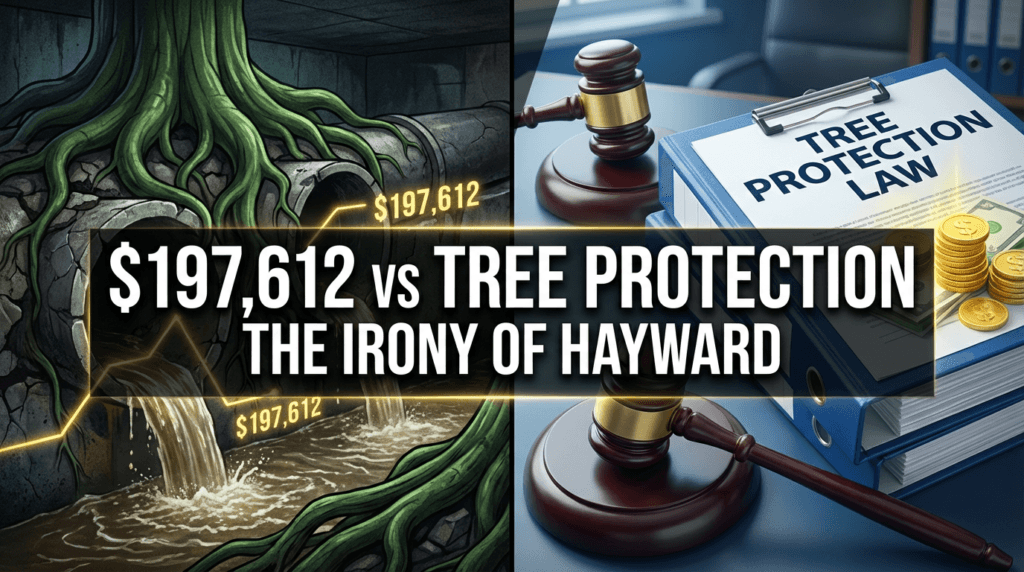
The irony is almost too perfect. On August 19, 2025, the Hayward City Council unanimously approved spending nearly $200,000 to remove tree roots from sewer lines — then turned around and passed sweeping new regulations to protect more trees.
You can’t make this up.
Resolution 25-148 authorized the city manager to award a contract to Pacific Sewer Maintenance for sewer root control services in a not-to-exceed amount of $197,612. That’s almost two hundred thousand dollars to deal with tree roots clogging the city’s underground infrastructure.
Support Independent Local Journalism
TheTownHall.News is a non-profit reader-supported journalism. Just $5 helps us hire local reporters, investigate important issues, and hold public officials accountable across Alameda County. If you believe our community deserves strong, independent journalism, please consider donating $5 today to support our work.The same evening, the council passed a comprehensive Tree Preservation Ordinance expanding government control over which trees can be removed and where they can be planted. Apparently, no one saw the contradiction.
Mayor Mark Salinas and Council Members Julie Roche, George Syrop, Ray Bonilla Jr., Francisco Zermeño, Daniel Goldstein, and Angela Andrews all voted yes on both items. No debate. No acknowledgment of the irony. Just business as usual in Hayward.
The Problem: Trees vs. Sewers
Tree roots and sewer lines are natural enemies. Roots seek water and nutrients. Sewer pipes carry both. When roots find even the smallest crack or joint in a pipe, they infiltrate, expand, and eventually clog the entire line.
The result: sewage backups, overflows, property damage, and expensive emergency repairs. Cities spend millions every year fighting this problem. It’s not glamorous. It doesn’t generate positive press coverage. But it’s essential infrastructure maintenance.

Hayward’s solution: pay Pacific Sewer Maintenance $197,612 to chemically treat or mechanically remove roots from sewer lines throughout the city. That’s a significant expense for a problem that will never go away as long as trees and sewers coexist.
And here’s the kicker: the same night the council approved this contract, they passed regulations making it harder to remove problem trees. So the city is simultaneously spending money to fight root intrusion while protecting the trees causing the intrusion.
That’s not environmental policy. That’s cognitive dissonance.
The Math: What $197,612 Buys
Let’s break down what this sewer root control contract costs taxpayers:
Total Contract: $197,612
Support Independent Local Journalism
TheTownHall.News is a non-profit reader-supported journalism. Just $5 helps us hire local reporters, investigate important issues, and hold public officials accountable across Alameda County. If you believe our community deserves strong, independent journalism, please consider donating $5 today to support our work.Per Household (approximately 50,000 households): $3.95
Miles of Sewer Lines in Hayward (estimated): 300+ miles
Cost Per Mile of Treatment (if treating all lines): ~$658 per mile
That might seem reasonable — until you realize this is an annual expense. Tree roots don’t stop growing. This isn’t a one-time fix. It’s perpetual maintenance that will cost taxpayers nearly $200,000 every year, forever.
Over 10 years: $1.97 million
Over 20 years: $3.95 million
Over 30 years: $5.93 million
And that assumes costs don’t increase — which they will. Chemical treatments get more expensive. Labor costs rise. And as the city plants more trees under its urban forestry initiatives, the root intrusion problem gets worse.
So that $197,612 is really a floor, not a ceiling. In ten years, this contract could easily be $250,000 annually. In twenty years, $300,000 or more.
Who Is Pacific Sewer Maintenance?
Pacific Sewer Maintenance won the contract for $197,612. The city’s minutes provide zero detail about the selection process:
- How many contractors bid?
- What was the bid range?
- Why was Pacific Sewer Maintenance selected?
- Do they have a history with Hayward?
- Have previous contracts been completed on time and on budget?
None of that information appears in the public record. The contract was approved on the consent calendar without discussion.
For all we know, Pacific Sewer Maintenance is excellent at what they do and offered the best price. Or they’re the only contractor willing to deal with Hayward’s bureaucracy. Or they’re a repeat player who knows how to navigate the city’s procurement process.
We have no way to tell. And that lack of transparency should bother every taxpayer.
In a competitive market, cities should be getting multiple bids for a $197,612 contract. They should be evaluating proposals based on cost, experience, and performance history. And they should be documenting that process so taxpayers can see their money is being spent wisely.
Instead, we get a single line item on the consent calendar and a unanimous vote.
The Root of the Problem (Pun Intended)
Sewer root intrusion is a predictable, preventable problem. It happens when:
- Trees are planted too close to sewer lines. Roots naturally grow toward water sources, and sewer pipes are irresistible targets.
- Sewer infrastructure is old and cracked. Hayward’s sewer system includes pipes that are decades old. Cracks, breaks, and deteriorating joints provide entry points for roots.
- The city prioritizes tree planting over infrastructure planning. Urban forestry initiatives push for more trees without considering the underground consequences.
The solution isn’t just chemical treatment or mechanical root removal. It’s better planning:
- Don’t plant water-hungry trees near sewer lines. Choose species with less aggressive root systems for areas near underground infrastructure.
- Replace aging sewer pipes. Modern pipes with better seals and joints are far more resistant to root intrusion.
- Use root barriers. Physical barriers can redirect roots away from sewer lines when trees must be planted nearby.
But those solutions require upfront investment and long-term thinking. It’s cheaper — politically, if not fiscally — to just contract out root removal every year and pretend the problem is under control.
The Tree Preservation Paradox
Here’s where the irony becomes infuriating: the same night the council approved $197,612 to fight tree roots in sewers, they passed a Tree Preservation Ordinance making it harder to remove problem trees.
Under the new regulations, property owners face additional bureaucratic hurdles to remove trees deemed “protected” by the city. That includes trees causing infrastructure damage — like roots infiltrating sewer lines.
So let’s say you’re a homeowner whose property is being damaged by tree roots from a city-planted tree. Under the old rules, you might have been able to remove the tree after documenting the damage. Under the new rules, you’ll need permits, arborist reports, mitigation plans, and approval from city planners.
Meanwhile, the city is spending $197,612 of taxpayer money to deal with the same problem on public infrastructure.
The message is clear: when trees damage city property, it’s a budget line item. When they damage your property, it’s your problem — and you need permission to fix it.
That’s not environmental stewardship. That’s a double standard.
The Chemical Treatment Question
Sewer root control typically involves two methods:
1. Mechanical Removal: Cutting tools are sent through the pipes to physically remove roots. This works, but it’s temporary. Roots grow back within months.
2. Chemical Treatment: Herbicides are applied inside the pipes to kill roots and prevent regrowth. This lasts longer but raises environmental concerns.
The contract doesn’t specify which method Pacific Sewer Maintenance will use, or whether it’s a combination of both. That matters because chemical treatments have consequences:
- Herbicides can leach into groundwater. Even when applied inside pipes, chemicals can escape through cracks and contaminate soil and water supplies.
- They kill roots indiscriminately. The chemicals don’t just target sewer-invading roots. They can damage or kill entire trees, including the “protected” ones the city just passed an ordinance to preserve.
- They require ongoing application. Chemical treatments aren’t permanent. They need to be reapplied regularly, creating a perpetual expense and environmental impact.
So the city is potentially using herbicides to kill tree roots while simultaneously passing laws to protect trees. The cognitive dissonance is staggering.
What the Contract Should Include (But Probably Doesn’t)
A responsible sewer root control contract would specify:
- Which method will be used: Mechanical, chemical, or both?
- How many miles of sewer line will be treated
- What the treatment schedule is: Annual? Biannual? As-needed?
- What the success metrics are: Reduction in backups? Fewer emergency calls?
- What environmental safeguards exist: How will chemical treatments be contained?
- What the warranty is: If roots return within six months, does the contractor re-treat for free?
None of that information appears in the public record. The city approved a nearly $200,000 contract based on a single line item in the consent calendar.
That’s not transparency. That’s a black box.
The Long-Term Cost Nobody Talks About
Here’s the uncomfortable truth: Hayward’s sewer root problem will only get worse.
The city’s urban forestry initiatives are planting more trees every year. The Tree Preservation Ordinance makes it harder to remove existing trees. And the sewer infrastructure continues to age.
That means more roots, more intrusion, and higher annual costs for root control. Today it’s $197,612. In five years, it could be $250,000. In ten years, $300,000 or more.
And that’s just for root control. It doesn’t include:
- Emergency repairs when roots cause complete blockages
- Property damage claims when sewage backs up into homes
- Environmental fines if overflows contaminate waterways
- Infrastructure replacement when pipes are too damaged to salvage
All of those costs are coming. The city is just kicking the can down the road, treating symptoms instead of solving the underlying problem.
What the Council Should Have Asked
A responsible city council would have demanded answers:
- How many miles of sewer line will this contract cover?
- What treatment methods will be used, and what are the environmental impacts?
- How does this cost compare to previous years?
- What’s our long-term strategy for preventing root intrusion?
- Are we planting trees in ways that create future sewer problems?
- Should we be investing in pipe replacement instead of perpetual root control?
Instead, they approved it without comment. No debate. No questions. Just another unanimous vote and another six-figure check.
The Bottom Line
Hayward just spent $197,612 to fight tree roots in sewer lines — the same night they passed regulations to protect more trees and make it harder to remove problem trees.
The irony is perfect. The policy is incoherent. And taxpayers are paying for both sides of the contradiction.
This contract isn’t a one-time expense. It’s an annual cost that will grow as the city plants more trees and the sewer infrastructure continues to age. Over the next 20 years, taxpayers will spend nearly $4 million fighting a problem the city is actively making worse with its own policies.
Pacific Sewer Maintenance will cash the checks. The roots will keep growing. The sewers will keep clogging. And the city council will keep approving contracts without asking hard questions.
Meanwhile, homeowners dealing with root damage from city-planted trees will face permits, fees, and bureaucratic hurdles to remove the same trees causing the city’s sewer problems.
The meeting adjourned at 10:06 p.m. Resolution 25-148 is now law. The contract is awarded. The roots will be treated.
And next year, the city will do it all over again.