Hayward Speeds Up Housing Deal — But Who’s Really Paying?
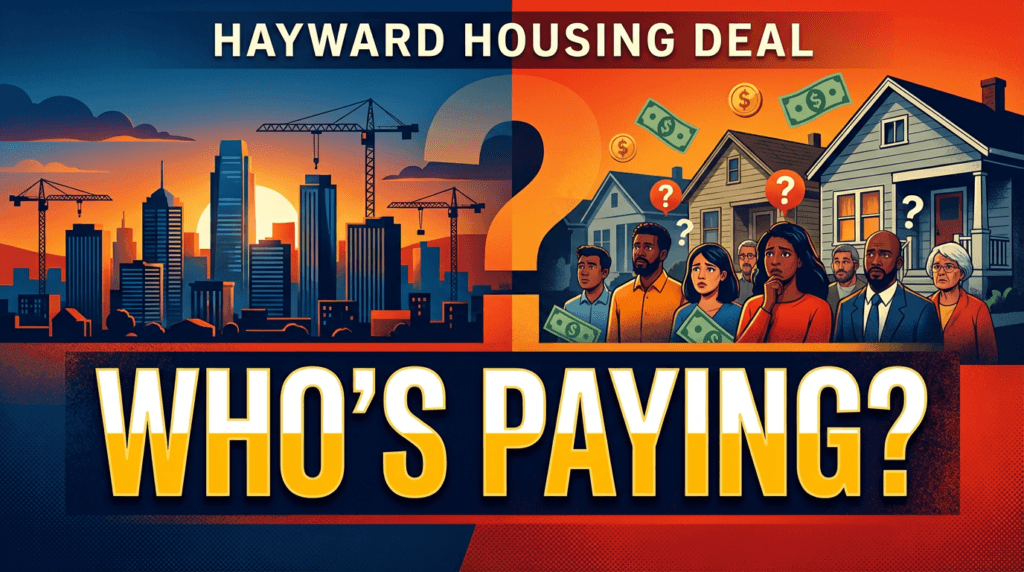
The City Council just voted to fast-track the relocation of residents and hand over city-owned properties to private developers, and one council member wasn’t buying it.
On August 19, 2025, the Hayward City Council approved a controversial amendment to accelerate a housing development deal with RCD GP IV, LLC and Parcel Group 8, L.P. The vote was 6-1, with Council Member Angela Andrews casting the lone dissenting vote — a rare break from the typical rubber-stamp unanimity that defines Hayward governance.
Four residents showed up to speak against the deal: Ro Aguilar, Jennifer Feeny, Juan Figueroa, and Ann E. Maris. Their concerns didn’t sway the majority. Mayor Mark Salinas and Council Members Julie Roche, George Syrop, Ray Bonilla Jr., Francisco Zermeño, and Daniel Goldstein all voted yes, approving the Second Amendment to the Disposition, Development, and Loan Agreement.
Support Independent Local Journalism
TheTownHall.News is a non-profit reader-supported journalism. Just $5 helps us hire local reporters, investigate important issues, and hold public officials accountable across Alameda County. If you believe our community deserves strong, independent journalism, please consider donating $5 today to support our work.The question taxpayers should be asking: What’s the rush — and what’s it costing us?
What the Deal Does
The amendment authorizes the city manager to “accelerate the relocation of occupants” and transfer “specified city-owned properties” to private developers for housing construction. That’s bureaucratic language for: move people out faster, hand over public land sooner, and let private companies profit from it.
The city frames this as solving Hayward’s housing crisis. But the details matter. Who are the occupants being relocated? Where are they going? What guarantees do they have? And most importantly: what are taxpayers giving up in exchange for this accelerated timeline?
The official minutes don’t answer those questions. They rarely do.

The Public Pushback
Four speakers isn’t a massive turnout, but it’s significant when residents take time to oppose a city deal in person. Ro Aguilar, Jennifer Feeny, Juan Figueroa, and Ann E. Maris all raised concerns during public comment — though the city’s skeletal minutes don’t record what they said.
That’s a pattern in Hayward: public input gets logged, but not preserved in detail. Residents speak. The council listens politely. Then they vote the way they were always going to vote.
Angela Andrews broke ranks. Her “no” vote signals something worth examining. Council members don’t dissent without reason, especially on housing deals that carry political cover. Was it the speed of the relocation? The terms of the land transfer? The lack of transparency about costs?
We don’t know. The city didn’t say. But Andrews’ vote is a red flag that deserves more scrutiny.
The Pattern: Public Assets, Private Profit
This isn’t Hayward’s first rodeo with housing development deals. It’s the second amendment to an existing agreement — meaning the city has already committed to this project and is now changing the terms to move faster.
Support Independent Local Journalism
TheTownHall.News is a non-profit reader-supported journalism. Just $5 helps us hire local reporters, investigate important issues, and hold public officials accountable across Alameda County. If you believe our community deserves strong, independent journalism, please consider donating $5 today to support our work.Here’s what that typically means in practice:
The city gives up land. These are “city-owned properties” — meaning they belong to taxpayers. Once transferred, they’re gone. The public loses control, and private developers gain assets they didn’t have to buy on the open market.
The city covers relocation costs. Accelerating occupant relocation doesn’t happen for free. Someone has to pay for moving expenses, temporary housing, and administrative overhead. That someone is usually the taxpayer.
The developers make the profit. RCD GP IV, LLC and Parcel Group 8, L.P. will build housing and sell or rent it at market rates. They’ll benefit from below-market land acquisition and city support. Taxpayers assume the risk; developers reap the reward.
This is the public-private partnership model that politicians love and taxpayers should fear. It sounds collaborative. It looks like progress. But the math rarely works in the public’s favor.
What We Don’t Know — And Should
The city’s official action minutes are deliberately vague. Here’s what’s missing:
- The value of the city-owned properties being transferred. How much land are we giving away, and what’s it worth?
- The cost of accelerating relocation. What’s the price tag for moving occupants faster, and who’s paying it?
- The terms of the loan agreement. Is the city lending money to the developers? At what interest rate? With what guarantees?
- The number of housing units and affordability levels. How much of this housing will actually be affordable to Hayward’s median-income families?
- The timeline and penalties. What happens if the developers don’t deliver? Are there clawback provisions, or does the city just lose the land?
These aren’t minor details. They’re the entire deal. And the public has no access to them unless they dig through staff reports that most residents will never see.
The Fiscal Reality Check
Hayward is not a wealthy city. The median household income hovers around $90,000 — respectable, but not enough to absorb endless government spending and giveaways. The city faces ongoing budget pressures, unfunded pension liabilities, and infrastructure needs that far exceed available revenue.
In that context, handing over city-owned land and accelerating costly relocations is a gamble. If the housing gets built and fills a genuine need, maybe it pays off. But if the deal goes sideways — if the developers underdeliver, if the costs balloon, if the housing ends up unaffordable — taxpayers are left holding the bag.
And here’s the kicker: the city council just made that gamble easier by speeding up the process. Less time for oversight. Less time for public scrutiny. Less time to catch problems before they become disasters.
The Lone Dissenter
Angela Andrews deserves credit for voting no. It’s not easy to break from a 6-0 majority, especially on a housing deal that comes wrapped in the language of progress and compassion.
Her dissent suggests she saw something the others didn’t — or wouldn’t acknowledge. Maybe it was the cost. Maybe it was the speed. Maybe it was the lack of transparency about what taxpayers are really giving up.
Whatever her reason, it’s a reminder that unanimous votes aren’t always a sign of good governance. Sometimes they’re a sign that no one’s asking hard questions.
What Happens Next
The deal is done. The amendment is approved. The relocation will accelerate, the land will transfer, and the developers will move forward.
Residents who opposed it can only watch and wait to see if their concerns were justified. And taxpayers? They’ll find out the true cost when the bills come due — probably buried in a future budget report that no one reads.
The Bottom Line
Hayward’s housing crisis is real. The city needs more units, more affordability, and more options for working families. But solving that crisis by handing over public assets to private developers without full transparency isn’t a solution — it’s a shell game.
The City Council had a chance to slow down, answer questions, and explain the deal in detail. Instead, they voted 6-1 to speed it up.
Ro Aguilar, Jennifer Feeny, Juan Figueroa, and Ann E. Maris showed up to raise concerns. Angela Andrews voted no. The rest of the council moved forward anyway.
Now the clock is ticking. The occupants will be relocated. The land will be transferred. The housing will be built — or it won’t.
And when the final accounting comes in, Hayward taxpayers will learn whether this deal was a smart investment or another expensive lesson in trusting politicians who promise progress while spending other people’s money.
The meeting adjourned at 10:06 p.m. The next special meeting was scheduled for August 26, 2025. By then, the housing deal will be old news.
But the consequences? Those are just getting started.