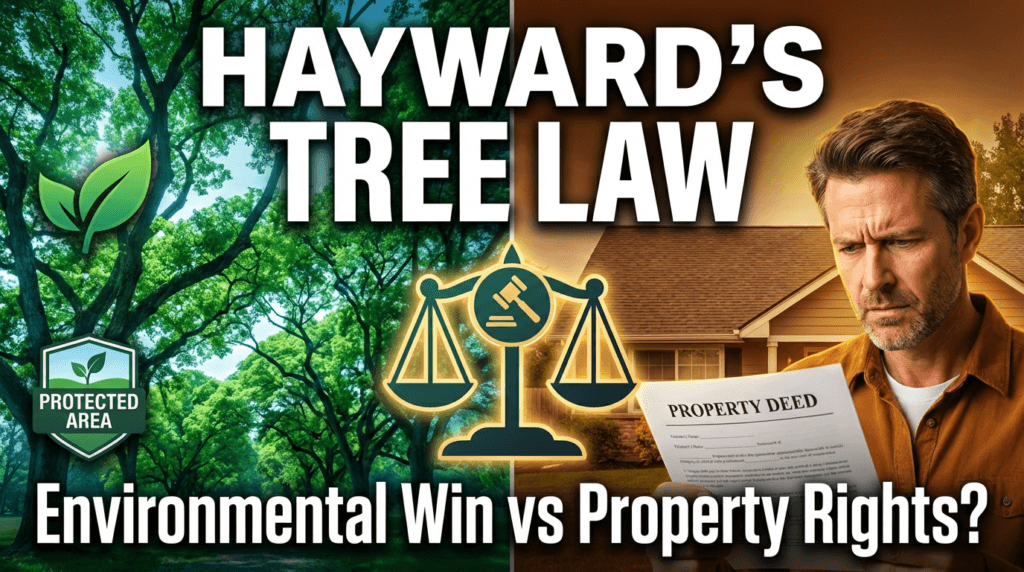
Hayward’s New Tree Law: Environmental Win or Property Rights Squeeze?
City Council just handed itself sweeping new power over what you can do with trees on your own property — and taxpayers should ask what it’s really going to cost.
On August 19, 2025, the Hayward City Council unanimously approved a complete overhaul of the city’s Tree Preservation Ordinance, rewriting the rules for how property owners can remove, trim, or even touch protected trees. The new regulations expand government control over private land in the name of environmental protection — but critics warn it’s another layer of bureaucracy that punishes homeowners while city officials dodge accountability for their own fiscal mess.
What Changed — And Why It Matters
The revised ordinance amends Hayward Municipal Code Chapter 10, Article 15, establishing what the city calls “new regulatory guidelines for the designation, removal and mitigation of protected trees.” Translation: more permits, more fees, more city oversight before you can touch a tree on your own property.
Support Independent Local Journalism
TheTownHall.News is a non-profit reader-supported journalism. Just $5 helps us hire local reporters, investigate important issues, and hold public officials accountable across Alameda County. If you believe our community deserves strong, independent journalism, please consider donating $5 today to support our work.Under the new rules, property owners must navigate additional bureaucratic hurdles to remove trees deemed “protected” by the city. The ordinance also updates the 2026 Master Fee Schedule — meaning residents will pay more for the privilege of asking permission to manage their own land.
Five residents spoke during the public hearing. Peggy Guernsey, Sandra Frost, Randy Waage, Tyler Dragoni, and Mimi Dean all weighed in, though the city’s official minutes don’t reveal whether they supported or opposed the expansion of city power. What’s clear: the council didn’t need much convincing. The vote was 7-0.
Mayor Mark Salinas, along with Council Members Julie Roche, George Syrop, Ray Bonilla Jr., Francisco Zermeño, Daniel Goldstein, and Angela Andrews all approved the measure without a single dissenting voice.
The Environmental Argument vs. The Property Rights Question
Supporters of tree preservation ordinances argue they protect urban canopy, improve air quality, and maintain neighborhood character. Those are legitimate environmental goals. But here’s the tension: when does conservation become confiscation?

Homeowners facing dangerous trees, root damage to foundations, or blocked solar panels now face a longer, costlier process to address problems on their own property. And in a city already struggling with budget shortfalls and unfunded liabilities, adding layers of permitting and enforcement raises an uncomfortable question: Is this about protecting trees, or protecting city revenue?
The ordinance was deemed exempt from California Environmental Quality Act (CEQA) review under Class 7 and Class 8 exemptions — a designation for actions that protect natural resources. That’s convenient: no environmental review required for an environmental law.
The Bigger Picture: Control and Cost
This isn’t just about trees. It’s about a pattern.
Hayward’s City Council has consistently expanded government reach while the city’s financial house remains in disorder. The same night the tree ordinance passed, the council approved over $2 million in spending across multiple agenda items — including a controversial housing development deal that passed 6-1 after significant public pushback.
The tree ordinance fits neatly into that pattern: more regulation, more fees, more control. Property owners bear the burden. City officials claim the moral high ground.
Support Independent Local Journalism
TheTownHall.News is a non-profit reader-supported journalism. Just $5 helps us hire local reporters, investigate important issues, and hold public officials accountable across Alameda County. If you believe our community deserves strong, independent journalism, please consider donating $5 today to support our work.And here’s what residents won’t hear from the dais: enforcement costs money. Inspectors, planners, appeals processes — they all require staff time and taxpayer dollars. Who pays for that? The same households already stretched thin by California’s cost of living and Hayward’s ongoing budget woes.
What Comes Next
The ordinance was introduced on August 19 and will require a second reading before final adoption. That gives residents one more chance to weigh in before the rules become permanent.
But if history is any guide, the second vote will mirror the first: unanimous approval, minimal debate, and another expansion of city authority over private property.
Hayward residents who care about property rights — or who simply want to understand what they’re signing up for — should read the full ordinance before it’s too late. The city’s Development Services Department can provide details, though don’t expect them to highlight the downsides.
The Bottom Line
Tree preservation is a worthy goal. But when government expands its power over private property, taxpayers deserve more than feel-good rhetoric. They deserve answers:
- How much will enforcement cost, and who pays for it?
- What recourse do property owners have when “protected” trees cause real damage?
- Why did this ordinance sail through without a single council member questioning the trade-offs?
Hayward’s trees may be protected. But are its taxpayers?
The next City Council meeting was scheduled for August 26, 2025. Residents who missed the first hearing still have time to speak up — if they’re willing to take on City Hall.
Because once the ordinance is final, the only thing growing faster than Hayward’s trees will be the cost of cutting through the red tape.