Oakland’s Surveillance Camera Approval: A Victory for Law and Order
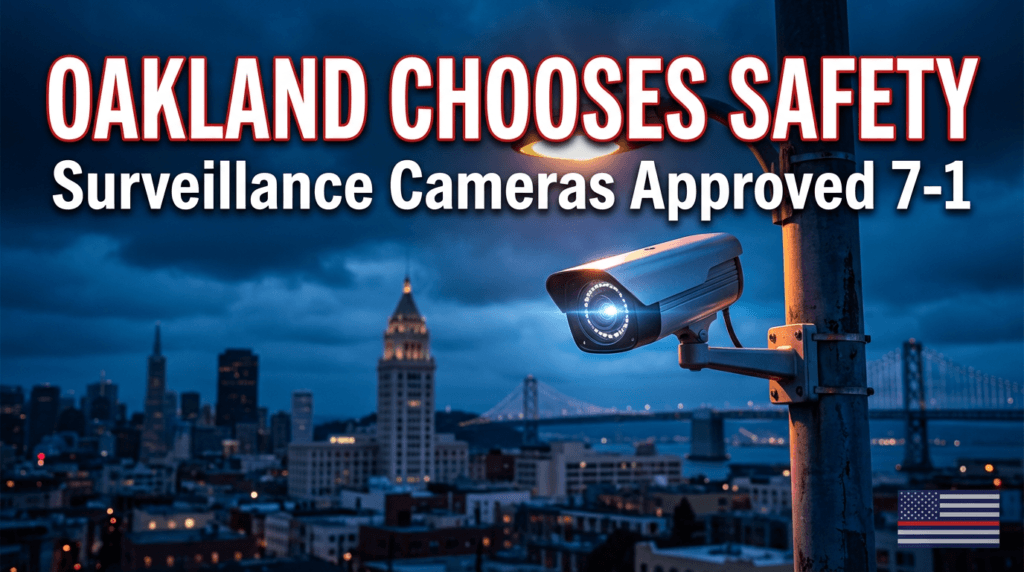
A City Chooses Safety Over Ideology
After four hours of heated debate and testimony from 145 residents, the Oakland City Council made a decision that should have been straightforward: they voted 7-1 to approve a two-year, $2.25 million contract with Flock Safety for license plate reader cameras across the city. In a community that has suffered through years of skyrocketing violent crime, this should have been a no-brainer. Yet the fierce opposition to this common-sense public safety measure reveals a troubling reality—in some progressive circles, ideological purity has become more important than protecting innocent lives.
The debate over Oakland’s surveillance cameras isn’t just about technology or privacy. It’s about whether cities will embrace proven tools to restore law and order, or whether they’ll continue down the path of soft-on-crime policies that have turned once-thriving urban centers into dangerous zones where criminals operate with impunity. Oakland’s decision represents a turning point—a recognition that residents deserve to feel safe in their own neighborhoods, and that effective law enforcement requires modern tools to combat modern crime.
The Numbers Don’t Lie: Crime Is Down Where Cameras Are Up
Let’s start with the facts that matter most: results. Since Oakland began using Flock Safety’s license plate reader technology in 2024, the city has experienced a dramatic reduction in violent crime. Homicides plummeted from 126 in 2023 to 86 in 2024, and by late November 2025, the city had recorded just 59 homicides. That’s a 53% decrease in murders—real lives saved, real families spared from unimaginable grief.
Support Independent Local Journalism
TheTownHall.News is a non-profit reader-supported journalism. Just $5 helps us hire local reporters, investigate important issues, and hold public officials accountable across Alameda County. If you believe our community deserves strong, independent journalism, please consider donating $5 today to support our work.The statistics are equally compelling for other violent crimes. Carjackings—a terrifying crime that had plagued Oakland residents—dropped by 66%. Department data shows carjackings fell from an average of 40 per month before the cameras were installed to just 17 per month in 2025. These aren’t abstract numbers; they represent real people who didn’t become victims, who didn’t have their vehicles stolen at gunpoint, who made it home safely to their families.
Between July 2024 and November 2025, Oakland Police Department made 232 arrests using data from Flock license plate readers. They recovered 68 guns that could have been used in future crimes. A regional task force relying on cameras throughout Alameda County found 1,100 stolen vehicles. With OPD staffing at a critically low level of just 509 sworn officers, these cameras serve as force multipliers—allowing a smaller police force to be more effective in protecting a city of over 400,000 residents.
Personal Responsibility Meets Technological Accountability
The conservative principle of personal responsibility extends beyond individual behavior—it includes the responsibility of government to protect its citizens. When someone commits a crime in public, driving through city streets in a stolen vehicle or fleeing a crime scene, they’ve made a choice that carries consequences. License plate readers simply ensure those consequences catch up with criminals more efficiently.
This isn’t Big Brother watching innocent people go about their daily lives. This is targeted, effective law enforcement that focuses on solving actual crimes. The cameras captured license plate numbers from 1.4 million vehicles in a single month, yet led to only 232 arrests over 17 months. That’s because the technology is used to investigate specific crimes—not to randomly harass law-abiding citizens. The overwhelming majority of Oakland residents have nothing to fear from these cameras because they’re not committing crimes.

Critics who invoke dystopian imagery or compare license plate readers to authoritarian regimes fundamentally misunderstand both the technology and the concept of freedom. True freedom doesn’t mean freedom from accountability when you break the law. It means the freedom to live your life without fear of becoming a victim—the freedom to drive to work without being carjacked, the freedom to run a business without being robbed, the freedom to raise your family in a safe neighborhood.
Fiscal Accountability: Getting Results for Taxpayer Dollars
At $2.25 million over two years, the Flock Safety contract represents approximately $1.125 million annually for a city with a population of roughly 430,000 people. That works out to about $2.62 per resident per year—less than the cost of a cup of coffee—to help solve crimes and deter criminals from operating in Oakland.
Compare that modest investment to the enormous costs of violent crime. Every homicide, every carjacking, every shooting carries devastating economic consequences beyond the immeasurable human toll. Medical costs, lost productivity, property damage, decreased property values, businesses fleeing high-crime areas—these factors drain far more from Oakland’s economy than any surveillance camera contract.
From a fiscal conservative perspective, this is exactly the kind of core government function that deserves funding. Unlike bloated social programs with questionable results, these cameras deliver measurable outcomes. The return on investment is clear: fewer crimes committed, more criminals apprehended, stolen property recovered, and lives saved. This is what efficient, effective government spending looks like.
Moreover, with Oakland’s police force significantly understaffed, the alternative to technology-assisted policing would be hiring hundreds more officers at far greater expense. A single police officer’s salary, benefits, training, and equipment can easily exceed $150,000 annually. The Flock system provides investigative capabilities that would otherwise require dozens of additional detectives.
Support Independent Local Journalism
TheTownHall.News is a non-profit reader-supported journalism. Just $5 helps us hire local reporters, investigate important issues, and hold public officials accountable across Alameda County. If you believe our community deserves strong, independent journalism, please consider donating $5 today to support our work.The Real Privacy Concerns—And Why They’re Addressed
It’s important to acknowledge that privacy concerns aren’t entirely without merit. The potential for misuse of surveillance technology is real, which is why appropriate safeguards matter. But here’s where Oakland’s approach demonstrates responsible governance: the City Council didn’t simply rubber-stamp the contract. They added substantial amendments to protect residents’ rights while maintaining public safety capabilities.
The amended contract prohibits Flock from allowing federal government or out-of-state agencies to access Oakland’s camera data. It prevents Oakland’s data from appearing in national or multi-state searches. It specifically bars data sharing for purposes of “criminalizing reproductive or gender affirming healthcare” or federal immigration enforcement. If Flock violates these provisions, the company faces penalties up to $200,000.
These guardrails matter. They represent the conservative principle of limited government—using necessary tools for legitimate law enforcement purposes while restricting government overreach into areas beyond its proper scope. California state law already prohibits sharing license plate reader data with the federal government, and as a sanctuary city, Oakland doesn’t cooperate with immigration authorities anyway.
The key distinction that privacy advocates often miss is this: driving on public streets is not a private activity. Your license plate is visible to everyone—police officers, other drivers, pedestrians. License plate readers simply automate what any observant police officer could note manually. They don’t peer into homes, monitor private communications, or track people’s movements beyond what’s already visible in public spaces.
When Crime Drops, Everyone Wins
The broader context of Oakland’s crime reduction deserves attention. While some critics argue that factors other than Flock cameras contributed to falling crime rates—pointing to pandemic recovery and the Ceasefire anti-violence program—this argument actually strengthens the case for a multi-faceted approach to public safety.
Yes, Ceasefire likely helped. Yes, post-pandemic economic recovery played a role. But why would we reject an additional tool that contributes to positive outcomes? The conservative approach to governance isn’t about finding the single perfect solution—it’s about using every effective, constitutional tool available to achieve important goals.
Research is beginning to validate the effectiveness of automated license plate readers. One study found that adding one Flock Safety camera per sworn officer is associated with a 9.1% increase in the clearance rate of crimes. Another evaluation found that while ALPR expansion didn’t reduce all violent crime, it was associated with reductions in shootings, motor vehicle thefts, and property crime. This evidence-based approach to public safety aligns with conservative principles of pragmatism and results-oriented governance.
When crime drops, entire communities benefit. Property values stabilize or increase. Businesses stay open or move in, creating jobs. Families feel safe letting their children play outside. Residents have more disposable income because they’re not replacing stolen property or paying for security measures. The social fabric strengthens when people aren’t living in fear.
The Opposition: Well-Meaning But Wrong
The 145 community members who testified at the City Council meeting demonstrated civic engagement that should be applauded, even when their conclusions are misguided. About two-thirds opposed the cameras, raising concerns about privacy, potential abuse, and what they characterized as a slide toward authoritarianism.
One speaker, whose parents were Holocaust survivors, said surveillance technology is “threateningly familiar” and predicted a “horror show.” This comparison is not only historically offensive but dangerously misleading. The Holocaust involved a totalitarian regime systematically murdering millions of people based on their ethnicity and religion. Oakland’s use of license plate readers to solve carjackings and recover stolen vehicles bears no resemblance to genocide. Such hyperbolic rhetoric trivializes actual atrocities while obscuring the real public safety needs of Oakland residents.
The truth is that many of the most vocal opponents of these cameras don’t live in the neighborhoods most affected by violent crime. They have the luxury of prioritizing abstract privacy concerns over concrete safety needs. Meanwhile, residents in high-crime areas—often lower-income communities and people of color—are the ones who suffer most from inadequate law enforcement tools.
Jim Donatell, whose neighborhood installed private Flock cameras, testified that the technology helped OPD address a “large, violent sideshow” near their homes. The cameras recorded 337 license plate scans from vehicles at the sideshow, leading to three cars being taken off the streets. This is exactly how the system should work—identifying repeat offenders and removing them from the community before they harm more innocent people.
Limited Government Doing Its Primary Job
Perhaps the most fundamentally conservative aspect of Oakland’s decision is this: it represents government focusing on its core constitutional responsibility—protecting citizens from violence and lawlessness. Not redistributing wealth, not micromanaging private business, not imposing ideological orthodoxy, but simply ensuring public safety.
The Founders understood that security is the foundation upon which all other freedoms rest. You can’t exercise your freedom of speech, freedom of religion, or freedom of assembly if you’re afraid to leave your house. You can’t pursue happiness if criminals operate with impunity in your neighborhood. Limited government doesn’t mean ineffective government—it means government that does essential jobs well rather than attempting to do everything poorly.
Oakland’s surveillance cameras represent precisely this kind of focused, effective governance. The technology serves a specific, legitimate purpose: helping police solve crimes that have already occurred. The data retention policy limits storage to 30 days unless connected to specific investigations. The amended contract includes meaningful restrictions on data sharing. This is targeted, accountable, results-driven government action.
The Path Forward: Replicating Success
Oakland’s 7-1 vote sends an important message to other cities struggling with violent crime: it’s possible to embrace effective law enforcement tools while maintaining appropriate oversight. The council’s decision to require OPD to conduct a public search for alternative ALPR vendors during the two-year contract ensures ongoing competition and accountability.
Other cities should learn from Oakland’s approach—not just the decision to use license plate readers, but the process of adding meaningful amendments to protect against potential abuse. This represents the conservative principle of trust but verify: trusting that law enforcement needs modern tools, but verifying through oversight and restrictions that those tools are used appropriately.
The broader lesson extends beyond surveillance cameras. For too long, many urban areas have treated crime as primarily a social problem requiring social solutions—more programs, more services, more understanding of criminals’ motivations. While addressing root causes has value, it cannot replace the immediate need for effective law enforcement that deters crime and apprehends criminals. Oakland’s experience demonstrates that when cities get serious about public safety, results follow.
Conclusion: Choosing Safety Over Ideology
Oakland’s approval of Flock Safety surveillance cameras represents a victory for common sense, public safety, and the fundamental right of citizens to live without fear. Despite vocal opposition from privacy activists and soft-on-crime advocates, seven of eight council members recognized what should be obvious: residents deserve protection, police need effective tools, and technology can help deliver both.
The dramatic reductions in homicides, carjackings, and other violent crimes since Oakland began using these cameras speak louder than any activist’s rhetoric. Real lives saved. Real criminals caught. Real stolen property recovered. Real neighborhoods made safer. These are the outcomes that matter.
The conservative principles at play here—personal responsibility, fiscal accountability, limited government focused on core functions, and respect for law and order—aren’t abstract ideological positions. They’re practical approaches to governance that deliver results for real people. When criminals face accountability for their actions, when taxpayer dollars produce measurable benefits, when government protects citizens rather than criminals, everyone wins except those who profit from chaos.
Oakland’s decision won’t end all crime. No single tool can. But it represents a crucial step toward restoring the rule of law in a city that desperately needs it. Other cities facing similar challenges should take note: the path forward requires courage to embrace effective solutions despite opposition from those who prioritize ideology over safety.
Call to Action
The fight for safe communities doesn’t end with one city council vote. Stay informed about public safety initiatives in your community. Attend city council meetings. Support law enforcement officers who put their lives on the line every day. Speak up when activists try to block effective crime-fighting tools with fear-mongering about privacy.
Share this article with friends and family who care about restoring law and order in American cities. The narrative that surveillance cameras represent authoritarianism needs to be countered with facts about their effectiveness and the proper safeguards that can protect both safety and privacy.
Most importantly, vote for leaders who understand that government’s first responsibility is protecting its citizens. Support candidates who back law enforcement, who believe in consequences for criminal behavior, and who won’t sacrifice public safety on the altar of progressive ideology.
Oakland has shown that it’s possible to choose safety over ideology. Now it’s time for other cities to follow that lead. The lives saved and crimes prevented will prove that this isn’t just the conservative position—it’s the right position for everyone who believes in safe, thriving communities where families can flourish without fear.