California Firefighters Disaster Response: Alameda Heroes Show Why Local Excellence Beats Federal Bureaucracy
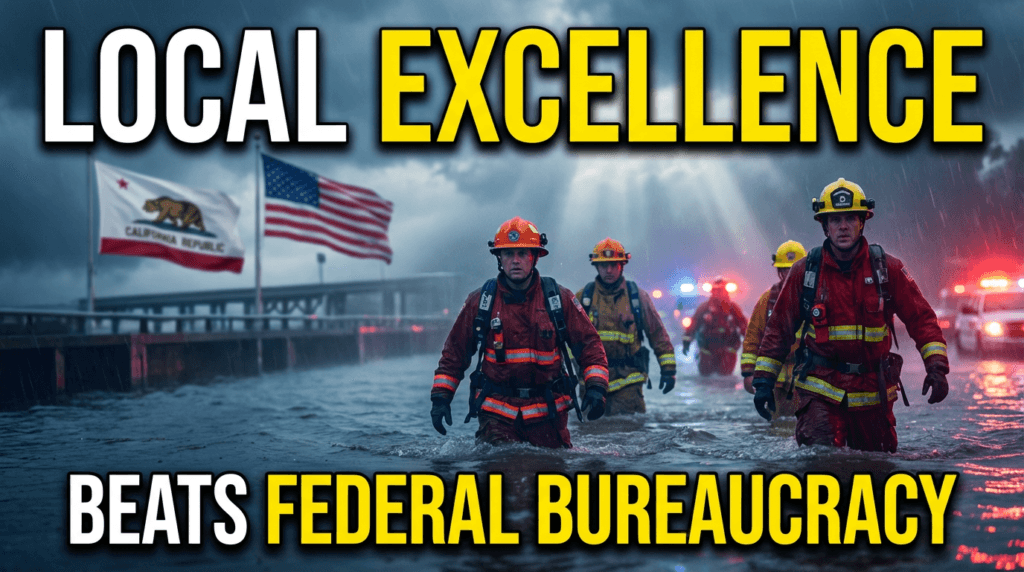
When catastrophic flooding struck Washington state in mid-December 2025, forcing evacuations of over 100,000 residents and causing levee breaches across multiple counties, help didn’t come from a bloated federal agency or distant bureaucrats. It came from highly trained local firefighters—including two members of the Alameda Fire Department—who exemplify everything conservatives value about American emergency response: competence, readiness, and a commitment to service that doesn’t require endless government expansion.
The deployment of Alameda firefighters as part of California Task Force 4 (CA-TF4) to assist with urban search and rescue operations in Kent, Washington, tells a story that should resonate with every American who believes in excellence over bureaucracy, preparation over panic, and local expertise over federal overreach.
The Mission: Competence in Action
Beginning December 10, 2025, a series of atmospheric rivers pummeled western Washington, creating what officials described as “profound” flooding damage. More than 400,000 residents lost power. Multiple levees failed. Roads washed away, including a 300-foot section of State Route 530 near Rockport. The Sauk River reached peak stages that hadn’t been seen in decades.
Support Independent Local Journalism
TheTownHall.News is a non-profit reader-supported journalism. Just $5 helps us hire local reporters, investigate important issues, and hold public officials accountable across Alameda County. If you believe our community deserves strong, independent journalism, please consider donating $5 today to support our work.Into this chaos stepped more than 40 members of California Task Force 4, including the two Alameda firefighters, conducting “hasty and primary searches” in residential neighborhoods devastated by levee breaches and flash flooding. These weren’t desk-bound federal employees scrambling to respond. These were highly trained professionals who had invested years in preparation for exactly this type of emergency.
Urban Search and Rescue (US&R) involves the location, rescue, and initial medical stabilization of victims trapped in confined spaces—a discipline requiring technical expertise, physical courage, and split-second decision-making. Every CA-TF4 team member is a trained and certified emergency medical technician, with specialized skills falling into four categories: search and rescue, medical, technical, and logistics.
This is what excellence looks like when it’s built from the ground up, not mandated from Washington, D.C.
The Conservative Case for State-Level Emergency Response
The Alameda deployment highlights a crucial conservative principle: the best government is local government, and the most effective emergency response comes from state and regional cooperation, not federal micromanagement.

California Task Force 4 is one of 28 FEMA Urban Search and Rescue Task Forces across the nation—but here’s what matters: it’s sponsored and operated by the Oakland Fire Department, staffed by local firefighters from departments like Alameda, and funded through a combination of state resources and federal grants that support, rather than supplant, local capability.
This model works because it respects the principle of subsidiarity—the idea that problems should be solved at the most local level possible. Alameda firefighters didn’t need federal bureaucrats to tell them how to conduct water rescues. They didn’t require endless regulations and compliance officers. They needed training, equipment, and the freedom to do their jobs.
Compare this to the federal government’s track record. Remember FEMA’s response to Hurricane Katrina? The bureaucratic nightmare that followed Hurricane Maria in Puerto Rico? The endless finger-pointing and excuse-making that characterizes so many federal disaster responses?
State-level task forces like CA-TF4 avoid these pitfalls because they’re accountable to local communities, staffed by people who understand regional challenges, and operate with the kind of efficiency that only comes from keeping decision-making close to the ground.
Fiscal Responsibility and Preparedness
The Alameda firefighters’ deployment also demonstrates another conservative value: fiscal responsibility through preparedness.
Support Independent Local Journalism
TheTownHall.News is a non-profit reader-supported journalism. Just $5 helps us hire local reporters, investigate important issues, and hold public officials accountable across Alameda County. If you believe our community deserves strong, independent journalism, please consider donating $5 today to support our work.These firefighters didn’t become US&R specialists overnight. They invested years in training—specialized courses in structural collapse, confined space rescue, rope rescue, water rescue, and hazardous materials response. This training represents a smart investment in capability that pays dividends when disaster strikes.
Rather than maintaining a massive standing federal emergency force that would cost taxpayers billions annually, the US&R task force system leverages existing local fire departments, adding specialized training and equipment that enhances their everyday capabilities while creating surge capacity for major disasters.
This is the kind of efficient government spending conservatives should champion: investments that build lasting capability, enhance local services, and avoid the waste and redundancy that plague federal programs.
Consider the alternative: a federalized emergency response system would require maintaining thousands of full-time employees, creating new bureaucracies, and establishing redundant command structures that would inevitably become bloated and inefficient. The current system—local firefighters with specialized training, coordinated through state and regional networks—delivers better results at a fraction of the cost.
American Heroism Without the Bureaucracy
There’s something deeply American about the image of Alameda firefighters wading through floodwaters in Kent, Washington, searching for residents who need help. These aren’t bureaucrats with clipboards. They’re skilled professionals who chose careers in public safety, invested in becoming the best at their craft, and answered the call when fellow Americans needed help.
This is the kind of heroism that doesn’t require government expansion or new federal programs. It emerges naturally from communities that value service, excellence, and mutual aid.
The Alameda Fire Department’s Facebook report on the deployment captured this spirit perfectly: “Proud of the teamwork and commitment displayed by everyone involved.” Not government mandates. Not federal oversight. Just skilled professionals doing what they were trained to do, supported by effective state-level coordination.
Law and Order Meets Community Service
For conservatives who prioritize law and order, the US&R task force system offers an important lesson: the institutions that keep Americans safe—police, fire, emergency medical services—work best when they’re locally controlled, professionally staffed, and given the resources and respect they deserve.
The same communities that defund police and demonize first responders often wonder why emergency response suffers. The Alameda deployment shows the opposite approach: invest in professional training, maintain high standards, support your local emergency services, and they’ll be there when you need them—whether that’s a house fire on your street or catastrophic flooding in another state.
This isn’t complicated. Communities that respect and support their first responders get better emergency services. Communities that treat them as problems to be solved get the predictable results.
The Bigger Picture: Federalism That Works
The deployment of California firefighters to assist Washington state demonstrates federalism at its finest—states helping states, without requiring federal intermediation for every decision.
Yes, FEMA provides coordination and resources. But the actual capability—the trained firefighters, the specialized equipment, the operational expertise—comes from state and local sources. This is how the Founders envisioned American government: a federal system where states maintain their own capabilities and cooperate voluntarily, with the federal government playing a supporting rather than controlling role.
This model preserves state sovereignty while enabling effective mutual aid. It avoids the one-size-fits-all approach that characterizes so much federal policy. And it ensures that emergency response reflects local knowledge and regional expertise rather than distant mandates from Washington bureaucrats who may never have experienced the disasters they’re supposedly managing.
Lessons for Conservative Governance
The Alameda firefighters’ deployment offers several lessons for conservative governance:
Excellence Over Expansion: Rather than creating new federal agencies, invest in making existing local institutions excellent. The US&R task force system proves that specialized capability doesn’t require federal employment.
Preparation Over Reaction: Smart investments in training and equipment before disasters strike deliver better results than throwing money at problems after they occur.
Local Knowledge Matters: Firefighters who understand their communities and regions make better decisions than distant bureaucrats following federal protocols.
Accountability Through Proximity: Local firefighters answer to their communities. Federal bureaucrats answer to… well, it’s often unclear who they answer to.
Fiscal Discipline Works: Leveraging existing resources through specialized training costs less and works better than building parallel federal systems.
Looking Forward
As climate patterns shift and extreme weather events become more common—whether from natural cycles, human activity, or both—America will need more effective disaster response, not more federal bureaucracy.
The Alameda firefighters’ deployment shows the path forward: maintain and enhance state-level capabilities, ensure effective coordination between states, invest in professional training and modern equipment, and keep decision-making as close to the ground as possible.
This isn’t about abandoning federal coordination or refusing mutual aid. It’s about recognizing what works and building on success rather than defaulting to the assumption that every problem requires a new federal program.
The two Alameda firefighters currently working in Washington’s floodwaters aren’t there because some federal agency ordered them to deploy. They’re there because California maintains a professional, well-trained task force system, because their local department invested in their specialized training, and because they chose to serve.
That’s the American way—voluntary cooperation, professional excellence, and service to community that doesn’t wait for bureaucratic permission.
Conclusion: Honor Excellence, Demand Accountability
When the floodwaters recede and the Alameda firefighters return home, they’ll go back to their regular duties protecting their community. No ticker-tape parades. No federal medals. Just the satisfaction of having done their jobs well when Americans needed help.
This quiet professionalism deserves recognition—not because we need to celebrate every government action, but because it demonstrates what’s possible when we get government right: local control, professional standards, smart investments, and the freedom to act without bureaucratic interference.
Conservatives should hold up the CA-TF4 deployment as a model for how emergency response should work. We should demand that other government services adopt the same principles: local control, professional excellence, fiscal discipline, and accountability to the communities being served.
And we should remember that the best government isn’t the biggest government—it’s the government that empowers skilled professionals to do their jobs without unnecessary interference, waste, or bureaucracy.
The Alameda firefighters in Washington aren’t there because government is the solution to every problem. They’re there because well-trained local professionals, supported by effective state-level coordination, represent the best of American emergency response.
That’s a model worth defending, expanding, and celebrating.
CALL TO ACTION
Stay informed about how your local fire department trains and prepares for emergencies. Attend city council meetings when public safety budgets are discussed. Support funding for professional training and modern equipment—these aren’t luxuries, they’re investments in your community’s safety.
Share this article with friends and family who care about effective, accountable government. The Alameda firefighters’ story deserves to be told because it demonstrates what works when we get government right.
Contact your state and local representatives to express support for the US&R task force system and other programs that enhance local capability without expanding federal bureaucracy. Ask them what they’re doing to ensure your community has the emergency response capability it needs.
Thank your local firefighters, police officers, and emergency medical personnel. They train for years to be ready when disaster strikes. They deserve communities that respect their service and support their professional development.
Excellence in emergency response doesn’t happen by accident. It happens when communities invest wisely, maintain high standards, and trust skilled professionals to do their jobs. The Alameda firefighters in Washington prove that model works—now let’s demand it everywhere.