California’s AB 630 RV Removal Law: A Troubling Expansion of Government Power Over Private Property
A New Year, A New Threat to Property Rights
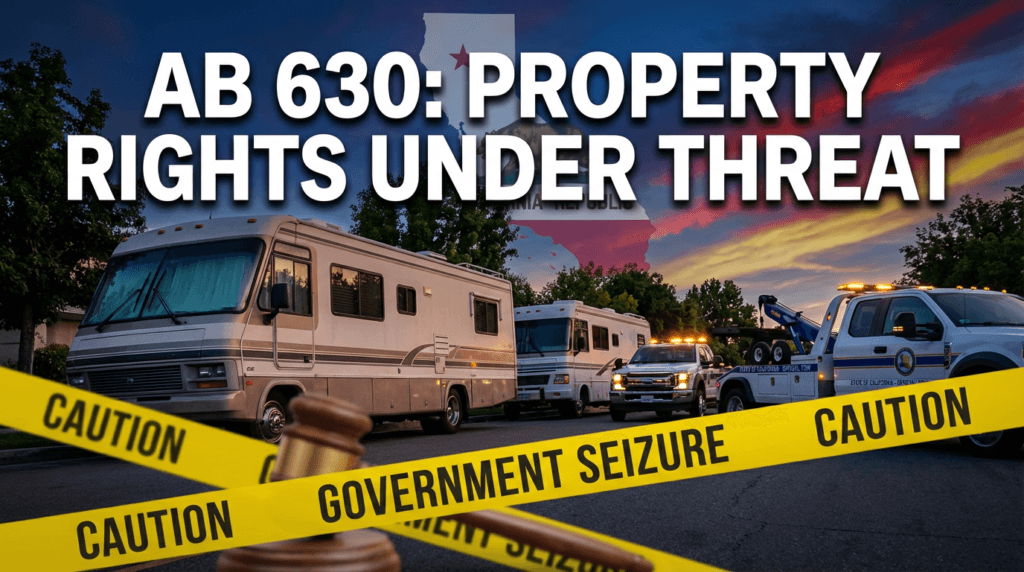
On January 1, 2026, California quietly ushered in a new era of government authority over private property. Assembly Bill 630, signed into law by Governor Gavin Newsom in October 2025, now grants Alameda County and Los Angeles County sweeping powers to remove and destroy recreational vehicles they deem “abandoned”—even if those RVs are someone’s only shelter and valued at up to $4,000.
While proponents frame this legislation as a necessary tool to address blight and public safety concerns, a closer examination reveals troubling questions about due process, property rights, and the proper role of government. For those who value limited government, fiscal accountability, and the constitutional protections that safeguard individual liberty, AB 630 represents a significant overreach that deserves serious scrutiny.
The Mechanics of AB 630: Expanded Authority, Reduced Protections
Previously, California law allowed local governments to dispose of abandoned vehicles valued at $500 or less through a specific legal process. AB 630 raises that threshold dramatically—to $4,000—but only for recreational vehicles, and only in two counties. This pilot program, set to expire in 2030, establishes a framework that should concern anyone who believes government power must be carefully constrained.
Support Independent Local Journalism
TheTownHall.News is a non-profit reader-supported journalism. Just $5 helps us hire local reporters, investigate important issues, and hold public officials accountable across Alameda County. If you believe our community deserves strong, independent journalism, please consider donating $5 today to support our work.Here’s how the law works: Peace officers or authorized public employees can attach a notice to an RV stating it will be removed in 72 hours. After removal, the government must notify the registered owner within 48 hours and provide 30 days to reclaim the vehicle. If unclaimed, the RV can be disposed of to a dismantler or scrap processor—but only if the government determines it is “inoperable” (meaning it can only be moved by tow truck) or poses an environmental or public safety hazard.
On paper, these procedural safeguards sound reasonable. In practice, they raise fundamental questions about who decides what constitutes “abandoned,” “inoperable,” or a “hazard”—and whether those determinations will be made fairly and consistently.
The Property Rights Problem: Your Assets at Government Discretion
At the heart of conservative philosophy lies a simple but profound principle: private property rights are sacred. The Fifth Amendment to the U.S. Constitution guarantees that no person shall “be deprived of life, liberty, or property, without due process of law.” Property ownership is not merely an economic arrangement—it is a cornerstone of individual freedom and a bulwark against government tyranny.
AB 630 undermines this principle in several ways. First, it allows government officials to make subjective determinations about whether a vehicle is “abandoned” based on appearance rather than clear legal standards. An RV parked legally on a public street, with current registration and no outstanding violations, could still be tagged for removal if an officer believes it “appears” abandoned.

Second, the $4,000 threshold—eight times higher than the previous $500 limit—means the government can now destroy property of substantial value with minimal oversight. For many working-class Californians, $4,000 represents months of savings or their only significant asset. The notion that government can unilaterally determine this property is worthless and dispose of it should alarm anyone who values economic freedom and personal autonomy.
Third, the 72-hour notice period is woefully inadequate. What happens when an owner is out of town, hospitalized, or simply unable to move their vehicle within three days? What recourse exists for those who work irregular hours or lack the resources to immediately relocate a large vehicle? The law assumes all property owners are constantly available and capable of immediate action—an assumption that ignores the realities of working-class life.
Fiscal Accountability: Who Pays When Government Gets It Wrong?
Conservatives rightly demand that government operate efficiently and be held accountable for its mistakes. AB 630 includes provisions requiring the public agency to pay towing and storage costs if it’s determined the vehicle was not actually inoperable or not a hazard. This sounds like accountability—until you realize who ultimately bears that cost.
When government agencies make errors, taxpayers foot the bill. Every wrongful removal, every disputed determination, every administrative hearing generates costs that come from public coffers. Meanwhile, the vehicle owner faces immediate financial hardship: their property has been seized, they must navigate a bureaucratic appeals process, and even if they prevail, they’ve lost time, income, and potentially their shelter.
Moreover, AB 630 requires annual reporting on the number of RVs removed, how many were operable versus inoperable, and how many people were found living in them. While transparency is commendable, these reporting requirements create additional administrative burdens—and thus additional costs—without addressing the fundamental question: Should government have this authority in the first place?
Support Independent Local Journalism
TheTownHall.News is a non-profit reader-supported journalism. Just $5 helps us hire local reporters, investigate important issues, and hold public officials accountable across Alameda County. If you believe our community deserves strong, independent journalism, please consider donating $5 today to support our work.The fiscal implications extend beyond direct costs. Towing and storing RVs requires contracts with private towing companies, storage facilities, and dismantlers. These arrangements create opportunities for waste, fraud, and the kind of public-private entanglements that conservatives traditionally view with suspicion. Who benefits financially from increased RV removals? What safeguards prevent these relationships from becoming cozy arrangements that prioritize revenue over justice?
Law and Order vs. Government Overreach: Finding the Right Balance
Conservatives strongly support law and order—but not lawlessness by government itself. There is a crucial distinction between enforcing legitimate laws that protect public safety and expanding government authority to address social problems through property confiscation.
Truly abandoned vehicles—those with no registered owner, expired registration, or clear evidence of long-term neglect—present legitimate public safety and environmental concerns. Derelict RVs can leak hazardous fluids, attract criminal activity, block emergency access, and create fire hazards. Local governments need tools to address these genuine problems.
However, AB 630’s broad language allows removal of vehicles that are simply old, weathered, or parked in areas where residents would prefer not to see them. The law empowers government to make aesthetic judgments about private property and enforce those judgments through confiscation. This is not law and order—it is subjective enforcement of preferences masquerading as public safety policy.
True law and order requires clear standards, consistent application, and robust protections against arbitrary government action. AB 630 fails on all three counts. It grants discretionary authority to individual officers, applies only in two counties (raising equal protection concerns), and provides minimal due process protections for property owners.
The Homelessness Question: Compassion Cannot Justify Constitutional Violations
It is impossible to discuss AB 630 without acknowledging the elephant in the room: homelessness. According to recent data, approximately 6,800 people in Los Angeles County alone live in RVs. For many, these vehicles represent their only shelter, their last line of defense against sleeping on the streets.
Conservatives approach homelessness from a framework of personal responsibility and community-based solutions rather than government intervention. However, personal responsibility cuts both ways. While individuals bear responsibility for their circumstances, government bears responsibility for respecting constitutional rights—even when addressing difficult social problems.
The troubling reality is that AB 630 appears designed not to remove truly abandoned vehicles, but to displace people living in RVs from neighborhoods where they are unwanted. The Legal Aid Foundation of Los Angeles has already filed legal challenges, arguing the law is being implemented in ways that violate both state law and constitutional protections.
Compassion for those experiencing homelessness does not require abandoning property rights. Nor does supporting law and order require empowering government to seize and destroy the property of the most vulnerable. Conservative principles demand better: solutions that respect individual rights while maintaining public order, that rely on community and private charity rather than government coercion, and that address root causes rather than simply moving problems from one location to another.
Limited Government: A Principle Worth Defending
Perhaps the most troubling aspect of AB 630 is what it represents: the steady expansion of government authority into areas previously protected by property rights and due process. This is not a partisan issue—it is a constitutional issue.
The legislation applies only to Alameda and Los Angeles counties, with the California Legislature explicitly declaring that “a special statute is necessary” due to the “unique needs” of these counties. This raises obvious questions: If the problem is truly unique to two counties, why does the solution involve expanding government power rather than enforcing existing laws? And if the problem is not unique, why are property owners in other counties afforded greater protections?
Limited government means government that exercises only those powers necessary to protect rights and maintain order—no more, no less. It means skepticism toward new authorities, especially those that infringe on fundamental rights. It means demanding that government prove the necessity of expanded powers rather than assuming necessity from the mere existence of a problem.
AB 630 fails this test. California already had laws addressing abandoned vehicles. Local governments already possessed authority to remove vehicles that posed genuine hazards. What AB 630 provides is not new authority to address abandoned vehicles—it is expanded authority to remove vehicles that government officials subjectively determine are undesirable.
A Call to Action: Defending Rights Requires Vigilance
AB 630 is now law, but the fight over its implementation—and its future—continues. This pilot program expires in 2030, meaning the California Legislature will revisit whether to renew, expand, or terminate it. What happens in Alameda and Los Angeles counties over the next four years will determine whether this expansion of government power becomes permanent and statewide.
For those who value property rights, limited government, and constitutional protections, the path forward is clear:
Stay informed. Monitor how AB 630 is implemented in your community. Pay attention to local reporting on the number of RVs removed, the grounds for removal, and the outcomes of administrative hearings. Transparency is meaningless without citizens who actually review the data and hold officials accountable.
Get involved. Attend local government meetings where RV removal policies are discussed. Contact your county supervisors and city council members. Let them know that expanded government authority over private property concerns you, regardless of the social problem it purports to address.
Support alternatives. Conservative principles favor community-based solutions over government intervention. Support organizations that address homelessness through private charity, faith-based outreach, and voluntary services rather than coercion. Advocate for policies that remove barriers to housing and employment rather than simply removing people from sight.
Demand accountability. When government claims new powers are necessary, insist on evidence. When officials make mistakes, demand consequences. When laws produce unintended consequences, call for repeal rather than further expansion.
Share this article. The greatest threat to liberty is not government power itself, but citizen indifference to its expansion. Share this information with friends, family, and neighbors. Make property rights a topic of conversation. Remind people that rights undefended are rights lost.
Conclusion: The Price of Freedom is Eternal Vigilance
Assembly Bill 630 may seem like a narrow, technical law addressing a local problem. In reality, it represents a fundamental question about the relationship between citizens and government: Who decides what happens to your property—you, or bureaucrats with subjective standards and broad discretion?
For conservatives who believe in limited government, property rights, fiscal accountability, and constitutional protections, the answer is clear. Government exists to protect rights, not to determine which rights are convenient to respect. Law and order means enforcing clear standards consistently, not empowering officials to make arbitrary judgments about private property.
California’s experiment with expanded RV removal authority will reveal whether these principles still matter in American governance—or whether the steady erosion of property rights will continue unchecked. The outcome depends not on politicians or bureaucrats, but on citizens willing to defend the constitutional foundations of freedom.
The question is simple: Will you?
About This Article: This analysis is based on the full text of California Assembly Bill 630 (Chapter 699, Statutes of 2025), effective January 1, 2026. For more information, visit the California Legislative Information website.