Trump’s Greenland Play at Davos Exposes Europe’s Strategic Weakness and America’s Vital Interests
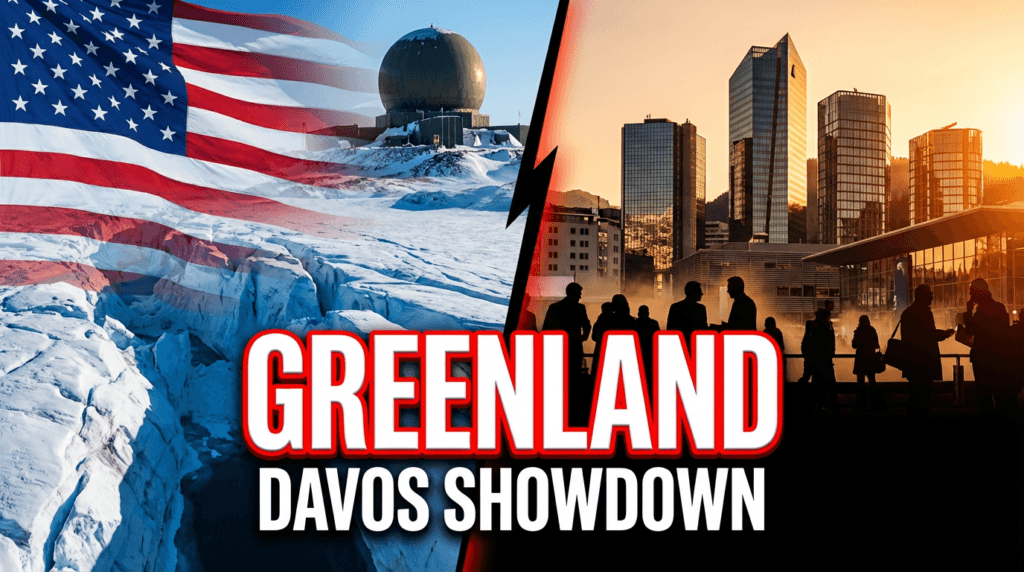
When President Donald Trump arrives in Davos, Switzerland this week to address the World Economic Forum, he won’t be delivering the usual platitudes about global cooperation that have characterized these gatherings for decades. Instead, he’s bringing an uncomfortable truth that European elites would rather ignore: their inability to defend their own territory has created a dangerous security vacuum that threatens American interests.
Trump’s push to acquire Greenland—backed by tariff threats on eight European nations starting February 1st—has sent shockwaves through the global establishment. Markets tumbled, European leaders expressed outrage, and the diplomatic class clutched their pearls. But beneath the controversy lies a serious question that transcends political theater: Can Denmark realistically protect one of the world’s most strategically vital territories from Chinese and Russian encroachment?
The answer, increasingly, appears to be no. And that’s precisely why Trump’s hardball approach deserves serious consideration rather than reflexive dismissal.
Support Independent Local Journalism
TheTownHall.News is a non-profit reader-supported journalism. Just $5 helps us hire local reporters, investigate important issues, and hold public officials accountable across Alameda County. If you believe our community deserves strong, independent journalism, please consider donating $5 today to support our work.The Strategic Reality Europe Won’t Acknowledge
Greenland isn’t just another piece of real estate. It’s a 836,000-square-mile Arctic island sitting at the crossroads of North America, Europe, and the rapidly opening Arctic Ocean. Its location gives it outsized importance for continental defense, early warning systems, and control of emerging Arctic shipping routes that China has explicitly targeted as part of its “Polar Silk Road” strategy.
The United States already operates Pituffik Space Base (formerly Thule Air Base) in northwestern Greenland—America’s northernmost military installation and a critical node in our missile defense and space surveillance network. During the Cold War, this base was essential to detecting Soviet bomber and missile threats. Today, it plays an equally vital role in monitoring Russian and Chinese activities in the Arctic, where both adversaries are dramatically expanding their military presence.
But here’s what the foreign policy establishment doesn’t want to discuss: Denmark provides Greenland with approximately $600-700 million in annual subsidies while maintaining minimal military capability to defend it. Denmark’s entire defense budget is roughly $7 billion—less than what the U.S. spends on a single aircraft carrier strike group. The Danish military consists of fewer than 20,000 active personnel and possesses virtually no capacity to project power in the Arctic.
Meanwhile, Russia operates 40 icebreakers (with more under construction) and has reopened Soviet-era Arctic military bases. China, despite having no Arctic territory, has declared itself a “near-Arctic state” and is aggressively pursuing mineral extraction rights and infrastructure investments across the region. Beijing’s state-owned companies have already attempted to purchase abandoned naval bases in Greenland—efforts that Denmark barely managed to block under U.S. pressure.

This isn’t hypothetical threat inflation. It’s the reality of great power competition in the 21st century, and Denmark is woefully unprepared to handle it alone.
The Mineral Wealth That Changes Everything
Beyond military geography, Greenland holds an estimated $4.4 trillion in known mineral resources, including massive deposits of rare earth elements that are absolutely critical to modern technology, defense systems, and the clean energy transition that progressives claim to champion.
Currently, China controls approximately 70% of global rare earth production and over 85% of processing capacity. These minerals are essential components in everything from F-35 fighter jets and precision-guided munitions to smartphones, wind turbines, and electric vehicle batteries. American dependence on Chinese rare earths represents a catastrophic national security vulnerability—one that could be weaponized in any future conflict over Taiwan or other flashpoints.
Greenland’s Kvanefjeld deposit alone contains one of the world’s largest reserves of rare earth elements, along with significant uranium deposits. The island also holds substantial reserves of zinc, lead, gold, iron ore, and potentially vast offshore oil and gas resources. Yet Denmark has been unable to develop these resources at scale, hamstrung by environmental regulations, lack of infrastructure investment, and Greenland’s own political dynamics.
The economic case is straightforward: these resources in American hands would reduce dependence on China, create economic opportunities for Greenlanders far beyond Denmark’s modest subsidies, and strengthen the industrial base needed for both military readiness and technological leadership.
Support Independent Local Journalism
TheTownHall.News is a non-profit reader-supported journalism. Just $5 helps us hire local reporters, investigate important issues, and hold public officials accountable across Alameda County. If you believe our community deserves strong, independent journalism, please consider donating $5 today to support our work.The Fiscal Accountability Question
Let’s address the elephant in the room: why should American taxpayers care about acquiring territory that would require ongoing investment?
The answer lies in what we’re already spending. The United States provides the security umbrella that allows Denmark and other European NATO allies to maintain generous welfare states while chronically underspending on defense. Denmark finally reached NATO’s 2% of GDP defense spending target in 2024—but only after decades of free-riding on American military power.
If the U.S. already bears the cost of defending Greenland through our NATO commitments and our Pituffik Space Base operations, why shouldn’t we have direct control over the territory and its resources? Why should American service members risk their lives defending Danish sovereignty over land that Denmark cannot adequately protect or develop?
Trump’s tariff threats—starting at 10% on February 1st and escalating to 25% by June if no deal is reached—are simply applying basic negotiating leverage. Eight European countries (including Denmark, France, Germany, and the United Kingdom) recently sent troops to Greenland in a symbolic show of solidarity. Trump’s response was to target those specific nations with tariffs, making clear that virtue signaling has consequences.
This is fiscal accountability in action: demanding that our allies either take defense seriously or acknowledge that American interests require American control.
The Sovereignty Strawman
Critics frame Trump’s Greenland push as neo-imperialism that violates international norms. But this argument ignores several inconvenient facts.
First, Greenland is not an independent nation. It’s an autonomous territory within the Kingdom of Denmark, with Copenhagen controlling its foreign affairs, defense, and monetary policy. Greenlanders themselves have been debating independence for years, with many recognizing that their current economic model—dependent on Danish subsidies and a fishing industry—is unsustainable long-term.
Second, territorial transfers between willing parties are entirely legitimate under international law. The U.S. purchased Alaska from Russia in 1867, the Virgin Islands from Denmark in 1917, and explored purchasing Greenland as far back as 1946. Trump isn’t proposing military conquest; he’s proposing a transaction that would need to be negotiated with both Denmark and Greenland’s government.
Third, the alternative to American acquisition isn’t status quo preservation—it’s gradual Chinese economic colonization. Beijing has already invested heavily in Greenland’s mining sector and infrastructure. Chinese companies have bid on airport construction projects and telecommunications networks. If Denmark cannot or will not develop Greenland’s economy and defend its territory, someone else will fill that vacuum. Would critics prefer Chinese control to American?
The real question isn’t whether Trump’s approach offends diplomatic sensibilities. It’s whether the West has the will to prevent strategic assets from falling into adversarial hands through economic dependence and military weakness.
Limited Government, Maximum Security
Some conservatives might instinctively oppose territorial expansion as inconsistent with limited government principles. But national defense is the core constitutional responsibility of the federal government—the one area where robust action is not just justified but required.
Securing Greenland wouldn’t expand the administrative state’s domestic reach. It would fulfill the basic obligation to protect American security interests and prevent hostile powers from establishing footholds near our territory. The Louisiana Purchase and Alaska acquisition didn’t violate limited government principles; they secured the geographic foundations for American prosperity and security.
Moreover, Greenland’s acquisition could be structured to respect both limited government and local autonomy. The territory could maintain substantial self-governance similar to U.S. territories like Puerto Rico or Guam, with federal responsibility limited to defense, foreign affairs, and resource development partnerships. Greenlanders would gain access to American economic opportunities, infrastructure investment, and security guarantees—without Washington micromanaging local affairs.
What Davos Really Reveals
Trump’s Greenland gambit at Davos isn’t just about one Arctic island. It’s exposing the fundamental unseriousness of the European political class and the global institutions they dominate.
For decades, forums like Davos have promoted a vision of borderless cooperation, climate activism, and “stakeholder capitalism” while ignoring hard realities of geopolitical competition. European leaders lecture America about international norms while failing to meet basic defense commitments. They preach about confronting China while becoming economically dependent on Beijing. They champion rare earth-dependent green technologies while blocking the mining needed to produce them.
Trump’s willingness to use tariffs as leverage—threatening economic consequences for military freeloading—forces a long-overdue reckoning. Either Europe takes responsibility for its own security and strategic resources, or it acknowledges that America’s disproportionate burden warrants disproportionate say in how those resources are controlled.
The market reaction tells the story: European stocks fell while investors worldwide recognized that the post-Cold War era of consequence-free European weakness is ending. That’s not instability—it’s the return of strategic clarity.
The Path Forward
Trump’s Wednesday speech at Davos will likely elaborate on his vision for Greenland and broader U.S.-European relations. The specifics of any potential deal remain unclear, but the principles should be straightforward:
Security First: Any arrangement must ensure that Greenland cannot become a staging ground for Chinese or Russian military presence. American control achieves this; Danish stewardship demonstrably does not.
Economic Development: Greenland’s resources should be developed to benefit both Greenlanders and American strategic interests, breaking Chinese rare earth monopolies and creating genuine prosperity beyond subsidy dependence.
Negotiated Transfer: The U.S. should pursue a negotiated acquisition that compensates Denmark and secures Greenlandic consent through referendum or representative government approval, not coercion.
Allied Accountability: European NATO members must either dramatically increase their own Arctic capabilities or acknowledge that American security guarantees come with American strategic prerogatives.
The alternative is continuing the fiction that Denmark can adequately manage a territory it cannot defend or develop, while China methodically expands its Arctic presence and rare earth dominance. That’s not a conservative outcome—it’s a recipe for strategic defeat disguised as diplomatic propriety.
Conclusion: Bold Leadership in Serious Times
Trump’s Greenland push isn’t diplomatic recklessness—it’s the kind of forward-looking strategic thinking that built American power in the first place. From the Louisiana Purchase to the Panama Canal to the Alaska acquisition, American leaders have recognized that geography, resources, and security are too important to be left to chance or the approval of international bureaucrats.
The conservative case for pursuing Greenland is compelling: it advances national security, reduces dependence on China, promotes fiscal accountability among allies, and secures resources essential to both military readiness and economic strength. These aren’t peripheral concerns—they’re core responsibilities of American leadership.
European outrage and market volatility are temporary. Chinese control of Arctic resources and sea lanes would be permanent. The question isn’t whether Trump’s approach makes diplomats comfortable. It’s whether America will secure its interests while we still can, or defer to a European establishment that has proven incapable of defending even its own territory.
That’s the real issue being decided in Davos this week—not the fate of one island, but whether the West still possesses the strategic seriousness to compete in an era of great power rivalry.
Call to Action
The mainstream media will dismiss Trump’s Greenland strategy as provocative bluster. Don’t let them set the narrative. Share this article with friends and family who need to understand what’s really at stake in the Arctic. Follow the Davos developments closely—Trump’s Wednesday speech will reveal whether European leaders are ready to take security seriously or will continue their decades of strategic complacency.
Stay informed. Stay engaged. Subscribe to our newsletter for clear-eyed analysis that cuts through establishment spin. The future of American security is being negotiated right now—and it’s too important to leave to the foreign policy elite who got us into this position in the first place.
What do you think? Should America pursue control of Greenland to counter China and secure critical resources? Join the conversation in the comments below.