Americans Could Soon Buy $15,000 Cars Again—If This Trump Plan Survives
When Did Affordable Cars Become Impossible?
Remember when young families could buy a reliable new car for under $20,000? When a high school graduate with their first job could finance a basic sedan without crushing debt? That America wasn’t ancient history—it was barely a decade ago.
Today, the average new car costs over $50,000. Entry-level vehicles have virtually disappeared from dealer lots. Working families face an impossible choice: take on massive debt for transportation they need to work, or buy aging used vehicles and hope for the best.
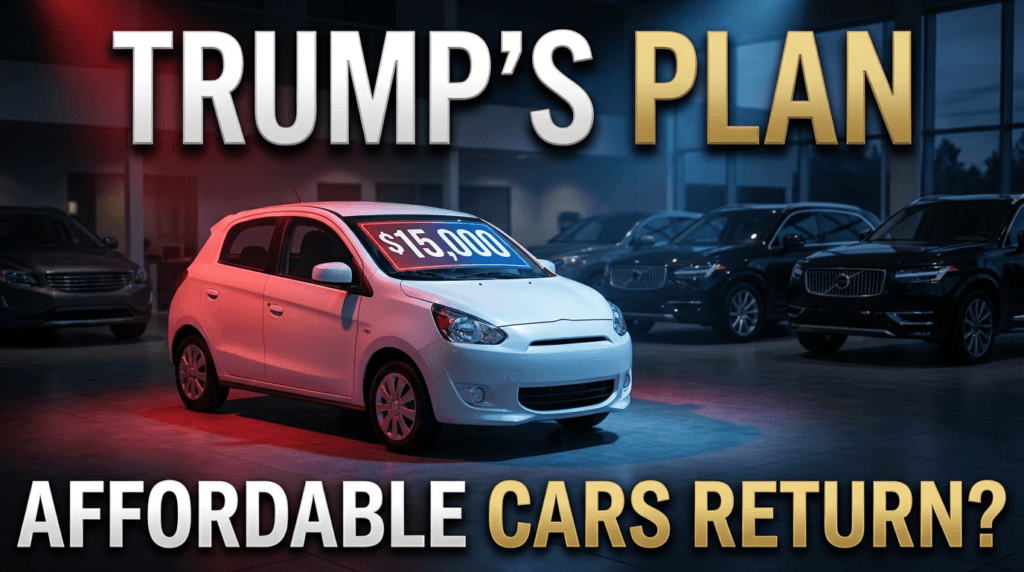
This isn’t inevitable. It’s the result of deliberate policy choices that prioritized regulatory agendas over American families’ ability to afford basic transportation. Now, President Trump’s automotive reforms promise to reverse course—eliminating mandates, cutting red tape, and reopening the market to genuinely affordable vehicles, including tiny Japanese “Kei cars” that could sell for $15,000 or less.
Support Independent Local Journalism
TheTownHall.News is a non-profit reader-supported journalism. Just $5 helps us hire local reporters, investigate important issues, and hold public officials accountable across Alameda County. If you believe our community deserves strong, independent journalism, please consider donating $5 today to support our work.But powerful interests—from environmental activists to legacy automakers protecting profit margins—are mobilizing to kill these reforms before Americans ever see the benefits. The question isn’t whether affordable cars are possible. It’s whether the political will exists to stand up to the forces that profit from keeping them expensive.
The $50,000 Problem: How We Got Here
Average new car transaction prices hit $50,326 in December 2025, according to Cox Automotive. For context, that’s more than the median American household earns in an entire year after taxes. It represents a 40% increase from just five years ago, far outpacing wage growth and general inflation.
Multiple factors contributed to this crisis, but government regulation played the leading role. Biden-era Corporate Average Fuel Economy (CAFE) standards demanded that automakers achieve fleet-wide efficiency targets that effectively required selling expensive electric vehicles or advanced hybrids to offset profitable trucks and SUVs.
The result? Automakers abandoned affordable segments entirely. Why invest in engineering a $18,000 compact car that barely breaks even when regulations force you to sell $45,000 EVs anyway? The cheapest new car in America—the Mitsubishi Mirage—disappeared from the market in 2024. The Nissan Versa, once under $16,000, now starts above $20,000 when you can find one.

Environmental Protection Agency tailpipe emissions requirements compounded the problem, mandating expensive emissions control technology that added thousands to vehicle costs. California’s authority to impose even stricter standards created a patchwork regulatory nightmare that forced automakers to build for the most restrictive market, raising prices nationwide.
Meanwhile, the $7,500 federal EV tax credit funneled billions to affluent buyers purchasing $60,000+ electric vehicles while doing nothing for working families who couldn’t afford any new car. This wasn’t environmental policy—it was regressive wealth transfer dressed up as climate action.
Trump’s Solution: Markets Over Mandates
The Trump administration’s “Freedom Means Affordable Cars” initiative attacks this problem at its regulatory roots. Transportation Secretary Sean Duffy laid out the philosophy clearly during a tour of the Detroit Auto Show: “We shouldn’t use government policy to encourage EV purchases all the while penalizing combustion engines.”
The reforms include eliminating the EV tax credit, rolling back Biden’s aggressive CAFE standards, rescinding California’s special regulatory authority, and canceling penalties that punished automakers for building what consumers actually wanted. The Department of Transportation estimates these changes would reduce average vehicle costs by $930 immediately—meaningful savings, though just the beginning.
More significantly, Trump personally endorsed bringing Japanese Kei cars to America. These tiny vehicles—about half the size of a Ford F-150—dominate Asian markets because they’re cheap, fuel-efficient, and perfect for urban environments. In Japan, a used Kei car costs $3,000-$6,000. Even accounting for safety modifications and import costs, new Kei cars could realistically sell for $12,000-$18,000 in the U.S. market.
Support Independent Local Journalism
TheTownHall.News is a non-profit reader-supported journalism. Just $5 helps us hire local reporters, investigate important issues, and hold public officials accountable across Alameda County. If you believe our community deserves strong, independent journalism, please consider donating $5 today to support our work.Currently, a 25-year import rule and regulatory barriers make Kei cars nearly impossible to sell here legally. Trump’s reforms would change that, opening American markets to genuine budget options. After his Japan visit, Trump posted: “I have just approved TINY CARS to be built in America. These cars of the very near future are inexpensive, safe, fuel efficient and, quite simply, AMAZING!!!”
Stellantis has already responded, announcing plans to sell the Fiat Topolino—a tiny electric city car with a top speed under 30 mph—in coming months. Other manufacturers are evaluating whether to bring affordable small vehicles to America for the first time in years.
The Resistance: Who’s Fighting Affordable Cars?
If $15,000 cars sound great for consumers, why the opposition? Follow the money.
Environmental activist groups like the Natural Resources Defense Council attacked the reforms immediately. NRDC’s Kathy Harris claimed: “The oil industry will rake in billions more from cash-strapped Americans who can’t afford to spend more to fuel up their car or truck.”
This argument is both paternalistic and economically backwards. Yes, less efficient vehicles consume more fuel. But if a family can’t afford a $50,000 hybrid, they’re not choosing between that and a $15,000 gas car—they’re choosing between a $15,000 gas car and no car at all. Without transportation, they can’t work. The NRDC’s position effectively says: better to have no car than an “inefficient” one.
Legacy automakers present a more complex picture. Publicly, they support “consumer choice.” Privately, many prefer the current system. Why? Profit margins. Automakers make minimal profit on cheap cars but enormous margins on $70,000 trucks and $60,000 EVs. Regulations that eliminate affordable segments while subsidizing expensive vehicles serve their financial interests perfectly.
Ford CEO Jim Farley acknowledged this tension, saying the company is “working on affordability” while simultaneously noting that small cars “don’t make business sense” under current market conditions. Translation: regulations make cheap cars unprofitable, so we won’t build them.
The political establishment also resists. Democratic lawmakers claim Trump’s reforms will “harm consumers” through increased fuel costs and emissions. Senator Ed Markey called the changes “a gift to oil companies at the expense of American families.”
But this frames the debate dishonestly. The question isn’t whether more efficient vehicles are better—of course they are, all else equal. The question is whether government should use regulatory force to eliminate affordable options, pricing working families out of vehicle ownership entirely.
The Real Trade-Offs: Honest Cost-Benefit Analysis
Conservative principles demand honest accounting. What would Trump’s reforms actually cost, and what would they deliver?
The Department of Transportation estimates that rolling back Biden’s CAFE standards would increase fuel consumption by up to 100 billion gallons through 2050, costing consumers up to $185 billion in additional fuel expenses. That sounds alarming until you examine the assumptions.
First, this assumes zero technological progress in fuel efficiency absent mandates—implausible given that market competition has consistently driven automotive innovation. Second, it ignores that many Americans priced out of new vehicles buy older, less efficient used cars instead, so the actual efficiency loss is smaller than projected. Third, it treats all fuel consumption as equivalent cost, ignoring that rural Americans, contractors, and others who need trucks or capability have no practical alternative.
Most importantly, it completely ignores the benefits: millions of Americans gaining access to affordable transportation, enabling employment, education, and economic mobility. What’s the value of a single mother getting a reliable car that lets her take a better job across town? Or a young person starting their career without $40,000 in auto debt? These benefits don’t appear in EPA spreadsheets, but they’re real.
Safety concerns about small cars deserve serious consideration. Kei car enthusiasts acknowledge that driving a 1,500-pound vehicle on highways alongside 6,000-pound trucks feels vulnerable. Transportation Secretary Duffy conceded that small cars would “probably not” suit interstate travel.
But this is exactly why consumer choice matters. Urban commuters who rarely exceed 45 mph might find a $15,000 Kei car perfect. Rural drivers who regularly travel highways would choose differently. Adults can assess these trade-offs themselves—they don’t need bureaucrats making decisions for them.
Market Innovation vs. Government Planning
Critics of Trump’s reforms assume government mandates drive innovation. History suggests otherwise.
Japan’s Kei cars emerged not from regulation but from market conditions: expensive fuel, crowded cities, and high vehicle taxes that created demand for tiny, efficient transportation. Manufacturers innovated to meet that demand, producing remarkably sophisticated vehicles—turbocharged engines, advanced transmissions, even sports car variants—all in packages barely larger than golf carts.
American automotive innovation follows similar patterns. Henry Ford’s assembly line, catalytic converters, modern safety features, and fuel injection all emerged from competitive markets, not government mandates. When consumers value efficiency, manufacturers compete to deliver it profitably.
Tesla itself demonstrates this principle. Love or hate Elon Musk, Tesla succeeded by building EVs people actually wanted, not by lobbying for mandates forcing competitors to subsidize their development. When the EV tax credit expires, Tesla will compete on merit—exactly how markets should work.
Removing regulatory barriers doesn’t mean abandoning efficiency. It means trusting markets to deliver efficiency at prices consumers can afford, rather than mandating efficiency at prices they can’t.
What’s at Stake: Freedom and Opportunity
This debate transcends automotive policy. It’s fundamentally about whether Americans control their own economic decisions or whether government experts make those decisions for them.
The progressive vision sees government as wise planner, using regulatory power to engineer society toward approved outcomes. Can’t afford the vehicles we’ve decided you should buy? Too bad—our vision matters more than your budget.
The conservative vision trusts free citizens to make responsible choices based on their own circumstances, values, and priorities. Government’s role is ensuring safety and preventing fraud, not dictating what products may exist.
Vehicle affordability directly impacts economic mobility—the ability to improve your circumstances through work and education. When transportation costs consume 20-30% of working-class household budgets, economic advancement becomes nearly impossible. When entry-level vehicles disappear entirely, young people start careers with massive debt or no reliable transportation.
Trump’s reforms would restore what once seemed obvious: Americans should be able to buy inexpensive, basic transportation that meets their needs. Not everyone needs a $50,000 SUV with every advanced feature. Some need cheap, reliable transportation to get to work. Markets can provide that—if government allows it.
Conclusion: The Fight for Affordable Transportation
Trump’s automotive reforms offer a clear test of competing principles. Will America trust markets and consumer choice, or will regulatory mandates continue dictating what vehicles exist at what prices?
The stakes are real. Millions of working families struggle with transportation costs that previous generations never faced. Young people delay careers and families because they can’t afford basic mobility. Rural Americans face particular hardship as affordable trucks and vans disappear from markets.
The solution isn’t complicated: eliminate mandates that force expensive technology, end subsidies that benefit the wealthy, remove barriers that prevent affordable imports, and let markets work. Whether the result is $15,000 Kei cars, budget-friendly compacts, or innovations nobody’s imagined yet, consumers will decide what succeeds based on value delivered.
But powerful interests profit from the current system. Environmental groups use automotive regulations to pursue climate agendas regardless of costs to working families. Automakers protect profit margins on expensive vehicles. Politicians leverage regulations to reward favored constituencies and punish disfavored ones.
Trump’s reforms threaten all of that, which is why the opposition is fierce. The question is whether political will exists to prioritize American families over special interests.
The answer will determine whether affordable cars return to American markets—or whether $50,000 vehicles become the new normal, with all that implies for economic opportunity and personal freedom.
Call to Action
The fight over affordable vehicles is happening right now—and your voice matters. Contact your congressional representatives and demand they support market-based automotive reforms over regulatory mandates that price working families out of transportation. Share this article with friends and family who struggle with vehicle costs. Stay informed about regulatory changes affecting automotive affordability.
Most importantly, make your priorities clear: you want the freedom to choose vehicles that meet your needs at prices you can afford, not whatever options survive after bureaucrats finish engineering markets to match their preferences.
The difference between $50,000 cars and $15,000 cars isn’t technology—it’s whether government allows affordable options to exist. Make sure your representatives know which side you’re on.