Hayward’s “Balanced Budget” Is Built on Borrowing and One-Time Fixes, Not Reform
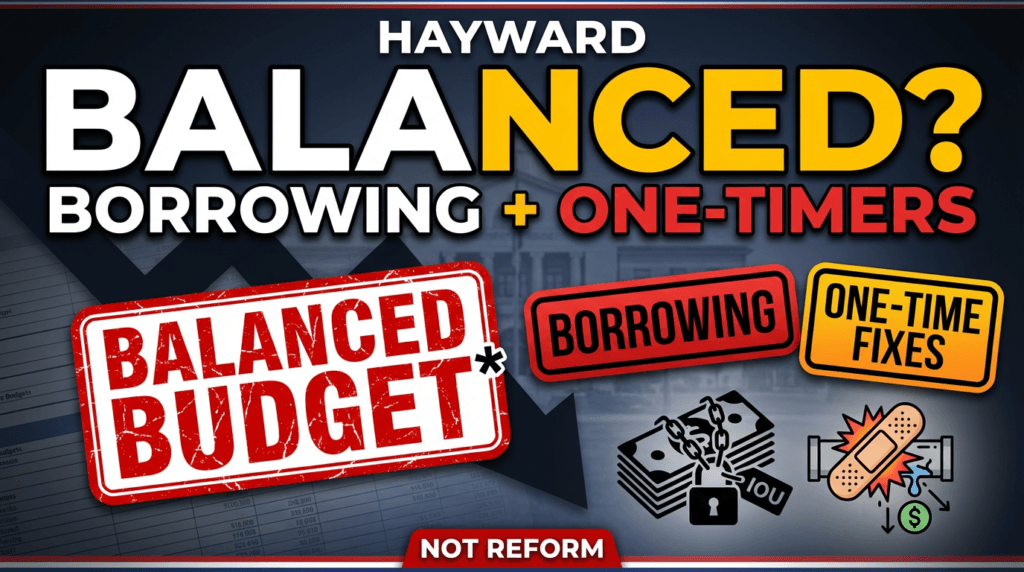
The most telling moment in Hayward’s latest budget update is not a dramatic vote or a fiery speech. It is a quiet set of numbers that, once you read them plainly, tells taxpayers exactly what is happening.
Hayward is presenting a “balanced” plan, but it is not balanced the way families balance a household budget. It is balanced the way a credit card balances a checking account, by shifting money around, tapping one-time transfers, and leaning on internal loans to paper over a structural problem that has not been solved.
If you live in Hayward, you should treat that as a warning.
Support Independent Local Journalism
TheTownHall.News is a non-profit reader-supported journalism. Just $5 helps us hire local reporters, investigate important issues, and hold public officials accountable across Alameda County. If you believe our community deserves strong, independent journalism, please consider donating $5 today to support our work.What the City is doing to claim the budget is “balanced”
According to the City’s budget presentations, the plan relies on a stack of stopgap moves, including:
- $9.75 million in Measure C fund transfers and loans
- $1.9 million in one-time transfers
- $1.5 million in anticipated one-time recoveries
Those are not recurring reforms. They are temporary patches.
Measure C is voter-approved revenue often sold as targeted funding for specific priorities. When a city starts leaning on those dollars to stabilize the broader budget picture, that is a signal the General Fund is under strain and leaders are reaching for available cash wherever they can find it.
One-time transfers and “recoveries” may help close a hole this year, but they can create a deeper hole next year because the underlying cost structure does not shrink with them. The math is simple: a one-time dollar only pays one-time bills.

Why one-time solutions become permanent damage
Cities get into trouble when they normalize a cycle like this:
- Spend at a level that outpaces predictable revenue
- Announce a budget “fix” using one-time money
- Repeat the following year with fewer options and higher stakes
That cycle is how local governments end up in perpetual “budget emergency” mode, where residents are told cuts are painful but unavoidable, while the core political class avoids accountability for the policy decisions that drove costs up in the first place.
In Hayward’s case, the presentations themselves show the fragility. Even after the balancing actions, staff says the City still needs an additional $2 million to $4 million just to create a 1 to 2 percent operating contingency over the next six months.
That is not a cushion. That is a city walking a financial tightrope.
The risk to taxpayers: a “balanced” budget that collapses mid-year
When a budget depends on internal loans and one-time transfers, taxpayers should expect one of two outcomes:
Support Independent Local Journalism
TheTownHall.News is a non-profit reader-supported journalism. Just $5 helps us hire local reporters, investigate important issues, and hold public officials accountable across Alameda County. If you believe our community deserves strong, independent journalism, please consider donating $5 today to support our work.- Service instability, as departments scramble to freeze spending, hold vacancies, or reduce maintenance to make numbers work.
- New taxes and fees, because leaders will argue the problem is “revenue” rather than spending discipline.
The presentations already point in that direction with discussion of revenue options and ballot measure planning. That is what often follows when spending is not brought back into alignment with recurring revenue.
The accountability question Hayward leaders must answer
Here is the question every councilmember and senior administrator should be forced to answer publicly, on the record:
If the budget is truly stable, why does it require $9.75 million in transfers and loans, plus $1.9 million in one-time transfers, plus $1.5 million in one-time recoveries to balance?
Because a stable budget does not need a financial shell game.
A stable budget is built on recurring revenues funding recurring costs, with reserves that grow instead of being shuffled.
What real reform would look like
If Hayward wants credibility, it should stop pretending short-term cash movement is long-term governance. At minimum, the City should:
- Separate “structural balance” from “one-time balance” in every public presentation, so residents can see the difference.
- Publish a plain-English list of every transfer and loan, including the source fund, destination, repayment terms, and risk if revenues miss projections.
- Commit to a multi-year plan that reduces reliance on one-time money each year until it reaches zero for ongoing operations.
If the City cannot do that, then taxpayers are not looking at a balanced budget. They are looking at a delayed bill.
Why this matters now
Hayward residents are busy. Most people do not have time to read budget slide decks. That is why this matters: the financial story is being told in technical language, but the consequences are painfully real.
A city that runs on one-time money eventually runs out of room. When that happens, leaders come back to the public with a familiar message: pay more, accept less, and trust us again.
Hayward taxpayers should not accept that script.
The public should show up, ask direct questions, and demand that “balanced” means balanced without borrowing from tomorrow.
Impact metrics to watch: if this issue is exposed clearly, expect higher turnout at council meetings, social media engagement around transparency, and potentially policy reversals, spending cuts, or leadership changes as residents demand real fiscal reform.