Minnesota ICE Ruling: Why Sanctuary Cities Force Confrontation—and Two Americans Died
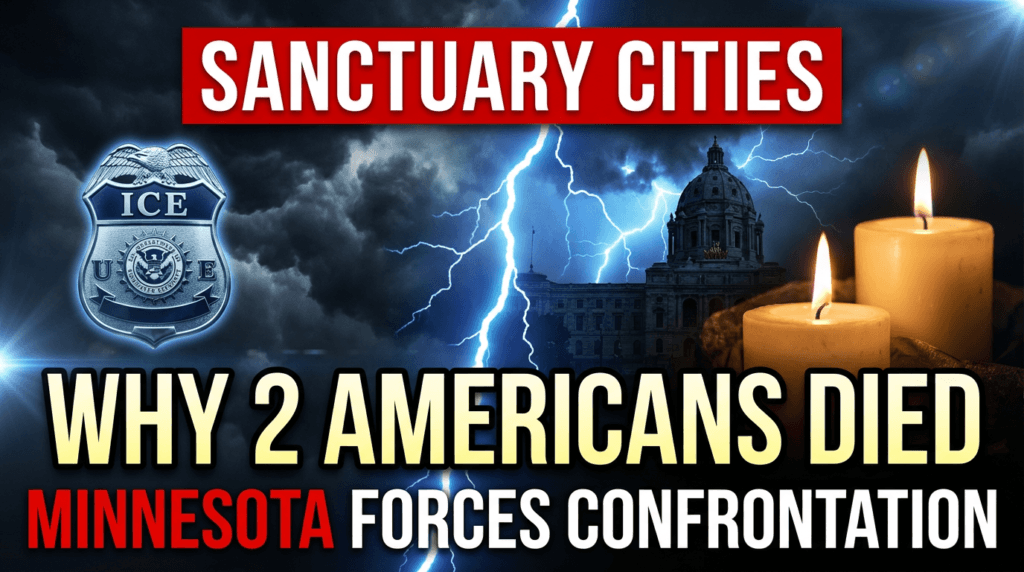
On Saturday, January 31, 2026, federal Judge Katherine M. Menendez delivered a ruling that cuts to the heart of America’s immigration crisis: she refused to halt Operation Metro Surge, the federal immigration enforcement operation that has deployed approximately 3,000 agents to Minnesota. Her decision came as more than 300 protests erupted nationwide, with activists demanding an end to federal law enforcement operations.
The question before Judge Menendez wasn’t just about immigration policy. It was about whether federal law enforcement can do its job when state and local officials actively obstruct it. It was about whether sanctuary city policies that shield criminal aliens from deportation represent legitimate state sovereignty or dangerous defiance of federal authority. And it was about whether the rule of law still means something in America.
The judge’s ruling represents a crucial victory for law and order—but the battle is far from over. As protesters take to the streets and corporate leaders issue carefully worded statements about “de-escalation,” Americans who believe in constitutional governance and public safety must understand what’s really at stake in Minnesota.
Support Independent Local Journalism
TheTownHall.News is a non-profit reader-supported journalism. Just $5 helps us hire local reporters, investigate important issues, and hold public officials accountable across Alameda County. If you believe our community deserves strong, independent journalism, please consider donating $5 today to support our work.The Case: Federal Authority vs. Sanctuary Obstruction
Minnesota Attorney General Keith Ellison, along with the mayors of Minneapolis and St. Paul, filed a lawsuit arguing that Operation Metro Surge violates the Constitution’s 10th Amendment, which limits federal power to infringe on state sovereignty. They sought an immediate preliminary injunction to halt or limit the operation.
The Department of Justice called the lawsuit “legally frivolous”—and Judge Menendez essentially agreed. In her ruling, she found that “evidence supporting both sides’ arguments as to motivation” existed, and “the relative merits of each side’s competing positions are unclear.” Because the plaintiffs couldn’t demonstrate a likelihood of success on their constitutional claims, she declined to issue the injunction.
This is the correct legal outcome. The federal government has clear constitutional authority over immigration enforcement under Article I, Section 8 of the Constitution. When Congress passes immigration laws, federal agencies have not just the right but the duty to enforce them. State and local governments cannot nullify federal law simply because they disagree with it—that question was settled in 1865.
The federal government’s argument is straightforward: Operation Metro Surge exists because federal efforts to enforce immigration law have been “hindered by state and local sanctuary laws and policies.” When local jurisdictions refuse to cooperate with ICE detainer requests, when they warn criminal aliens about impending enforcement actions, when they actively obstruct federal officers, the federal government must deploy additional resources to do the job local officials refuse to do.

Attorney General Pam Bondi praised the ruling on social media, calling it “another HUGE legal win” for the Justice Department. She’s right—but the legal victory is only part of the story.
The Reality: Criminal Aliens and Public Safety
Operation Metro Surge began in December 2025 targeting the Minneapolis-St. Paul metropolitan area, later expanding statewide. According to DHS, federal agents have made more than 3,000 arrests. The operation’s stated purpose is clear: to remove criminal aliens from American communities.
This is not about rounding up families or targeting people based on ethnicity. Federal immigration law prioritizes the removal of individuals who pose public safety threats—those with criminal convictions, gang affiliations, or outstanding warrants. When local jurisdictions refuse to cooperate with these enforcement priorities, they’re not protecting immigrants. They’re protecting criminals.
The conservative principle of law and order demands that we enforce the laws on the books. Congress passed immigration statutes. Presidents from both parties have enforced them. The fact that Minnesota officials find these laws inconvenient or politically unpopular doesn’t give them the authority to obstruct federal enforcement.
Border Patrol commander Gregory Bovino stated that agents were attempting to detain an undocumented immigrant with a “significant criminal history” when the January 24 incident occurred. While the Minnesota Department of Corrections later disputed this specific claim, the broader point remains: federal agents are in Minnesota because local officials have created an environment where criminal aliens can operate without fear of deportation.
Support Independent Local Journalism
TheTownHall.News is a non-profit reader-supported journalism. Just $5 helps us hire local reporters, investigate important issues, and hold public officials accountable across Alameda County. If you believe our community deserves strong, independent journalism, please consider donating $5 today to support our work.The Tragedy: Two Deaths and Unanswered Questions
Two American citizens—Renée Good on January 7 and Alex Pretti on January 24—were shot and killed by federal agents during Operation Metro Surge. These deaths are tragic, and they demand thorough, transparent investigation.
Alex Pretti, a 37-year-old intensive care nurse and military veteran, was legally carrying a concealed firearm when he was shot multiple times by Border Patrol agents. Video evidence reviewed by major news organizations shows Pretti holding a cell phone, not a weapon, in the moments before being tackled. An agent removed Pretti’s gun from his holster, and approximately one second later, another agent fired at close range. Ten shots were fired in five seconds, with additional shots fired after Pretti lay motionless.
For conservatives who champion Second Amendment rights, this raises serious concerns. Pretti had a valid Minnesota permit to carry. He had no criminal record. Minnesota law allows both open and concealed carry with a proper license. The fact that he was armed should not have been a death sentence.
Multiple Republican senators—including Rand Paul, Susan Collins, Ted Cruz, and Thom Tillis—have called for thorough, independent investigations. Gun rights organizations including the NRA and Gun Owners of America condemned administration officials who suggested that lawfully carrying a firearm justified the shooting. Representative Thomas Massie, a Kentucky Republican, wrote: “Carrying a firearm is not a death sentence, it’s a Constitutionally protected God-given right.”
These concerns are legitimate. Law and order conservatives support police and federal agents—but we also demand accountability when force is used. The video evidence raises questions about tactics, training, and whether lethal force was necessary after Pretti had been disarmed.
The Department of Justice has opened a civil rights investigation into Pretti’s death. That investigation must be thorough, transparent, and free from political interference. Americans deserve answers.
The Difficult Truth: Enforcement Has Consequences
Here’s what many conservatives understand but few politicians will say clearly: when you deploy thousands of federal agents to enforce immigration law in a hostile environment, incidents will occur. When protesters actively interfere with law enforcement operations, when they block streets and surround federal officers, when tensions run high, the risk of tragedy increases.
This doesn’t excuse poor tactics or unjustified use of force. But it does mean we need to be honest about cause and effect.
Minnesota’s sanctuary policies created the conditions that required Operation Metro Surge. Local officials’ refusal to cooperate with ICE meant the federal government had to deploy overwhelming force to accomplish what should have been routine enforcement. Activist groups organized “ICE observer” networks—with 80,000 people joining a single video call to learn how to monitor and interfere with federal operations. Protesters physically blocked agents from entering businesses where suspects had fled.
Multiple policing experts who reviewed the Pretti shooting video criticized the agents’ tactics as unnecessarily escalatory—shoving bystanders instead of using verbal commands, failing to communicate clearly after disarming Pretti, and firing additional shots after he was immobilized. These criticisms appear valid and should inform training reforms.
But we must also acknowledge that federal agents were operating in an environment deliberately designed to be hostile and obstructive. When local officials encourage resistance to federal law enforcement, when protesters are trained to interfere with operations, when agents are surrounded by crowds filming and shouting, the difficulty and danger of their mission increases exponentially.
The Constitutional Question: Who Decides Immigration Policy?
Minnesota officials argue that Operation Metro Surge represents federal overreach—that deploying 3,000 agents to one state violates principles of federalism and state sovereignty. This argument has superficial appeal, especially to conservatives who value limited government and states’ rights.
But it’s wrong.
Immigration policy is explicitly a federal responsibility. The Constitution grants Congress the power “to establish an uniform Rule of Naturalization.” Federal courts have consistently held that states cannot create their own immigration policies or obstruct federal enforcement. The Supremacy Clause means federal immigration law preempts conflicting state policies.
Sanctuary city policies don’t represent legitimate state sovereignty—they represent nullification. When Minneapolis refuses to honor ICE detainer requests, when Minnesota warns criminal aliens about federal operations, when state officials actively interfere with federal agents, they’re not exercising states’ rights. They’re obstructing federal law.
Conservatives who support federalism must distinguish between legitimate state authority and illegal obstruction. States have broad powers over education, public health, criminal law, and countless other areas. Immigration is not one of them.
The federal government’s argument—that Operation Metro Surge became necessary precisely because Minnesota’s sanctuary policies hindered normal enforcement—is compelling. If local officials cooperated with routine ICE operations, massive deployments wouldn’t be needed. Minnesota’s obstruction created the crisis it now complains about.
The Political Reality: Protests, Pressure, and Corporate Cowardice
More than 300 protests occurred nationwide on January 31, part of a “National Shutdown” calling for “no work, no school, no shopping.” Thousands marched in Minneapolis for the second consecutive week. Demonstrations spread to Los Angeles, New York, Boston, Seattle, and dozens of other cities.
The protesters’ message is clear: they want ICE abolished and federal immigration enforcement ended. This is not a call for reform or better tactics. It’s a demand for open borders.
Meanwhile, corporate America has demonstrated remarkable cowardice. Over 60 CEOs of Minnesota-based companies—including Target, Best Buy, 3M, and General Mills—issued a joint statement calling for “immediate de-escalation of tensions.” The letter didn’t mention Pretti or Good by name. It didn’t call for any concrete action. It simply urged everyone to work together and find “real solutions.”
This is the language of surrender disguised as leadership. “De-escalation” has become corporate code for “please stop enforcing the law so we don’t have to take a position.” These same companies issued bold statements supporting Black Lives Matter in 2020. They had no problem taking political stances when it was fashionable. Now, when federal law enforcement faces organized resistance and two Americans are dead, they offer platitudes.
The contrast is telling. After George Floyd’s death in Minneapolis in 2020, corporate America rushed to condemn police and promise billions for diversity initiatives. After Alex Pretti’s death in Minneapolis in 2026, they issue carefully worded statements that avoid naming anyone or demanding anything.
Conservative principles demand better from business leaders. If you believe in the rule of law, say so. If you think federal agents acted wrongly, say that too. But don’t hide behind meaningless calls for “de-escalation” while protesters organize economic boycotts and national strikes.
The Path Forward: Accountability and Reform
Judge Menendez’s ruling allows Operation Metro Surge to continue while the lawsuit proceeds. This is appropriate—federal law enforcement shouldn’t be halted by preliminary injunctions when the underlying constitutional claims are weak.
But continuing the operation doesn’t mean ignoring legitimate concerns. The deaths of Renée Good and Alex Pretti demand accountability. The DOJ’s civil rights investigation into Pretti’s shooting must be thorough and transparent. If agents violated policies or used excessive force, they must face consequences. If training is inadequate for urban enforcement operations, it must improve.
Conservatives can simultaneously support immigration enforcement and demand accountability for how it’s conducted. These positions are not contradictory—they’re complementary. Law and order means enforcing the law against criminal aliens and holding federal agents to professional standards.
Border czar Tom Homan has indicated plans to “draw down” federal presence in Minnesota if local cooperation improves. This represents the sensible path forward. Federal enforcement should be targeted, professional, and conducted with local cooperation whenever possible. Massive deployments become necessary only when local obstruction makes routine operations impossible.
Minnesota officials should drop their sanctuary policies and cooperate with federal immigration enforcement. Federal officials should ensure agents receive proper training for urban operations and implement reforms based on lessons learned. Both sides should prioritize public safety over political posturing.
Conclusion: The Rule of Law Is Not Negotiable
The battle in Minnesota represents a fundamental question about American governance: Do we still believe in the rule of law?
Congress passed immigration statutes. Federal courts have upheld them. The executive branch has the constitutional duty to enforce them. State and local officials who disagree have every right to advocate for changing those laws—but they don’t have the right to obstruct their enforcement.
Judge Menendez understood this. Her ruling recognizes that federal immigration authority is not subject to state veto, even when enforcement is unpopular or politically controversial.
The deaths of Renée Good and Alex Pretti are tragic. They demand investigation and accountability. But they don’t change the fundamental reality: federal law enforcement has both the authority and the responsibility to enforce immigration law, even in sanctuary cities that don’t want them there.
The alternative to federal enforcement isn’t some peaceful compromise where everyone gets along. It’s a country where laws apply only when local officials feel like enforcing them, where criminal aliens operate with impunity in jurisdictions that refuse cooperation, and where the rule of law becomes optional based on geography and politics.
Conservatives understand that civilization requires order, that order requires law, and that law requires enforcement. The protesters demanding ICE abolition don’t want reform—they want surrender. The corporate leaders calling for “de-escalation” don’t want solutions—they want the problem to go away so they don’t have to take a position.
Judge Menendez’s ruling reminds us that in America, federal law still means something. Operation Metro Surge can continue. Federal agents can do their jobs. And the rule of law remains, even when it’s unpopular.
Call to Action
Support law enforcement. Federal agents are doing a difficult, dangerous job in a hostile environment. They deserve our support, proper training, and accountability when things go wrong.
Demand your representatives end sanctuary policies. Contact your state and local officials and tell them to cooperate with federal immigration enforcement. Sanctuary policies don’t protect immigrants—they protect criminals and create the conditions for tragedy.
Stay informed. Don’t just read activist narratives or corporate press releases. Read Judge Menendez’s actual ruling. Watch the video evidence. Form your own conclusions based on facts, not political spin.
Reject false choices. You can support immigration enforcement AND demand accountability for how it’s conducted. You can back the blue AND expect professional standards. These positions are not contradictory.
Share this article. The mainstream narrative frames this as federal agents vs. peaceful protesters. The reality is more complex: it’s about federal law enforcement trying to do its job while state officials actively obstruct and activists organize mass resistance.
The rule of law is not negotiable. Federal immigration authority is not optional. And the alternative to enforcement is not compassion—it’s chaos. Judge Menendez understood that. So should every American who believes in constitutional governance and public safety.