Alameda’s Ferry Parking Fees: A Model for User-Funded Public Safety
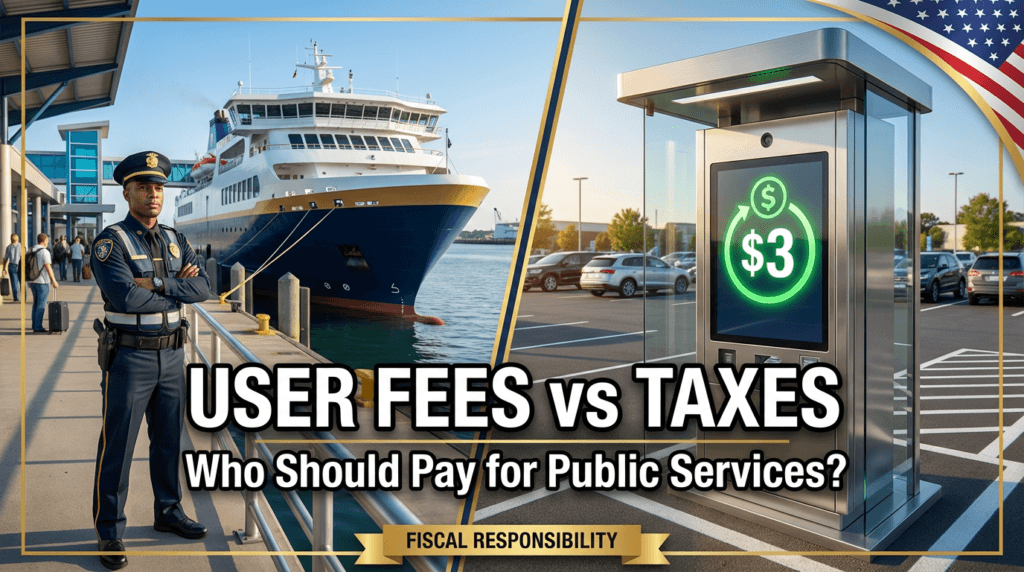
Create a high-resolution landscape image (16:9 ratio) to be used as a thumbnail for a news article. The image should have vivid, eye-catching colors that stand out on social media and news feeds.
- Style: professional, bold, and modern — designed to grab clicks.
- Include clear, readable text when applicable (short title keywords or phrases), placed so it’s visible even at small sizes.
- Use strong contrast between background and text for readability.
- Ensure the design communicates the theme and mood of the article (serious, urgent, patriotic, investigative, etc.).
- Avoid clutter — keep the layout clean and impactful.
When commuters who use a service pay for its security, everyone wins. Alameda’s new ferry terminal approach shows how conservative principles can solve real problems without burdening all taxpayers.
Starting today, February 3, 2026, Alameda’s Seaplane Lagoon Ferry Terminal introduces a security guard service paired with a modest $3 midweek parking fee. For anyone tired of watching their tax dollars fund services they never use, this represents a refreshing departure from the typical government playbook: those who benefit from a service actually pay for it.
Support Independent Local Journalism
TheTownHall.News is a non-profit reader-supported journalism. Just $5 helps us hire local reporters, investigate important issues, and hold public officials accountable across Alameda County. If you believe our community deserves strong, independent journalism, please consider donating $5 today to support our work.It’s a simple concept that used to be called common sense. Yet in an era when California governments reflexively reach for broad-based taxes to fund every initiative, Alameda’s decision to use targeted user fees to fund enhanced security deserves recognition—and replication across the state.
This isn’t just about parking meters. It’s about a fundamental question of fairness, fiscal responsibility, and the proper role of government in providing services. And it’s a model that demonstrates conservative principles aren’t just theoretical—they’re practical solutions that work in even the most progressive corners of California.
The User Fee Principle: Fairness in Action
Here’s what Alameda is doing: Ferry commuters who park at Seaplane Lagoon will pay $3 per day on Tuesdays, Wednesdays, and Thursdays—the busiest transit days when parking is most scarce and security needs are highest. Mondays, Fridays, and weekends remain free. The revenue directly funds a dedicated security guard service that responds to rider concerns about safety.
This is textbook user-fee policy, and it embodies a core conservative principle: those who directly benefit from a government service should bear its cost, rather than forcing all taxpayers to subsidize services they may never use.

Consider the alternative. The city could have funded security through general tax revenue, meaning every Alameda resident—whether they use the ferry or not—would pay for a service that benefits a specific group of commuters. A retiree in the West End who hasn’t taken the ferry in years would subsidize parking security for a tech worker commuting to San Francisco. A family struggling with California’s cost of living would fund amenities for relatively affluent ferry riders.
That’s not just inefficient—it’s fundamentally unfair.
User fees align costs with benefits. They ensure that those who consume a service contribute proportionally to its provision. This isn’t some abstract economic theory; it’s the same principle families follow when they pay for what they use rather than expecting neighbors to cover their bills.
Why This Matters: The Broader Context of California’s Fiscal Dysfunction
Alameda’s approach stands in stark contrast to California’s typical government expansion playbook, which relies on ever-increasing broad-based taxes to fund services regardless of who uses them.
Consider what’s happening elsewhere in the state. Sacramento City Unified faces insolvency. San Francisco projects massive budget deficits. Two-thirds of California school districts are considering cuts. Yet many of these same jurisdictions continue expanding services funded by general taxation rather than exploring user-fee models that promote fiscal sustainability.
Support Independent Local Journalism
TheTownHall.News is a non-profit reader-supported journalism. Just $5 helps us hire local reporters, investigate important issues, and hold public officials accountable across Alameda County. If you believe our community deserves strong, independent journalism, please consider donating $5 today to support our work.The result? Californians face some of the highest tax burdens in the nation—a top marginal income tax rate of 13.3%, sales taxes exceeding 10% in some cities, and property taxes that make homeownership increasingly unaffordable—while government services deteriorate and budgets remain perpetually strained.
Alameda’s ferry terminal approach suggests a different path: identify discrete services, calculate their costs, and charge users accordingly. It’s not complicated. It’s just honest accounting paired with a commitment to fairness.
Security Concerns: A Legitimate Government Function
Some might argue that public safety shouldn’t be funded through user fees—that security is a core government function that should be universally provided through general taxation.
This objection misunderstands both the nature of the service and the principle at stake.
Yes, public safety is a legitimate government function. But that doesn’t mean every security service must be funded identically. Police patrols on public streets? That’s a general public safety function appropriately funded through taxes. But dedicated security for a specific facility used by a discrete group of commuters? That’s a targeted service that can and should be funded by users.
The city already implemented this model at Harbor Bay Ferry Terminal in summer 2025, where security guards were deployed with the understanding that paid parking would eventually offset costs. According to city communications, nearly 80% of Harbor Bay riders already pay remotely via mobile app—a system that’s convenient, efficient, and minimally intrusive.
Ferry riders themselves requested enhanced security, according to city officials. They saw the need, they wanted the service, and now they’re paying for it. This is responsive government at its best: identifying constituent needs and creating sustainable funding mechanisms rather than promising services the budget can’t support.
Reddit discussions about Main Street Ferry Terminal reveal the problem the city is addressing. Users report car break-ins and note the proximity of homeless encampments to parking areas. One commenter advised: “Park at your own risk over there.” That’s unacceptable for any public facility, but the solution shouldn’t be forcing all taxpayers to fund security for a terminal many will never use.
The Design: Smart, Targeted, and Commuter-Friendly
Alameda’s implementation demonstrates thoughtful policy design that balances security needs with commuter convenience.
Targeted timing: Fees apply only Tuesday through Thursday—the peak transit days when parking scarcity is highest and security needs are greatest. Monday, Friday, and weekend parking remains free, reducing the burden on occasional users and maintaining accessibility.
Modest cost: At $3 per day, the fee is less than most San Francisco parking meters charge per hour. For regular commuters, that’s $36 per month (assuming four weeks of midweek parking)—a reasonable cost for dedicated security and improved parking availability.
Technology-enabled convenience: Riders can pay via the ParkSmarter mobile app or text-to-pay system after boarding the ferry, eliminating the hassle of feeding meters before catching a boat. On-site pay stations provide backup for those who prefer traditional payment methods.
Alternative options encouraged: The city actively promotes alternatives—biking (29% of Seaplane Lagoon riders already bike or walk), carpooling, AC Transit connections, or shifting travel to free parking days. This isn’t about forcing fees on captive users; it’s about managing demand and funding services sustainably.
Transparent purpose: The city explicitly states that fees offset security costs. This isn’t a stealth revenue grab disguised as a parking program—it’s honest about the connection between payment and service.
Compare this to typical government fee structures, which often bury costs in complex rate schedules, use revenue for purposes unrelated to the service, and provide no clear connection between what users pay and what they receive. Alameda’s approach is refreshingly straightforward.
What About Low-Income Commuters?
The inevitable objection: “But what about people who can’t afford $3 per day?”
This concern, while well-intentioned, misses several key points.
First, ferry commuters are not, as a group, economically disadvantaged. SF Bay Ferry service to San Francisco is primarily used by workers in professional jobs—tech, finance, professional services—who can afford the modest parking fee. The median household income in Alameda is over $100,000, and ferry riders skew higher than that average.
Second, the fee structure already accommodates budget-conscious commuters. Free parking on Mondays, Fridays, and weekends means flexible workers can avoid fees entirely. Those who bike, walk, carpool, or use AC Transit (which offers free transfers with a Clipper card) pay nothing.
Third, $3 per day is less than the cost of a latte. If someone can afford a $200+ monthly ferry pass to commute to San Francisco, they can afford $36 per month for parking with security. Let’s maintain perspective about what constitutes genuine hardship versus minor inconvenience.
Finally, and most importantly, the alternative—funding security through general taxation—would force lower-income Alameda residents who don’t use the ferry to subsidize parking for higher-income commuters who do. That’s not progressive; it’s regressive redistribution from the poor to the relatively affluent.
User fees are often more equitable than broad-based taxes precisely because they don’t force non-users to subsidize users.
Lessons for Other California Cities
Alameda’s ferry terminal approach offers a roadmap for other jurisdictions struggling with the perennial question: How do we fund services without constantly raising taxes?
Identify discrete services: Not every government function can be user-funded, but many can. Recreation facilities, parking structures, special events, permit processing—these and dozens of other services have identifiable users who can reasonably be charged.
Calculate true costs: Many government services are underpriced or free not because they’re cheap to provide, but because costs are hidden in general budgets. Honest accounting reveals what services actually cost, enabling informed decisions about pricing and provision.
Design fee structures thoughtfully: Alameda’s targeted midweek-only fees show that user-fee systems can be flexible and responsive rather than rigid and punitive. Smart design maximizes fairness while minimizing burden.
Communicate clearly: The city’s transparent explanation of why fees are being implemented and where revenue goes builds public trust. Contrast this with jurisdictions that impose fees without explanation, breeding cynicism about government motives.
Provide alternatives: User fees work best when users have choices. Alameda’s promotion of biking, transit, and schedule flexibility ensures that fees don’t become unavoidable taxes by another name.
Start small and prove the concept: By implementing paid parking first at Harbor Bay, then extending to Seaplane Lagoon, the city demonstrated that the system works before scaling up. This incremental approach builds confidence and allows for adjustments.
Other California cities should take note. From park maintenance to library services to specialized public safety programs, there are countless opportunities to shift from tax-funded to user-funded models that promote fiscal sustainability and fairness.
The Broader Principle: Limited Government That Works
Alameda’s ferry parking policy embodies a conservative vision of government that’s often mischaracterized by critics: not the absence of government services, but the smart provision of services funded by those who use them.
This is limited government in the best sense—limited not in what it does, but in who it forces to pay for what it does. It’s government that provides services people actually want, funded through mechanisms that align costs with benefits rather than spreading them across all taxpayers regardless of use.
It’s also accountable government. When security guards are funded by ferry commuters, those commuters have every incentive to ensure they’re getting value for money. If service quality declines, they can demand improvements or question why they’re paying. This direct accountability is lost when services are funded through general taxation, where the connection between payment and service is severed.
Compare this to California’s typical approach: promise expansive services, fund them through broad-based taxation, deliver mediocre results, blame insufficient funding, and demand more taxes. Repeat indefinitely while residents flee to states with more sensible governance.
Alameda’s model suggests an alternative: identify needs, design targeted solutions, fund them sustainably through user fees where appropriate, and deliver quality service to those who pay for it. It’s not ideological rigidity—it’s practical problem-solving grounded in principles of fairness and fiscal responsibility.
What Could Go Wrong: Vigilance Required
While Alameda’s approach deserves praise, eternal vigilance remains necessary to ensure user fees don’t become just another revenue stream divorced from their stated purpose.
Mission creep: The city must resist the temptation to increase fees beyond what’s needed to fund security, using “surplus” revenue for unrelated purposes. The moment fees exceed costs, they become taxes by another name.
Transparency: Regular reporting on security costs and fee revenue should be publicly available. Residents deserve to see that the connection between fees and services remains intact.
Service quality: If commuters are paying for security, they should receive security. Any decline in guard presence or service quality would justify questioning the fee structure.
Scope expansion: Other cities watching Alameda’s model might be tempted to impose user fees on services that should remain universally accessible. Not every government function is appropriately user-funded; the principle must be applied thoughtfully, not reflexively.
These concerns aren’t arguments against user fees—they’re reminders that any government funding mechanism requires oversight and accountability. But they’re far easier to monitor with user fees than with complex tax structures where the connection between revenue and services is opaque at best.
Conclusion: A Blueprint for Fiscal Sanity
Alameda’s decision to fund ferry terminal security through targeted user fees rather than general taxation represents more than just a parking policy. It’s a demonstration that conservative principles of fiscal responsibility, limited government, and fairness can solve real problems in even the most progressive jurisdictions.
The model is simple: identify a discrete service, calculate its cost, charge users accordingly, and deliver quality results. It promotes accountability, ensures fairness, and avoids the fiscal dysfunction that plagues so much of California government.
Other cities should pay attention. As budgets tighten across California and taxpayer patience with ever-increasing levies wears thin, Alameda’s approach offers a sustainable alternative to the tax-and-spend cycle that has dominated state and local government for decades.
Ferry commuters get the security they requested. Non-users aren’t forced to subsidize services they don’t use. The city funds a needed service without straining general revenues. Everyone wins—except those who believe government services should always be “free” (meaning funded by someone else’s taxes).
For those of us who believe in fiscal responsibility, limited government, and the principle that people should pay for what they use, Alameda’s ferry terminal policy is a small but significant victory. It proves that conservative principles aren’t obstacles to good governance—they’re the foundation of it.
The question now is whether other California jurisdictions will learn from this example, or whether they’ll continue down the path of fiscal dysfunction that has made the Golden State increasingly unaffordable for working families.
Alameda has shown there’s a better way. Let’s hope others have the courage to follow.
Call to Action
If you’re tired of watching your tax dollars fund services you never use, it’s time to demand change.
Contact your city council members and demand they explore user-fee models for appropriate services. Ask for transparent accounting showing what services actually cost and who uses them. Question why non-users should subsidize benefits for specific groups when targeted fees could promote both fairness and fiscal sustainability.
Share this article with friends and neighbors who care about fiscal responsibility. The conversation about how government funds services matters—it determines whether we continue down California’s path of ever-increasing taxes and declining services, or chart a different course based on accountability and fairness.
Attend city council meetings and speak up when new services are proposed. Ask the simple question: “Can this be user-funded rather than tax-funded?” You might be surprised how often the answer is yes—if officials have the courage to implement it.
Support elected officials who prioritize fiscal responsibility over political expediency. Alameda’s willingness to use user fees instead of general taxation shows that even in progressive jurisdictions, sensible policy can prevail when leaders focus on fairness rather than ideology.
Most importantly, remember: “Free” government services aren’t free—someone always pays. The question is whether it’s the people who use them or everyone else. Demand that your community adopt the Alameda model: those who benefit should pay, and those who don’t shouldn’t have to.
That’s not just good policy. It’s basic fairness. And it’s time California rediscovered what that means.