RIDER Act: Why Federal Funding for Transit Ambassadors Raises Accountability Questions
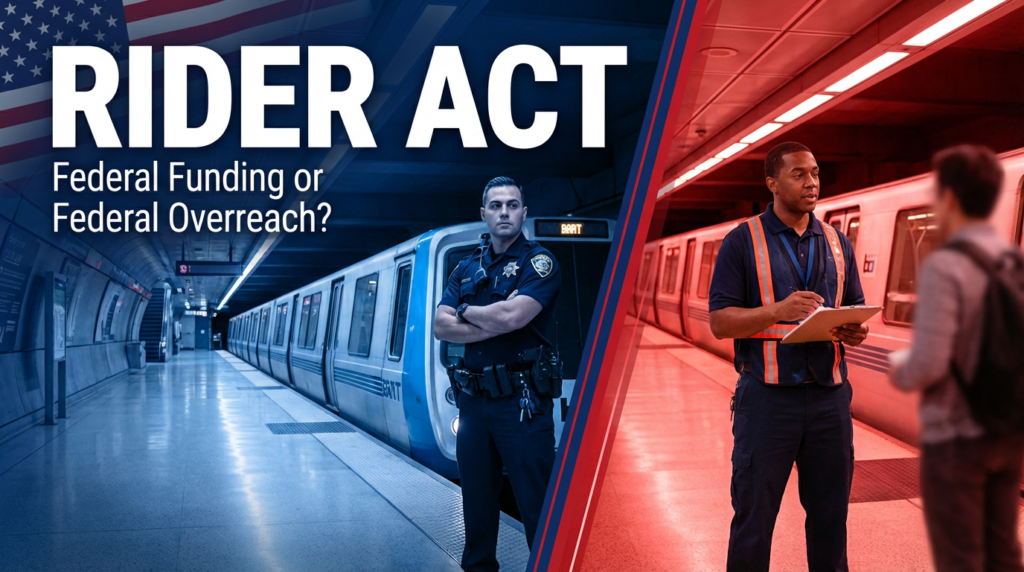
When Rep. Lateefah Simon (D-CA) stood inside Oakland’s 19th Street BART station on January 30, 2026, to announce her new federal legislation, she painted an optimistic picture: unarmed “transit support specialists” would make public transportation safer, ease the burden on police, and create a compassionate alternative to law enforcement. The Rapid Intervention and Deterrence for Enhanced Rider Safety Act—or RIDER Act—would allow transit agencies nationwide to tap federal crime prevention funds to hire these ambassadors instead of police officers.
It sounds reasonable on the surface. But when you examine the details, serious questions emerge about fiscal responsibility, public safety outcomes, and whether taxpayers should fund a program with mixed results and limited accountability.
Understanding the RIDER Act: What It Actually Does
The RIDER Act (H.R. 6069) amends existing federal transit law to make “transit support specialists” eligible for federal crime prevention and security grants. Currently, these grants under Section 5321 of Title 49 U.S. Code primarily fund law enforcement and security equipment. Simon’s bill would redirect operational funding from Section 5338 to pay for unarmed personnel who would:
Support Independent Local Journalism
TheTownHall.News is a non-profit reader-supported journalism. Just $5 helps us hire local reporters, investigate important issues, and hold public officials accountable across Alameda County. If you believe our community deserves strong, independent journalism, please consider donating $5 today to support our work.- Monitor transit stations and vehicles
- Provide assistance to riders
- Report medical emergencies
- Deter disruptive behavior through “presence”
- Handle “minor, non-criminal conflicts”
- Connect patrons with crisis intervention services
The bill, introduced in November 2025 and currently in the House Subcommittee on Highways and Transit, has four co-sponsors—all Democrats.
The Problem: Expanding Federal Funding Without Clear Accountability
Federal Dollars, Local Problems
The fundamental issue with the RIDER Act is that it takes a local transit management decision and makes it a federal funding priority. Transit agencies already have the authority and budget flexibility to hire ambassadors, social workers, or any other personnel they deem necessary. BART, for instance, launched its ambassador program in 2020 without federal legislation mandating it.
So why does this need to be a federal program? The answer appears to be simple: it allows transit agencies to shift costs from their own budgets to federal taxpayers. This is classic mission creep—expanding federal involvement and spending into areas traditionally managed at the state and local level.

The Missing Performance Metrics
Here’s what should concern every taxpayer: there’s remarkably little rigorous, independent evaluation of whether these programs actually work. BART spokesperson Alicia Trost admitted the agency has produced no analytical reports on its ambassador program’s effectiveness, despite it being “one of the oldest in the country.” They only provide data in quarterly reports—data that’s self-reported and not independently verified.
When Boston’s MBTA launched a similar program, an audit found the agency had overpaid the contractor by millions and failed to establish performance metrics. A 2023 report revealed that more than 25% of complaints about the program concerned ambassadors’ failure to assist customers. The MBTA had no systematic way to measure whether the program was achieving its goals.
A December 2025 UCLA study of Los Angeles Metro’s ambassador program found the initiative paid “below living wages,” lacked adequate on-the-job resources, and created “strenuous working conditions.” The researchers concluded that while ambassadors made “a positive contribution,” the program needed “many improvements, including training in conflict resolution.”
These aren’t success stories—they’re cautionary tales about rushing to expand programs before proving they work.
Support Independent Local Journalism
TheTownHall.News is a non-profit reader-supported journalism. Just $5 helps us hire local reporters, investigate important issues, and hold public officials accountable across Alameda County. If you believe our community deserves strong, independent journalism, please consider donating $5 today to support our work.The Safety Question: Are Riders Actually Safer?
Correlation Isn’t Causation
At the January 30 press conference announcing the RIDER Act, Rep. Simon and BART officials touted a 41% drop in overall crime on BART in 2025, with violent crime down 31% and property crime down 43%. They attributed this success to the collaboration between police and ambassadors.
But there’s a problem with this narrative: BART itself had previously credited the crime reduction primarily to its new modernized fare gates, not the ambassador program. Only at Simon’s press conference did BART Board President Melissa Hernandez pivot to emphasizing the “people, sworn officers and unarmed staff, working together.”
This inconsistency raises an important question: are ambassadors actually driving crime reduction, or is BART cherry-picking credit to support a political agenda? Without rigorous, independent analysis controlling for multiple variables—including the fare gates, changes in ridership patterns, economic conditions, and police deployment—we simply don’t know.
What Ambassadors Can’t Do
Let’s be clear about the limitations of unarmed personnel. Transit ambassadors cannot:
- Arrest violent offenders
- Respond to active threats with force
- Enforce fare evasion (a major source of transit revenue loss)
- Physically intervene in assaults or robberies
- Compel compliance from individuals causing disturbances
They can observe, report, and de-escalate—when the situation allows for de-escalation. But when a rider is being assaulted, robbed, or threatened, an unarmed ambassador’s ability to help is extremely limited. They become another potential victim or witness, not a solution.
The Fiscal Responsibility Issue: How Much Will This Cost?
No Cost Estimate Available
As of this writing, the Congressional Budget Office has not released a cost estimate for the RIDER Act. That means Congress is being asked to consider legislation without knowing its price tag. For taxpayers concerned about the $36 trillion national debt, this should be alarming.
Based on existing programs, we can make educated estimates. Downtown San Francisco estimated that funding ambassadors at just two BART stations would cost $2.8 million annually. BART’s ambassador program has expanded significantly since its 2020 pilot. If this model is replicated nationwide across major transit systems—New York, Chicago, Washington D.C., Los Angeles, Boston, Philadelphia, and dozens of smaller cities—the annual cost could easily reach hundreds of millions of dollars.
Operational Funding: The Gift That Keeps Taking
Here’s the most concerning aspect: the RIDER Act specifically authorizes operational funding, not just capital grants. Capital grants are one-time expenditures for equipment or infrastructure. Operational grants fund ongoing expenses—salaries, benefits, training, administration—year after year after year.
Once federal operational funding begins, it rarely ends. Transit agencies will build these positions into their staffing models, unions will organize the workers, and any attempt to reduce funding will be met with claims that Congress is “cutting safety.” The program becomes permanent, and the costs become baked into the federal budget indefinitely.
The Law and Order Perspective: Getting Priorities Right
Police Do More Than Ambassadors Can
There’s an underlying assumption in the RIDER Act that’s worth examining: that “de-escalation” and “crisis intervention” are always the appropriate response to disruptive behavior on transit systems. But this assumption doesn’t hold up to scrutiny.
Many transit crimes aren’t crises requiring social work intervention—they’re violations of law requiring enforcement. Fare evasion costs transit agencies hundreds of millions in lost revenue. Drug dealing on platforms isn’t a mental health crisis. Assault isn’t a conflict needing de-escalation. These situations require law enforcement, not social workers.
A Center for Policing Equity report found that BART’s fare enforcement operations had a “detrimental effect” on Black, Brown, and low-income riders, making them feel less safe. But the solution to discriminatory enforcement isn’t to abandon enforcement altogether—it’s to ensure fair, consistent, professional policing. Letting fare evasion go unenforced doesn’t help low-income riders; it bankrupts the transit system that serves them.
The Perception of Safety Matters
Surveys show that many riders feel safer when they see ambassadors. But feelings aren’t the same as actual safety. If crime is occurring but ambassadors can’t stop it, riders may feel temporarily better—until they or someone they know becomes a victim. Then the perception shifts dramatically.
Riders need to know that if something goes wrong, someone with authority and capability can intervene. An unarmed ambassador with a radio and a kind demeanor cannot stop a violent assault. A trained police officer can.
The Alternative: Proven, Accountable Public Safety
What Actually Works
The evidence is clear on what reduces transit crime: visible police presence, swift consequences for violations, functioning infrastructure (like fare gates), and well-maintained, well-lit facilities. These aren’t revolutionary concepts—they’re basic public safety principles applied consistently.
New York’s transit system saw dramatic crime reductions in the 1990s not through social workers, but through quality-of-life policing, fare enforcement, and removing graffiti. The “broken windows” approach—addressing minor violations before they escalate—proved effective when applied systematically.
BART’s own data suggests the fare gates deserve significant credit for crime reduction. Physical security measures work because they prevent crimes from occurring in the first place. An ambassador can report a fare evader; a functioning gate prevents them from entering.
Local Control, Local Accountability
If a transit agency wants to hire ambassadors, it should be free to do so with local funds and local accountability. San Francisco, Oakland, Berkeley, and other Bay Area communities can make that decision through their local transit boards. If the programs work, they’ll continue. If they don’t, local leaders can change course.
But when the federal government funds these positions, accountability becomes diffuse. Local transit agencies become dependent on federal dollars. When problems arise—overpayment, underperformance, lack of training—who’s responsible? The local agency blames federal funding constraints. Congress blames local implementation. Taxpayers foot the bill regardless.
The Broader Concern: Federalizing Local Decisions
A Pattern of Overreach
The RIDER Act fits a troubling pattern: taking problems that should be solved locally and making them federal issues requiring federal funding. This approach has several predictable consequences:
- Reduced local innovation: When federal funding comes with federal requirements, transit agencies lose flexibility to experiment with different approaches.
- One-size-fits-all solutions: What works in San Francisco may not work in Houston or Phoenix. Federal programs tend toward uniformity, not customization.
- Dependency: Once agencies rely on federal operational funding, they can’t easily switch to different models without losing that funding.
- Reduced accountability: Voters can more easily hold local transit boards accountable than they can influence federal policy.
Fiscal Federalism Matters
The Constitution doesn’t grant Congress unlimited power to fund any program that might be beneficial. The Tenth Amendment reserves powers not delegated to the federal government to the states and the people. While the Supreme Court has interpreted Congress’s spending power broadly, that doesn’t mean every federal expenditure is wise policy.
Conservative principles support keeping government closest to the people it serves. Transit is inherently local. The decision about how to staff transit systems should be made by local communities, not by Congress.
What Should Happen Instead
Let the Data Speak
Before Congress authorizes potentially hundreds of millions in federal spending, it should demand rigorous, independent evaluation of existing ambassador programs. Key questions include:
- What is the cost per prevented crime compared to traditional policing?
- How do programs perform in different types of transit systems (heavy rail vs. bus vs. light rail)?
- What are the optimal ratios of ambassadors to police officers?
- Which specific functions provide the most value?
- What training and compensation levels produce the best outcomes?
These aren’t ideological questions—they’re practical ones that deserve answers before taxpayers invest heavily in a national program.
Restore Transit Funding Priorities
Federal transit funding should prioritize what only the federal government can do: major infrastructure projects, interstate coordination, and safety standards that require national consistency. Staffing decisions should remain local.
If Congress wants to help transit agencies, it should:
- Fund infrastructure improvements (tracks, signals, stations, vehicles)
- Support interoperability between systems
- Invest in technology that prevents crime (modern fare systems, cameras, lighting)
- Remove regulatory barriers that increase costs
These investments have clear, measurable returns and don’t create permanent operational obligations.
Support Effective Law Enforcement
Rather than creating an alternative to police, Congress should support effective, professional, accountable law enforcement on transit systems. This includes:
- Training programs for transit police
- Technology for evidence collection and case management
- Mental health resources for officers
- Community policing initiatives
- Accountability systems that build public trust
Good policing isn’t incompatible with compassion. Officers can and should be trained in de-escalation, crisis intervention, and working with vulnerable populations. But they also need the authority and capability to enforce the law when necessary.
Conclusion: Accountability Before Expansion
The RIDER Act represents a well-intentioned but fundamentally flawed approach to transit safety. It would expand federal spending on programs with limited evidence of effectiveness, shift costs from local to federal budgets, and reduce accountability for results.
Rep. Simon’s district faces real challenges with transit safety, homelessness, and substance abuse. These problems deserve serious solutions, not political gestures that make good press releases but questionable policy.
Before Congress creates a new federal entitlement program for transit ambassadors, it owes taxpayers clear answers: How much will this cost? What results will it produce? Why can’t local transit agencies fund this themselves? What happens if it doesn’t work?
Until those questions have satisfactory answers, the RIDER Act should remain what it is today: a bill in committee, not a law spending taxpayer money.
The goal of public transit policy should be simple: safe, reliable, affordable service for all riders. That requires tough choices about enforcement, accountability, and priorities. It requires leadership willing to say that some problems need police, not social workers. And it requires fiscal discipline to ensure that every dollar spent produces real value for riders and taxpayers.
The RIDER Act doesn’t meet that standard. Congress should reject it and encourage transit agencies to focus on proven solutions: strong law enforcement, functioning infrastructure, and local accountability for results.
Call to Action: Make Your Voice Heard
The RIDER Act is currently in the House Subcommittee on Highways and Transit. Your representative needs to hear from constituents who believe in fiscal responsibility and effective public safety.
Take these steps today:
- Contact your U.S. Representative: Tell them you oppose H.R. 6069 and believe transit staffing decisions should remain local, not federally funded. Find your representative at house.gov.
- Ask the tough questions: Demand that Congress require independent evaluation of existing ambassador programs before authorizing federal funding for expansion.
- Support local accountability: Attend your local transit board meetings and advocate for proven safety measures: police presence, functioning fare gates, and well-maintained facilities.
- Share this article: Help inform others about the fiscal and safety implications of the RIDER Act. Use the share buttons below to spread the word on social media.
- Stay informed: Subscribe to The Town Hall newsletter for updates on this legislation and other issues affecting Alameda County and the Bay Area.
The debate over transit safety isn’t between compassion and enforcement—it’s between proven solutions and expensive experiments. Make sure your elected officials know where you stand.
About This Article: This analysis is based on the text of H.R. 6069, official BART reports, academic studies from UCLA and other institutions, government audits, and news reporting from multiple sources. All facts have been verified through primary sources where available.