The DHS Funding Crisis: Time for Fiscal Accountability and Border Security, Not Blank Checks
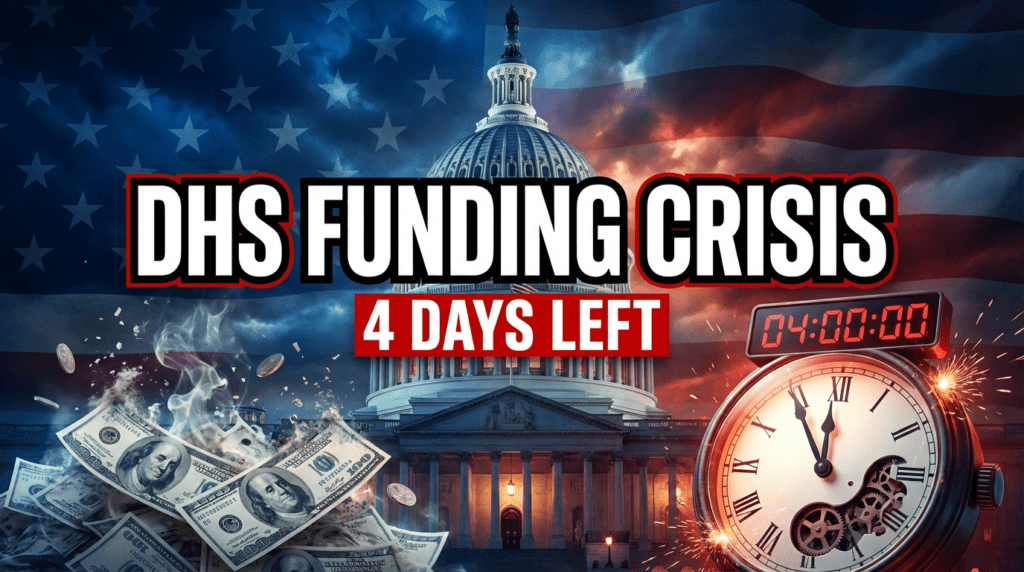
February 9, 2026 — With just four days remaining before the Department of Homeland Security runs out of funding, Congress faces a critical decision that will reveal whether our elected officials are serious about fiscal responsibility and border security—or whether they’re content to continue throwing taxpayer dollars at a bloated bureaucracy that has tripled in size while failing to secure our borders.
The deadline is February 13. The stakes couldn’t be higher. And the choice before Congress is clear: demand accountability for every taxpayer dollar, or continue business as usual in Washington.
A Crisis of Congress’s Own Making
Let’s be clear about how we arrived at this moment. After a 41-day government shutdown earlier this year, Congress passed a stopgap measure funding DHS at 2025 levels through February 13. Now, with the clock ticking, bipartisan negotiations have stalled—not over whether to fund critical homeland security functions, but over how much control and oversight taxpayers should have over an agency that has grown out of control.
Support Independent Local Journalism
TheTownHall.News is a non-profit reader-supported journalism. Just $5 helps us hire local reporters, investigate important issues, and hold public officials accountable across Alameda County. If you believe our community deserves strong, independent journalism, please consider donating $5 today to support our work.The Department of Homeland Security was created in 2003 with a budget of $31 billion. Today, it consumes over $103 billion annually—a staggering 230% increase. To put that in perspective, it now takes the entire tax revenue of more than 37 states to fully fund DHS. The department’s budget has grown twice as fast as our nation’s entire economy during the same period.
This isn’t growth driven by necessity. It’s growth driven by Washington’s addiction to spending.
Where Your Tax Dollars Are Really Going
While our southern border remains in crisis and Border Patrol agents struggle with inadequate resources, DHS spending tells a different story about the agency’s priorities. Over the past five years, overall DHS expenditures have grown 58%. Yet spending on actual “Border Activities”—including Customs and Border Protection, ICE, TSA, and the Coast Guard—has grown by only 24%.
So where is the money going? Follow the bureaucratic trail:

- The Office of Secretary and Executive Management grew 81%
- The Management Directorate grew 75%
- The Countering Weapons of Mass Destruction Office grew 57% (despite DHS Secretary admitting this office did nothing to investigate COVID-19 origins)
- The Cybersecurity and Infrastructure Security Agency grew 51%
Meanwhile, here’s what DHS has actually spent your money on:
- $123 million on electric vehicles that the Government Accountability Office confirmed DHS cannot even use
- $17 million on unused hotel rooms for illegal immigrants
- $4.3 million on grants to house illegal immigrants
- $160 million on projects to advance “environmental justice” at FEMA
- $1.3 million on a “cybersecurity diversity fellowship”
- $225,000 on a marketing campaign to convince migrants from Latin America not to come to the southern border (clearly money well spent, given the ongoing crisis)
This summer, the Trump administration took decisive action, terminating dozens of wasteful grants and saving taxpayers $18.5 million. Among the canceled programs: $851,836 to a DEI organization focused on “silencing ideological opposition,” $479,816 to a program that labeled traditional male behaviors as extremist, and $206,260 to target gamers with politically charged content under the guise of violence prevention.
These cuts represent a commitment to fiscal responsibility that should be the standard, not the exception.
The Real Debate: Accountability vs. Political Theater
As the February 13 deadline approaches, Democrats and Republicans remain deadlocked—but not over funding levels. The impasse centers on accountability and enforcement priorities.
Democratic leaders have laid out ten “guardrails” they’re demanding in exchange for their votes, including restrictions on ICE operations, bans on agents entering private property without judicial warrants, prohibitions on masks during enforcement operations, and requirements that agents stay away from “sensitive locations” like schools and churches. They’ve also demanded the removal of DHS Secretary Kristi Noem.
Support Independent Local Journalism
TheTownHall.News is a non-profit reader-supported journalism. Just $5 helps us hire local reporters, investigate important issues, and hold public officials accountable across Alameda County. If you believe our community deserves strong, independent journalism, please consider donating $5 today to support our work.Some of these proposals merit serious consideration. Body cameras and clear use-of-force policies, for instance, protect both citizens and law enforcement officers. But others—particularly the demand to unmask federal agents—would put officers and their families at direct risk of harassment, doxxing, and violence.
Republicans, meanwhile, are pushing for an end to sanctuary city policies that obstruct federal immigration enforcement and create safe havens for individuals who have entered the country illegally. Senator Lindsey Graham has introduced legislation to condition federal dollars on cooperation with immigration enforcement—a commonsense approach that says if you want federal funding, you must follow federal law.
Senator Katie Britt (R-Ala.) called the Democratic proposal a “ridiculous Christmas list of demands.” Senate Majority Leader John Thune (R-S.D.) accused Democrats of being “more interested in a political issue than a solution.”
Both may be right. But the American people deserve better than political posturing from either party.
What’s Actually at Stake
A DHS shutdown wouldn’t just affect immigration enforcement. It would impact:
- The Transportation Security Administration (TSA), responsible for aviation security at every airport in America
- The Federal Emergency Management Agency (FEMA), which responds to natural disasters
- The U.S. Coast Guard, which protects our maritime borders and conducts search-and-rescue operations
- The Secret Service, which protects the President and investigates financial crimes
- The Cybersecurity and Infrastructure Security Agency (CISA), which defends against cyber threats
These are critical functions that Americans depend on. They deserve full funding and proper oversight. What they don’t deserve is to be held hostage to partisan demands or used as leverage for unrelated policy goals.
The Path Forward: Demand Accountability
This funding crisis presents an opportunity—not just to keep the lights on at DHS, but to fundamentally reform how the agency operates and spends taxpayer money.
Congress should pass a full-year funding bill that:
Prioritizes core missions: Border security, disaster response, and counterterrorism should receive robust funding. DEI initiatives, political advocacy grants, and wasteful vehicle purchases should be eliminated entirely.
Demands transparency: Every dollar spent should be tracked and reported. Programs that cannot demonstrate measurable results toward DHS’s core mission should be defunded.
Enforces the law: Federal funding should be conditioned on cooperation with federal immigration enforcement. Sanctuary city policies that obstruct the rule of law should not receive taxpayer subsidies.
Protects civil liberties: Reasonable safeguards—including body cameras, clear use-of-force policies, and respect for constitutional rights—protect both citizens and law enforcement officers. These aren’t partisan issues; they’re American values.
Includes sunset provisions: New programs and spending increases should include automatic expiration dates, forcing Congress to evaluate results before renewing funding.
The Conservative Case for Reform
This isn’t about shutting down government or refusing to fund homeland security. It’s about demanding that government work for the people who pay for it.
Fiscal responsibility means refusing to write blank checks to agencies that have tripled in size while failing their core missions. Limited government means questioning why bureaucratic offices grow by 81% while border security grows by only 24%. Accountability means demanding measurable results for every tax dollar spent.
The rule of law means enforcing our immigration laws consistently and fairly—not creating carve-outs for jurisdictions that choose which federal laws they’ll follow. And personal responsibility means expecting our elected officials to make tough choices rather than kicking the can down the road with another stopgap measure.
The Department of Homeland Security has a vital mission: protecting the American people. That mission deserves adequate funding and strong leadership. But it also demands accountability, transparency, and a commitment to core functions over political pet projects.
Conclusion: The Time for Action Is Now
As Congress returns to Washington with just four days to reach a deal, the message from the American people should be clear: Do your job. Fund the core missions of homeland security. Cut the waste. Enforce the law. And stop treating taxpayer dollars like Monopoly money.
The DHS funding crisis is a test—of fiscal discipline, of commitment to the rule of law, and of whether our representatives work for us or for the Washington establishment.
It’s time they passed that test.
Call to Action
Stay informed. The DHS funding deadline is February 13. Contact your representatives in Congress and demand they support a full-year funding bill that prioritizes border security, eliminates wasteful spending, and enforces immigration law.
Get involved. Share this article with friends and family who care about fiscal responsibility and limited government. The more Americans who understand what’s at stake, the harder it becomes for Washington to maintain business as usual.
Hold them accountable. Remember how your representatives vote on this critical issue. Fiscal responsibility and the rule of law aren’t partisan issues—they’re American values that deserve bipartisan support.
The clock is ticking. Make your voice heard.