Trump’s Iran Ultimatum: What Conservatives Must Demand Before America Goes to War
By Tom Wong | The Town Hall | February 19, 2026
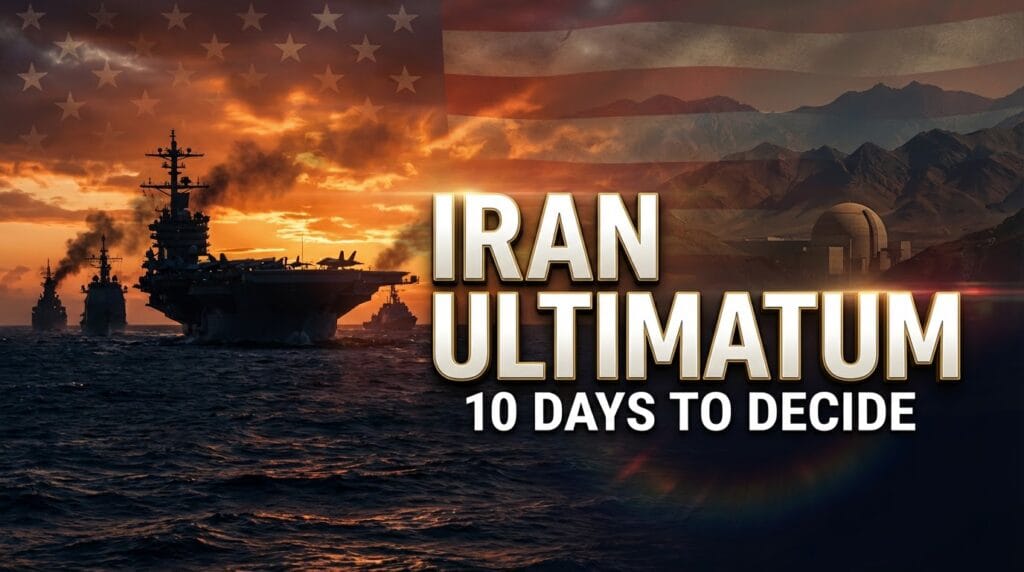
On Thursday, standing before the inaugural meeting of his newly created Board of Peace, President Donald Trump drew a line in the sand. Iran, he declared, has 10 days to reach a “meaningful deal” on its nuclear program — or face consequences he described only as “very traumatic.” Behind him, the most formidable American naval armada since the 2003 Iraq invasion is taking shape across the Middle East: two carrier strike groups, dozens of destroyers, stealth fighters, reconnaissance aircraft, and thousands of service members positioned from the Strait of Hormuz to the Red Sea.
It is a breathtaking display of American military power. It is also, for millions of Americans who value limited government, fiscal responsibility, and constitutional order, a moment that demands serious scrutiny — not blind opposition, and not blind allegiance, but the kind of sober, principled thinking that has always defined the best of conservative governance.
Support Independent Local Journalism
TheTownHall.News is a non-profit reader-supported journalism. Just $5 helps us hire local reporters, investigate important issues, and hold public officials accountable across Alameda County. If you believe our community deserves strong, independent journalism, please consider donating $5 today to support our work.The Case for Strength — And Its Limits
Let’s be clear about what we’re dealing with. Iran’s theocratic regime has spent over four decades sponsoring terrorism, crushing internal dissent, and pursuing nuclear weapons capability. The Institute for Science and International Security has assessed that Iran could enrich enough uranium for multiple nuclear weapons in as little as one week. Satellite imagery shows Tehran actively fortifying its nuclear sites with concrete and soil even as diplomats exchange notes in Geneva. Supreme Leader Khamenei has flatly rejected American demands to halt uranium enrichment.
This is not a regime that responds to weakness. President Trump’s supporters are right to point out that decades of diplomatic half-measures — from the deeply flawed 2015 JCPOA to years of unenforced red lines — emboldened Tehran rather than restrained it. The June 2025 “Operation Midnight Hammer” strikes on Iranian nuclear facilities at Fordow, Natanz, and Isfahan demonstrated that the United States possesses the capability to act decisively. That operation, involving 125 aircraft and B-2 stealth bombers carrying 30,000-pound Massive Ordnance Penetrators, sent an unmistakable message.
Peace through strength is not a slogan. It is a proven doctrine. Ronald Reagan won the Cold War not by capitulating to the Soviet Union but by making clear that the cost of aggression would be unbearable. Trump’s military buildup in the Persian Gulf follows that tradition.
But Reagan also understood something else: that strength without strategy is recklessness, and that the projection of power must serve clearly defined American interests — not open-ended commitments that drain the treasury and stretch the military beyond its limits.

Where Are the Guardrails?
This is where principled conservatives must ask hard questions.
First, what is the objective? At Fort Bragg last week, the President openly floated regime change in Iran, saying it “seems like that would be the best thing that could happen.” He added that “there are people” who could take over. History teaches us — painfully, in Iraq, Libya, and Afghanistan — that regime change without a credible plan for what comes next creates power vacuums that breed chaos. The 20-year war in Afghanistan cost American taxpayers over $2 trillion and ended in a humiliating withdrawal. Iraq cost nearly $3 trillion. Are we prepared to write another blank check?
Reuters reports that the Pentagon is now preparing for “sustained, weeks-long operations” against Iran — not a one-off strike like Midnight Hammer, but a prolonged campaign targeting state and security facilities beyond nuclear infrastructure. U.S. officials acknowledge they “fully expect Iran to retaliate,” leading to “back-and-forth strikes and reprisals over time.” Iran’s Revolutionary Guard has warned it could strike any American military base in the region. The United States maintains installations in Jordan, Kuwait, Saudi Arabia, Qatar, Bahrain, the UAE, and Turkey — every one of them a potential target.
The current deployment is estimated to cost approximately $30 million per day. A sustained, weeks-long campaign would multiply that figure dramatically. For a party and a movement that has rightly championed fiscal accountability, these numbers demand answers. Who is paying for this? What is the exit strategy? And what is the threshold for success?
Second, where is Congress? The Constitution is unambiguous: the power to declare war belongs to the legislative branch. Yet as CNN’s analysis noted this week, President Trump “has not sought significant public or Congressional buy-in” for potential strikes. White House press secretary Karoline Leavitt declined to set deadlines or define objectives. The President’s rationale, as one analysis put it, “is still opaque.”
Support Independent Local Journalism
TheTownHall.News is a non-profit reader-supported journalism. Just $5 helps us hire local reporters, investigate important issues, and hold public officials accountable across Alameda County. If you believe our community deserves strong, independent journalism, please consider donating $5 today to support our work.This should trouble every conservative who believes in the rule of law and the separation of powers. A bipartisan effort led by Rep. Ro Khanna and Rep. Thomas Massie — a libertarian-leaning Republican — is moving to force a war powers vote in the House. Sen. Tim Kaine has introduced a resolution requiring congressional authorization before any military action against Iran. These are not obstructionist maneuvers. They are the constitutional process working as designed.
Personal responsibility is a bedrock conservative value. It applies to presidents, too. If military action against Iran is justified — and it may well be — then the case should be made openly, debated publicly, and authorized properly. Americans who may be asked to fight and die deserve no less.
Diplomacy Is Not Weakness
The indirect talks in Geneva on Tuesday lasted three and a half hours. Iran’s top negotiator reported agreement on “a set of guiding principles.” An American official cautioned that “there are still a lot of details to discuss.” Secretary of State Marco Rubio is scheduled to travel to Israel on February 28 to brief Prime Minister Netanyahu.
These are not signs of capitulation. They are signs that diplomacy — backed by overwhelming military force — is being given a chance to work. Trump himself, through his press secretary, has stated that “diplomacy is his first option.”
Good. It should be.
The strongest conservative position is not to cheer for war but to insist on a deal that actually serves American interests: the permanent dismantlement of Iran’s nuclear weapons capability, verifiable restrictions on its ballistic missile program, and an end to its sponsorship of terrorist proxies across the region. Anything less is a Band-Aid. Anything more — regime change, nation-building, prolonged occupation — is a project that history tells us will cost far more in blood and treasure than any administration is willing to admit on the front end.
The Stakes Are Real — And Personal
Behind the carrier strike groups and satellite imagery are real people. American sailors on the USS Gerald Ford steaming toward the Persian Gulf. Airmen at Al Kharj air base in Saudi Arabia. Marines and special operators positioned across the region. Their families are watching the news tonight, wondering what comes next.
Conservative principles are not abstractions. They are commitments — to the men and women who serve, to the taxpayers who fund their mission, and to the constitutional order that governs when and how America goes to war. Supporting the troops means demanding that their leaders have a plan, a legal basis, and a clearly defined mission before sending them into harm’s way.
A 10-Day Test for American Leadership
President Trump has set the clock. In 10 days, we will know whether Iran blinks or whether the United States takes what the President calls “a step further.” The military is ready. The question is whether our political leadership — in the White House and on Capitol Hill — is equally prepared to meet this moment with the seriousness it demands.
Strength without accountability is not conservatism. It is something else entirely.
The coming days will test not just Iran’s resolve, but America’s commitment to the principles that have always made this nation exceptional: the rule of law, fiscal stewardship, transparent governance, and the unwavering belief that power must be wielded wisely, not merely wielded.
Stay Informed. Stay Engaged.
This is a defining moment in American foreign policy. Don’t let it pass without your voice being heard. Contact your representatives in Congress and demand transparency, constitutional process, and fiscal accountability. Share this article with fellow citizens who believe that conservative principles apply not just at home, but in how we project power abroad. Subscribe to The Town Hall for continued coverage and analysis as this story develops.