When Blue Helmets Bleed: The UNIFIL Attack and the Global Accountability Crisis the World Can No Longer Ignore
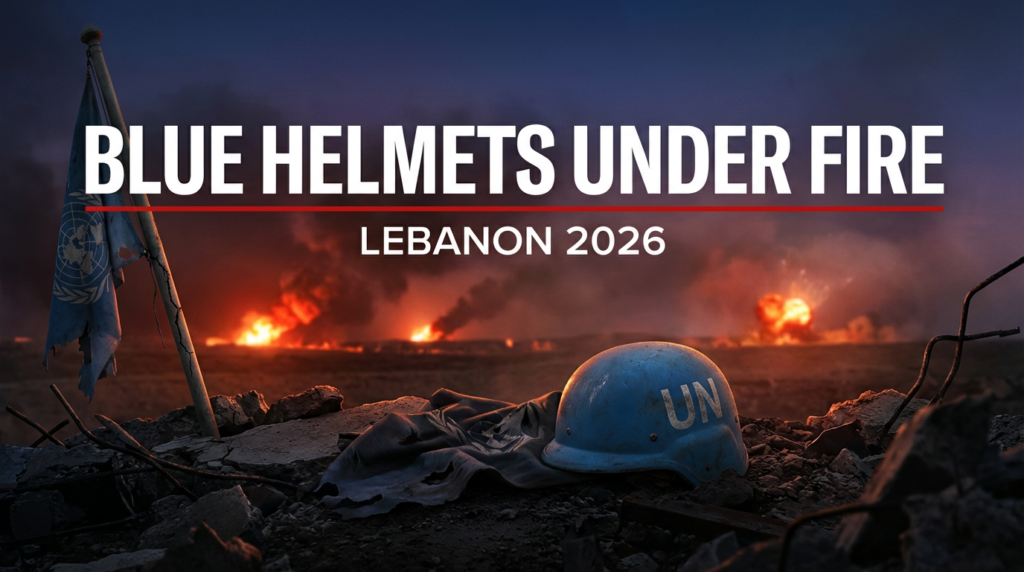
A Line Was Crossed on March 7, 2026
On Friday, March 7, 2026, the world woke to a sobering and deeply disturbing report from southern Lebanon: three United Nations peacekeepers — two of them Ghanaian soldiers critically wounded — were injured when their UNIFIL base in the village of Qawzah came under what Ghana’s military described as “two missile attacks.” The officers’ mess facility was burned to the ground. The most severely injured soldier was airlifted to a hospital in Beirut.
UNIFIL — the United Nations Interim Force in Lebanon — did not immediately assign blame. But the context was impossible to ignore. The strike occurred amid a sweeping Israeli military campaign against Hezbollah that had already killed more than 200 people since Monday and displaced an estimated 300,000 Lebanese civilians. Lebanese President Joseph Aoun condemned it as a “direct assault on UNIFIL.” French President Emmanuel Macron called it “unacceptable.” Human rights observers invoked the Geneva Conventions and the Rome Statute of the International Criminal Court.
Regardless of one’s position on the broader Middle East conflict, this moment demands a sober reckoning. When uniformed peacekeepers — men operating under a United Nations Security Council mandate, clearly marked, stationed at a fixed base — are struck and wounded in a war zone, the norms of law and order that hold civilized conduct together have been violated. Accountability must follow. Always.
Support Independent Local Journalism
TheTownHall.News is a non-profit reader-supported journalism. Just $5 helps us hire local reporters, investigate important issues, and hold public officials accountable across Alameda County. If you believe our community deserves strong, independent journalism, please consider donating $5 today to support our work.What Happened: The Facts on the Ground
The March 7 attack did not occur in a vacuum. It was the latest in a rapidly escalating chain of events. On March 3, UNIFIL confirmed that Israeli Defense Forces (IDF) soldiers had crossed into Lebanese border areas near Markaba, Al Adeisse, Kfar Kela, and Ramyah — a direct violation of UN Security Council Resolution 1701, the 2006 agreement that ended the last full-scale Israel-Hezbollah war and established the rules of engagement along the Blue Line border.
The Israeli military announced the ground operation publicly, framing it as a mission to establish a “security zone” to protect Israeli settlements from Hezbollah rocket fire. Israel’s position is not without context — Hezbollah had fired hundreds of rockets and drones into Israeli territory that week, with some 70 launched in the hours before midnight on Friday alone. Eight Israeli soldiers were wounded by projectile fire near the border.
But the attack on the UNIFIL base — a clearly marked, internationally protected facility — crossed a different kind of threshold. UNIFIL stated without ambiguity: “It is unacceptable that peacekeepers performing Security Council-mandated tasks are targeted.”
Law and Order Begins with Accountability — No Exceptions
For those who hold law and order as a foundational value, the principle applies universally. Whether on the streets of an American city or on the hills of southern Lebanon, the rule of law only means something when it is enforced consistently and without political favoritism. There can be no double standard — where some nations answer for attacking uniformed personnel and others do not based on geopolitical alliances.

This is not a call to condemn Israel wholesale, nor to ignore the very real and legitimate security threats it faces from Hezbollah, an Iranian-backed proxy that has fired rockets into civilian areas and openly called for the destruction of the Israeli state. Those threats are real. Israel’s right to defend itself is recognized in international law. But that right does not extend — legally or morally — to striking bases where UN peacekeepers are stationed.
The principle here is simple: accountability cannot be selective. Conservatives who rightly demand that rogue actors — whether foreign militaries, domestic rioters, or lawless street gangs — face consequences for violating protected persons and places must apply that same standard with equal vigor here. No nation, no matter how strategically important to Western interests, should be permitted to wound UN peacekeepers operating under a Security Council mandate and face zero accountability.
UNIFIL’s Own Failures: A Hard but Necessary Conversation
In the spirit of honest, balanced analysis, it is equally important to acknowledge what conservatives and defense analysts have long argued: UNIFIL has not been an unblemished institution. The Foundation for Defense of Democracies (FDD) and the Jewish Institute for National Security of America (JINSA) have both published detailed analyses showing that UNIFIL failed to prevent Hezbollah from massively rearming in southern Lebanon following the 2006 ceasefire — the very outcome Resolution 1701 was designed to prevent.
UNIFIL’s mandate was, in part, to help ensure that southern Lebanon south of the Litani River remained free of unauthorized weapons. By any objective measure, it did not. Hezbollah grew from a militia with a few thousand rockets in 2006 into one of the most heavily armed non-state actors in history, with an estimated 150,000 rockets at its peak — much of it stockpiled in the very territory UNIFIL was meant to monitor.
This is fiscal and institutional accountability in its starkest form. Governments — including the United States, which contributes to the UN’s budget — have funded UNIFIL to the tune of hundreds of millions of dollars over nearly five decades. Taxpayers deserve an honest accounting of what that investment produced. When an institution fails at its core mission, the responsible course is not to shield it from criticism — it is to demand reform, transparency, and results.
Support Independent Local Journalism
TheTownHall.News is a non-profit reader-supported journalism. Just $5 helps us hire local reporters, investigate important issues, and hold public officials accountable across Alameda County. If you believe our community deserves strong, independent journalism, please consider donating $5 today to support our work.The UN Security Council’s decision in August 2025 to phase out UNIFIL by the end of 2026 reflects a growing consensus that the mission, in its current form, has run its course. That conclusion may well be correct. But phasing out a peacekeeping force does not grant license to attack its personnel while they still serve.
The Bigger Picture: Sovereignty, Security, and Regional Order
What the Lebanon crisis ultimately illustrates is a problem that transcends any single military action: the erosion of enforceable international norms in a region where proxy wars, state and non-state actors, and great power competition have created overlapping and often contradictory obligations.
Conservatives value sovereignty — the right of nations to govern themselves, defend their borders, and protect their citizens. Israel, as a sovereign state, has that right. Lebanon, equally sovereign, has that right too. And therein lies the tragedy: a sovereign Lebanon, its army now actively working to dismantle Hezbollah infrastructure in the south, is watching its territory bombed and its population displaced while a new offensive compounds years of economic and political devastation.
The United States has a role here that goes beyond simple alliance management. American leadership — the kind that sets rules, holds allies accountable, and insists that the international order it helped build after World War II actually means something — is what this moment demands. Being a steadfast ally to Israel does not mean issuing blank checks. It means being honest with a partner when a line has been crossed, because long-term alliances are built on integrity, not unconditional silence. This is not weakness. It is the kind of principled, clear-eyed statecraft that has defined America’s greatest foreign policy moments.
What Must Happen Now
The path forward requires several concrete steps that reflect both practical conservatism and moral clarity:
First, UNIFIL must complete its investigation into the March 7 attack with full transparency. If the evidence confirms Israeli responsibility, the United States — as a permanent UN Security Council member — must ensure that finding is formally acknowledged, not buried in diplomatic ambiguity.
Second, any future peacekeeping arrangement for southern Lebanon must be built on enforceable mandates, not aspirational resolutions. The lesson of the past twenty years is that a peacekeeping force without teeth and without political backing is worse than no force at all — it creates a false sense of security that benefits bad actors on all sides.
Third, Hezbollah must be held equally and unequivocally accountable for its rocket fire into Israeli civilian areas. The condemnation of one side’s violations cannot be used as cover to ignore the other’s. Both are real. Both demand a response.
Fourth, the international community — led by the United States — must urgently pursue a genuine ceasefire framework, not merely a pause in fighting, that addresses the root drivers of this conflict: Hezbollah’s armed status, Iranian proxy financing, and Lebanon’s sovereignty deficit.
Conclusion: The Rules Still Matter
Two Ghanaian soldiers lie in a Beirut hospital tonight, critically wounded while performing a mission authorized by the United Nations Security Council. Their blue helmets and clearly marked base did not protect them. That is a profound failure — not just of military discipline, but of the broader principle that rules, when agreed upon by nations, must be honored.
Conservatives understand instinctively that order is not automatic. It must be built, maintained, and defended. The moment we begin making exceptions — deciding that some actors can strike peacekeepers with impunity while others cannot — is the moment the entire architecture of international law and order begins to crumble. And when that crumbles, it is not bureaucrats and diplomats who pay the price. It is soldiers, civilians, and families on all sides.
The men who serve under the blue helmet deserve better. So does the principle they represent.
Call to Action
Stay informed and stay engaged. The situation in Lebanon is evolving rapidly, and the stakes — for regional stability, for U.S. foreign policy, and for the rule of law — could not be higher. Share this article with friends, family, and colleagues who want honest, principled analysis of world events. Subscribe to our newsletter for timely, fact-based reporting that cuts through the noise. And contact your elected representatives to demand that America stand by its values — accountability, law and order, and principled leadership — in its Middle East policy.
The world is watching. Make sure your voice is heard.