When the Badge Betrays: The Sinaloa Cartel Police Corruption Network and Why Law and Order Must Win
The Rot Goes Deeper Than the Cartel
Imagine calling the police — only to learn the officer on the other end is on a cartel’s payroll. That nightmare isn’t fiction in Tijuana. It is fact, confirmed by an arrest sweep that should rattle every American who cares about law, order, and the safety of their community.
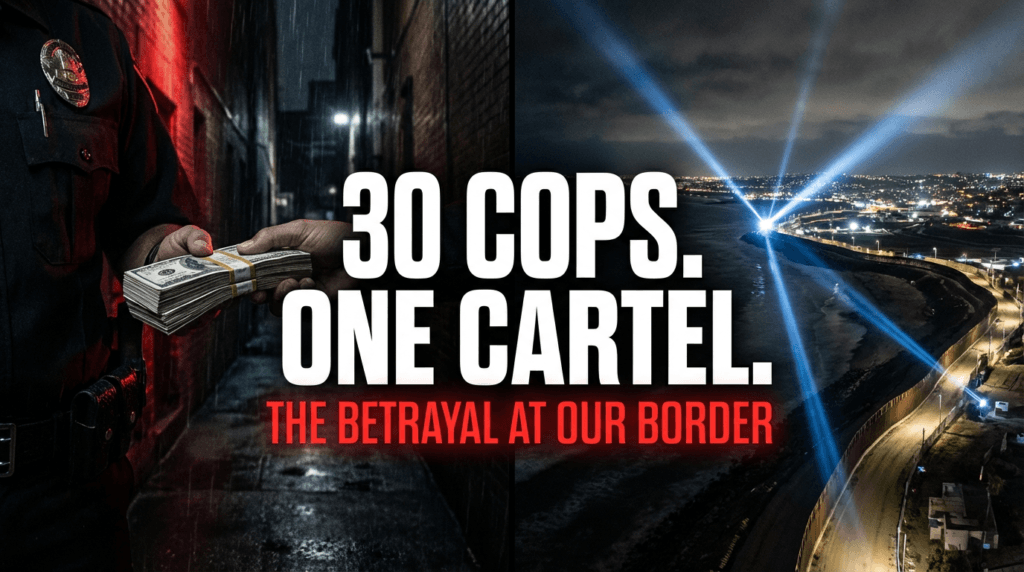
On March 6, 2026, the Baja California State Attorney General María Elena Andrade Ramírez announced the arrest of more than 30 municipal police officers across Baja California. Their alleged crime? Maintaining working relationships with René Arzate-García, known as “La Rana” (The Frog), and his brother Alfonso Arzate-García, known as “Aquiles” — the plaza bosses of the Sinaloa Cartel in Tijuana, one of the most dangerous and strategically critical drug-trafficking corridors in the Western Hemisphere.
“We have detained more than 30 police officers throughout the state — all had working relationships with the Arzate brothers,” Andrade Ramírez stated bluntly. “Some also had ties to other criminal groups.”
Support Independent Local Journalism
TheTownHall.News is a non-profit reader-supported journalism. Just $5 helps us hire local reporters, investigate important issues, and hold public officials accountable across Alameda County. If you believe our community deserves strong, independent journalism, please consider donating $5 today to support our work.This is not just a Mexican law enforcement problem. It is a direct threat to American families, American sovereignty, and the very principle that the rule of law — not the rule of criminals — governs a free society.
Who Are “La Rana” and “Aquiles”?
To understand the gravity of what these 30 officers allegedly enabled, you must understand who they were allegedly serving.
René Arzate-García, 42, and his brother Alfonso have jointly controlled the Tijuana Plaza for the Sinaloa Cartel for 15 years. According to U.S. federal prosecutors, they have maintained their grip on this territory through a calculated combination of murder, kidnapping, extortion, and the systematic corruption of police officers, military officials, and politicians.
The Tijuana Plaza is not just any criminal territory. It sits astride the busiest land border crossing in the Western Hemisphere — the gateway through which an ocean of fentanyl, methamphetamine, cocaine, and marijuana has flowed into American communities for over a decade. The Arzate brothers didn’t just traffic drugs; they weaponized a border crossing against the American people.

On February 26, 2026, the U.S. Attorney’s Office for the Southern District of California unsealed a superseding federal indictment charging René Arzate-García with:
- Narcoterrorism
- Material support to a Foreign Terrorist Organization
- Conducting a continuing criminal enterprise
- International conspiracy to distribute fentanyl, methamphetamine, cocaine, and marijuana
- Money laundering
The charges carry maximum penalties of life in prison. Both brothers have been fugitives since their first federal indictment in San Diego in 2014 — and the U.S. Department of State is now offering $5 million each for information leading to their arrest or conviction.
“René Arzate Garcia’s days as a narco-terrorist are numbered,” declared DEA San Diego Acting Special Agent in Charge James Nunnallee.
What This Means: Institutional Corruption Is a Law and Order Crisis
Conservatives have long argued that the integrity of law enforcement institutions is the cornerstone of a functioning, free society. When those institutions are hollowed out from within — when the badge becomes a shield for criminal enterprise — the entire social contract breaks down.
That is precisely what happened in Baja California.
Support Independent Local Journalism
TheTownHall.News is a non-profit reader-supported journalism. Just $5 helps us hire local reporters, investigate important issues, and hold public officials accountable across Alameda County. If you believe our community deserves strong, independent journalism, please consider donating $5 today to support our work.These weren’t rogue officers acting alone on a single occasion. According to Attorney General Andrade Ramírez, all 30 had active working relationships with the Arzate brothers. Some had ties to multiple criminal groups. This is not an aberration — it is evidence of a systemic infiltration of law enforcement by organized crime.
Think about what that means in practice. When an innocent family in Tijuana dials emergency services, they cannot know whether the responding officer is a public servant or a cartel asset. When a witness to cartel violence considers coming forward, they face the real possibility that their information will be passed directly to the criminals they are reporting. When border agents on the American side work to interdict drug shipments, corrupt officers on the Mexican side may be actively countering those efforts in real time.
This is the corrosive logic of cartel corruption: it doesn’t just enable crime, it dismantles the very capacity of the state to fight it. And it places ordinary, law-abiding citizens — on both sides of the border — in greater danger.
Fentanyl: The Weapon Being Smuggled Through Corrupt Hands
We cannot discuss the Arzate brothers’ network without confronting the human cost of what they traffic.
Fentanyl — a synthetic opioid estimated to be 100 times more potent than morphine — has become the leading driver of drug overdose deaths in the United States. According to the CDC, fentanyl and other synthetic opioids were responsible for the vast majority of over 70,000 overdose deaths recorded in the United States in recent years. Families across this country have buried fathers, mothers, sons, and daughters because of poison that flowed through the very corridor these men controlled.
Federal prosecutors allege that the Arzate brothers were among the Sinaloa Cartel’s “most prolific drug traffickers.” They didn’t merely move product. They allegedly provided fighters, weapons, and financing in a violent internal cartel war, expanding their territorial reach across Baja California and into the state of Sinaloa. Court documents describe military-style weapons, a grenade launcher, and imagery of armed fighters bearing insignia loyal to “La Rana.”
Every corrupt police officer who looked the other way — or worse, actively protected this operation — bears a share of moral responsibility for the consequences. Personal accountability must extend not only to the cartel leaders who pull the strings but to the public servants who chose criminality over duty.
The Bigger Picture: Why the FTO Designation Changed Everything
One of the most significant — and underappreciated — legal developments in recent years was the Trump Administration’s decision in February 2025 to designate the Sinaloa Cartel and five other Mexican criminal organizations as Foreign Terrorist Organizations (FTOs) and Specially Designated Global Terrorists.
Critics at the time called it political theater. It was anything but.
That designation unlocked a new arsenal of federal charges previously unavailable to prosecutors: narcoterrorism and material support of terrorism. U.S. Attorney Adam Gordon’s office in San Diego became the first in the nation to use these new tools — first in May 2025, and now again with even higher-profile targets in the Arzate brothers.
The message is clear and correct: Drug cartels that murder, extort, and terrorize communities at scale are not merely criminal enterprises — they are terrorist organizations, and they should be treated as such under the full weight of American law.
This is the kind of bold, principled action that actually defends American communities. It doesn’t require new spending programs or bureaucratic expansion. It requires the political will to name evil for what it is and prosecute it accordingly.
Accountability Must Flow Both Ways
The arrests in Baja California are a step in the right direction — and Attorney General Andrade Ramírez deserves credit for acting decisively. “I have all respect for the work being done by the municipal police officers,” she said. “A few do not define the actual work being done by our municipal police.” That distinction matters.
But accountability cannot stop at 30 officers. True institutional reform requires an honest reckoning with how deeply cartel influence has penetrated Mexican law enforcement — at the municipal, state, and federal levels. It requires transparent prosecution, meaningful sentencing, and structural reforms that remove the financial incentives that make corruption so attractive in the first place.
It also requires the United States to maintain pressure. The $5 million bounties on the Arzate brothers send the right signal. Continued cross-border law enforcement cooperation — DEA, FBI, and U.S. Attorneys working with Mexican counterparts who have demonstrated integrity — is essential. So is maintaining the legal and diplomatic framework that treats cartel leaders as the international threats they are, not as mere drug dealers subject to light-touch diplomatic niceties.
American taxpayers deserve to know that their government is using every available legal tool to protect them — and that border security is not a partisan talking point, but a fundamental obligation of governance.
Conclusion: Law and Order Is Not Negotiable
The arrest of 30 officers in Baja California is more than a news story. It is a snapshot of a civilizational struggle playing out along our southern border every single day — a struggle between the rule of law and the rule of criminal power.
The Arzate brothers built their empire on bribery, violence, and impunity. They exploited weak institutions, corrupt officials, and a porous border to funnel poison into American neighborhoods and grief into American homes. The federal indictments, the FTO designation, the $5 million bounties, and the arrests in Baja California represent, at last, the full force of law being brought to bear against them.
That is how a free society defends itself — not by appeasing those who would undermine its institutions, but by demanding accountability, enforcing the law without fear or favor, and refusing to allow criminal networks to operate with impunity.
“To those cartel leaders who remain at large, here’s the question: Who can you trust when you can’t trust anyone?” U.S. Attorney Adam Gordon asked during the February indictment announcement.
The answer, for the Arzate brothers and every corrupt officer who served them, should be: no one. Because justice is coming.
Call to Action
This story matters — and it’s happening at our doorstep. Share this article with friends and family who care about border security, law enforcement integrity, and protecting American communities from the fentanyl crisis. Stay informed on the ongoing pursuit of the Arzate brothers by following updates from the DEA and U.S. Attorney’s Office for the Southern District of California. If you have information on René Arzate-García or Alfonso Arzate-García, contact the DEA at +1-858-298-5670 (WhatsApp/Signal) or MFSinaloaTipLine@dea.gov. Up to $5 million is on the table — and every piece of information helps bring justice closer.
Demand accountability. Support law and order. Stay engaged.
Sources: U.S. Department of Justice (Feb. 26, 2026), U.S. Drug Enforcement Administration, U.S. Department of State Narcotics Rewards Program, Baja California Attorney General’s Office statement (March 6, 2026), East Bay Times / Border Report (March 6, 2026), U.S. Attorney Adam Gordon press conference.