When the Lights Go Out: Vietnam Fuel Crisis Is a Stark Warning About Energy Dependence and the Cost of Geopolitical Naivety
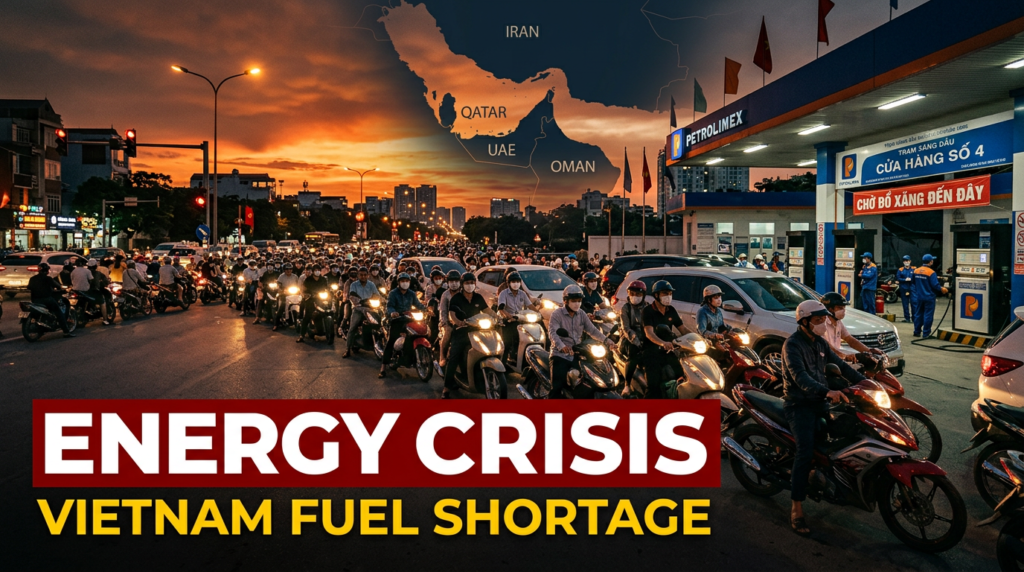
The images coming out of Hanoi today are both striking and sobering. Long lines of motorcycles and cars snake around city blocks, their riders waiting — sometimes hours — just to fill a tank. Gasoline prices have surged 32% in less than two weeks. Diesel is up 56%. Kerosene — the fuel that heats the homes and runs the stoves of millions of ordinary Vietnamese families — has spiked a staggering 80%. And in response, Vietnam’s government has done what governments instinctively do in a crisis: it has asked its people to stay home.
This is the reality of what happens when a nation outsources its energy security to a volatile region halfway across the world and then watches helplessly as that region ignites. Iran’s effective closure of the Strait of Hormuz — achieved through drone strikes and the paralysis of fear — has triggered a global energy shock. And Vietnam, heavily reliant on Middle East fuel imports, is among the countries paying the steepest price.
This is not merely a story about fuel. It is a story about the consequences of dependency, the fragility of supply chains built on geopolitical wishful thinking, and why the principles of self-reliance, fiscal discipline, and strategic foresight matter now more than ever.
Support Independent Local Journalism
TheTownHall.News is a non-profit reader-supported journalism. Just $5 helps us hire local reporters, investigate important issues, and hold public officials accountable across Alameda County. If you believe our community deserves strong, independent journalism, please consider donating $5 today to support our work.The Crisis in Plain Numbers
Let’s be clear about the facts on the ground. Since the U.S.-Israeli military conflict with Iran escalated and Iran moved to choke off the Strait of Hormuz — the narrow waterway through which roughly 20% of the world’s oil supply flows — Vietnam has been rocked by a fuel emergency of historic proportions.
According to data from Petrolimex, Vietnam’s top fuel trading company, prices since late February have risen as follows: gasoline up 32%, diesel up 56%, and kerosene up 80%. The country’s Ministry of Industry and Trade has called on businesses to “encourage work-from-home when possible to reduce the need for travel and transportation.” Prime Minister Pham Minh Minh has been on the phone with counterparts in Kuwait, Qatar, and the UAE, scrambling to secure alternative supplies. As of Monday, Vietnam has removed its import tariffs on fuels — a measure the government acknowledges will cost the state 1.02 trillion dong (approximately $39 million) in lost revenue — just to keep the pumps flowing through April.
This is what an energy crisis looks like. Not in the abstract, not in an academic paper — but in real time, in real streets, with real families feeling the pain at every fill-up.
A Warning Conservatives Have Sounded for Years
Here is what should not be glossed over: this crisis was foreseeable. For decades, conservatives have warned about the dangers of over-reliance on foreign energy. The principle is timeless: energy independence is not a luxury — it is a strategic necessity.

Vietnam’s predicament is a textbook case of what happens when a nation neglects that principle. Heavily dependent on Middle East crude and refined fuels, Vietnam left itself exposed to precisely the kind of geopolitical shock that prudent energy policy should guard against. There was no meaningful domestic buffer, no diversified supply chain robust enough to absorb the disruption, and no strategic reserve capable of cushioning the blow long enough for diplomacy to work.
The Vietnamese government is now doing what it should have been working toward all along — diversifying supply sources, contacting Gulf partners directly, and removing market barriers like import tariffs that were always a form of government-imposed friction on the free flow of energy. These are the right moves. But they are crisis responses, not the result of forward-thinking governance. Fiscal accountability demands more than reactive policy; it demands governments that plan for disruption before it arrives.
Personal Responsibility in a Time of Shortage
There is something worth acknowledging in the Vietnamese government’s call for citizens to work from home and refrain from hoarding fuel. Beneath the bureaucratic language lies an appeal to something conservatives hold dear: personal responsibility.
The call not to hoard, not to panic-buy, not to speculate — these are calls for civic virtue. They are reminders that individual behavior aggregates into national outcomes. When citizens make selfish short-term decisions — rushing to top off tanks they don’t immediately need, driving up prices through panic — they harm their neighbors. Every liter hoarded by one family is a liter not available to the delivery driver keeping food on someone else’s table, or the ambulance keeping someone’s parent alive.
This is where the conservative understanding of community and responsibility is most powerful. It is not government mandates or rationing orders that will see Vietnam through this — it is the collective discipline of millions of individuals choosing to act with restraint and consideration for others. That is a value worth naming, celebrating, and encouraging.
Support Independent Local Journalism
TheTownHall.News is a non-profit reader-supported journalism. Just $5 helps us hire local reporters, investigate important issues, and hold public officials accountable across Alameda County. If you believe our community deserves strong, independent journalism, please consider donating $5 today to support our work.The Limits of Government — and the Danger of Dependency
At the same time, it would be intellectually dishonest not to examine what this crisis reveals about the limits of government intervention and the dangers of state-managed economies.
Vietnam’s fuel market operates under substantial government regulation, including price controls and heavily managed import regimes. Import tariffs on fuels — which have now been hastily removed in an emergency — ranged up to 20%. These tariffs, ostensibly designed to protect state revenue and domestic industry, served in practice as artificial barriers that suppressed the kind of agile, market-driven supply diversification that might have softened the current shock.
Limited government works. When markets are free to respond to price signals, suppliers find alternative sources, consumers adjust their behavior, and the system absorbs disruptions more fluidly. Government price controls and tariff walls, by contrast, create false stability in calm times — and catastrophic fragility when the storm hits. Vietnam’s fuel crisis is, in part, a crisis made worse by the very structures its government erected over years of economic management.
The lesson for every nation watching this unfold — including the United States — is that bureaucratic barriers to energy market flexibility are not safeguards. They are liabilities.
The Broader Stakes: Global Order, Law, and Security
Iran’s closure of the Strait of Hormuz is not merely an economic event. It is an act of geopolitical aggression with global consequences — a deliberate attempt to weaponize a critical international shipping lane in order to coerce nations and shield a regime from military accountability. This is a direct challenge to the international rules-based order that underpins global trade, stability, and prosperity.
Conservatives have always understood that law and order do not enforce themselves — they require the credible willingness to defend them. The Strait of Hormuz is not Iran’s to close. It is an international waterway, and its security is a matter of global law. When one nation can unilaterally choke off 20% of the world’s oil supply and face no immediate, decisive consequence, every rogue actor in the world takes note.
Saudi Arabia’s Aramco has already described the potential for “catastrophic consequences” for global oil markets if the closure continues. The U.S. Energy Information Administration projects Brent crude will remain above $95 per barrel for at least the next two months. Shipping giant Maersk has introduced emergency surcharges. Exxon has evacuated non-essential staff from the Middle East. The economic and human costs of this single act of aggression are cascading across the globe — from the streets of Hanoi to the gas stations of middle America.
This is what happens when deterrence fails.
What Sound Policy Looks Like Going Forward
Vietnam’s crisis, painful as it is, offers a clear roadmap of what sound policy should look like going forward.
Energy diversification must be treated as a national security priority, not an afterthought. No nation should allow a single region or a single chokepoint to hold its economy hostage. Domestic energy development — whether through oil and gas, nuclear, or any other reliable base-load source — must be pursued with urgency.
Market barriers to energy flexibility should be dismantled before a crisis forces the issue. Vietnam’s emergency removal of fuel tariffs is the right move — but it should not have taken a geopolitical shock to make it happen. Free-market energy policy is resilient energy policy.
Strategic fuel reserves must be built and maintained. The ability to absorb a supply disruption for weeks or months without civilian suffering is not a luxury — it is a governing responsibility.
The international community must enforce freedom of navigation in critical waterways. This is not optional. It is foundational to global commerce, security, and order.
The Bottom Line
The images from Hanoi today — the fuel lines, the empty stations, the families calculating how far they can stretch what’s left in the tank — are a warning to every nation that has traded long-term resilience for short-term convenience.
Energy security is national security. Personal responsibility is social resilience. Free markets are more robust than managed ones. And the willingness to defend international law and order is not aggression — it is civilization’s backbone.
Vietnam did not cause this crisis. But the choices that left it exposed were years in the making. As the world navigates what comes next, the principles that could have prevented this suffering — strategic self-reliance, fiscal discipline, market freedom, and a credible commitment to international order — deserve to be at the center of every nation’s energy conversation.
The cost of ignoring them, as millions of Vietnamese families are learning right now, is far too high.