The Case for Pardoning Edward Snowden: Accountability, the Constitution, and the Limits of Government Power
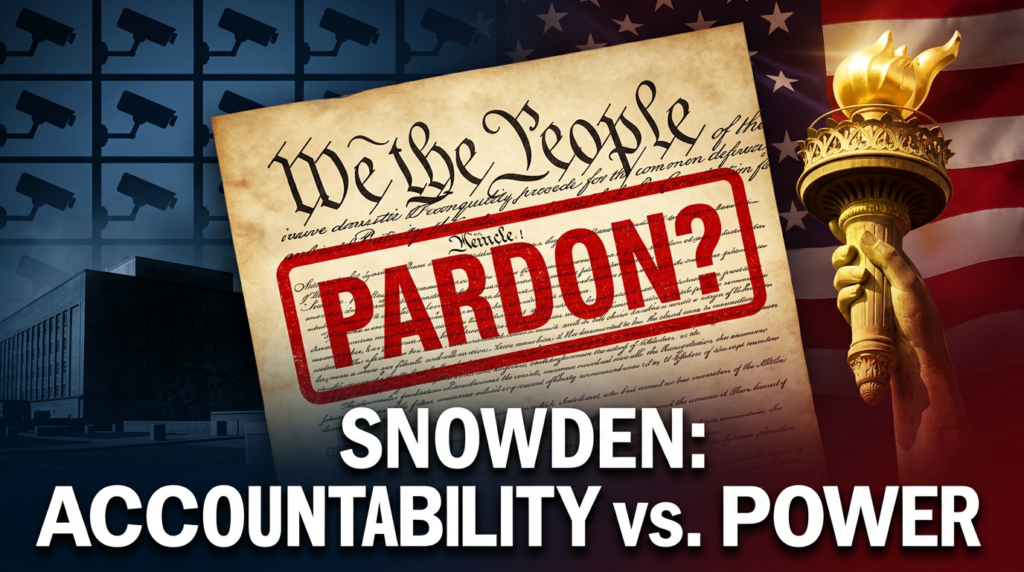
When the Government Breaks the Law, Who Answers for It?
There is a foundational principle in American constitutional governance that transcends partisan politics: no one — not a president, not a federal agency, and certainly not a sprawling intelligence apparatus — is above the law. That principle was tested in June 2013 when a 29-year-old NSA contractor named Edward Snowden disclosed classified documents revealing that the U.S. government had been secretly collecting the phone records of tens of millions of ordinary American citizens — without probable cause, without individualized suspicion, and without meaningful judicial oversight.
It wasn’t conspiracy theory. It was documented fact, later confirmed by a federal court. Today, more than a decade on, Snowden remains in exile in Russia — not because his disclosures were wrong, but because the government he exposed has never been held accountable. For conservatives who believe in the rule of law, limited government, and the sanctity of the Fourth Amendment, pardoning Edward Snowden is not a radical proposition. It is a principled one.
What Snowden Actually Revealed — The Facts Matter
Before making any moral or legal argument, the facts must be established clearly. In 2013, Snowden disclosed to journalists at The Guardian and The Washington Post the existence of several classified NSA surveillance programs, most notably PRISM and a bulk telephone metadata collection program operating under Section 215 of the Patriot Act.
Support Independent Local Journalism
TheTownHall.News is a non-profit reader-supported journalism. Just $5 helps us hire local reporters, investigate important issues, and hold public officials accountable across Alameda County. If you believe our community deserves strong, independent journalism, please consider donating $5 today to support our work.These programs allowed the NSA to collect the phone records of virtually every American — not targeted individuals, not terrorism suspects, but every citizen. In 2020, the U.S. Court of Appeals for the Ninth Circuit ruled definitively that the NSA’s bulk phone records collection program was illegal and may have violated the Fourth Amendment’s protection against unreasonable searches and seizures. The very program Snowden risked everything to expose was ruled unconstitutional by an American court.
The government prosecuted the man who told the truth while the architects of that illegal program faced zero criminal accountability. Former Director of National Intelligence James Clapper testified before Congress in March 2013 that the NSA was “not wittingly” collecting data on millions of Americans. That was a demonstrable lie — one Snowden’s disclosures proved. Clapper was never charged with perjury. This is a straightforward question of institutional accountability, and conservatives — who have long argued that government power must be checked — should be leading this conversation.
A Conservative Case Rooted in the Fourth Amendment
The Fourth Amendment is not a technicality. It is one of the crown jewels of the Bill of Rights, born from colonial fury over British general warrants that allowed agents of the Crown to search homes at will. The Founders wrote that protection into the Constitution because they understood what unchecked government surveillance feels like. When the NSA was secretly collecting the communications records of law-abiding Americans — people suspected of nothing, investigated for nothing — it was committing precisely the abuse the Fourth Amendment was designed to prevent.
Conservatives who rightly rail against government overreach in taxation and regulation should be equally outraged when that overreach targets the private communications of free citizens. Yet the government’s response to Snowden was not reform or apology — it was Espionage Act charges, the same World War I-era law designed to prosecute foreign spies. The officials who built and ran the illegal programs were promoted, not prosecuted. If conservatives believe in equal justice under the law, that disparity demands a response.

The Snowden Question in the Trump Era: Where Things Stand
President Trump has openly discussed pardoning Snowden on multiple occasions. During his first term, he said he would “look into” a pardon. Entering his second term, the discussion intensified — with several of Trump’s advisers and Cabinet nominees, including Tulsi Gabbard, having previously expressed sympathy for Snowden’s cause.
Gabbard, during her Senate confirmation hearings for Director of National Intelligence in January 2025, walked a careful line. She acknowledged that Snowden “broke the law” and stepped back from actively advocating for his pardon in her new official capacity — a politically understandable position for a nominee seeking Senate confirmation. But she also notably refused to call Snowden a “traitor,” instead acknowledging that his disclosures “revealed illegal and unconstitutional government programs.”
That is a crucial distinction. Breaking the law and being a traitor are not the same thing. Snowden did not sell secrets to foreign adversaries. He did not compromise military operations. He disclosed evidence of unconstitutional domestic surveillance to journalists and, through them, to the American public — the very public whose rights were being violated. As of March 2026, no pardon has been issued. But the conversation remains active, and the principled case for one is stronger than ever.
Personal Responsibility, Law, and the Space for Mercy
A thoughtful conservative position on Snowden does not require excusing lawbreaking wholesale. Personal responsibility matters. The rule of law matters. Snowden made a unilateral decision that carries real consequences, and he has acknowledged as much. He did not follow prescribed whistleblower channels — though critics note those channels have repeatedly failed legitimate whistleblowers in the national security space.
But the American tradition of executive clemency has always recognized that the law, applied mechanically without wisdom, can produce injustice. That is why the pardon power exists. Presidents from George Washington to Abraham Lincoln to Ronald Reagan have used clemency not to undermine the rule of law, but to correct outcomes that the rigid application of law could not adequately address.
Support Independent Local Journalism
TheTownHall.News is a non-profit reader-supported journalism. Just $5 helps us hire local reporters, investigate important issues, and hold public officials accountable across Alameda County. If you believe our community deserves strong, independent journalism, please consider donating $5 today to support our work.The question is not whether Snowden broke a law. He did. The question is whether the totality of his actions — exposing a program that a federal court later ruled illegal, igniting a national conversation about surveillance and civil liberties, and prompting genuine congressional reforms including the USA FREEDOM Act of 2015 — constitutes the kind of conduct that mercy, not imprisonment, is the appropriate response to. Context matters — and in Snowden’s case, the context is that a federal court confirmed he was right.
What a Pardon Would Signal — and Why It Matters
Pardoning Edward Snowden would send a clear message: in America, accountability flows in both directions. When the government violates the constitutional rights of its own citizens, the person who exposes that violation should not be treated as the criminal while the actual violators walk free.
It would reaffirm that the Fourth Amendment is not a suggestion. It would demonstrate that genuine conservative governance means defending individual liberty against the state — not just in rhetoric, but in action. Snowden living in Russia is not a victory for American justice. It is a symbol of an accountability system that punished the messenger and rewarded the wrongdoers. A pardon would not excuse lawbreaking broadly — it would signal that a confident, free nation will not allow prosecutorial power to be weaponized against those who speak inconvenient truths.
Conclusion: Principle Over Politics
The debate over Edward Snowden ultimately comes down to a simple question: do we believe in limited government and constitutional rights, or don’t we?
If we do — if those are more than campaign slogans — then the case for a pardon is straightforward. An illegal surveillance program was exposed. A court confirmed it was illegal. The people who built and lied about it faced no consequences. The man who told the truth has lived in exile for over a decade. That is not justice. And conservatives, of all people, should say so loudly.
President Trump has the opportunity to correct a historic wrong, reaffirm the Fourth Amendment, and deliver a genuine act of principled clemency. The moment calls for it. The facts support it. The Constitution demands it.
📢 Call to Action
The fight for constitutional accountability doesn’t happen in secret — it happens when informed citizens demand better. Share this article with friends and family who care about limited government and civil liberties. Stay informed by following credible reporting on government surveillance reform, executive clemency, and intelligence oversight. And contact your elected representatives to let them know you support accountability at every level of government — including at the top. A government that fears its citizens’ informed judgment is a government that has something to hide.