When Seconds Count: The Anthony Anderson Shooting and the Case for Fair, Accountable Policing in Alameda County
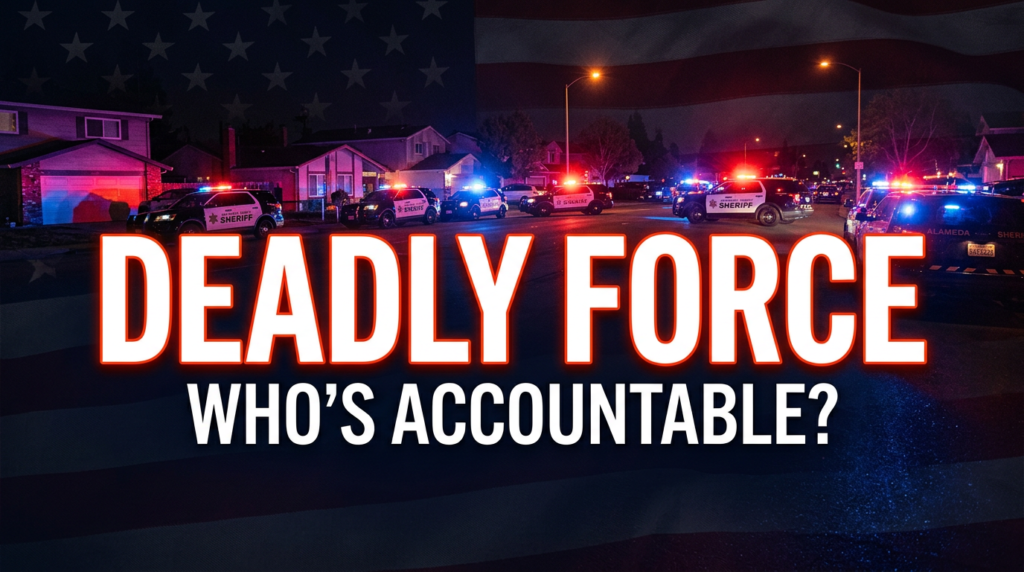
At 3:19 in the morning, a man called 911. He said he wanted to go on a “killing rampage.” He asked to speak with law enforcement. Deputies from the Alameda County Sheriff’s Office responded — as they were trained to, as they were obligated to — and moments later, 40-year-old Anthony Anderson was dead.
What followed has become a familiar ritual in California: a state investigation, community protests, calls for body camera footage, and a media narrative that quickly shifted from the facts of that early morning encounter to broader questions about systemic policing. Some of those questions deserve serious examination. But so does the dangerous habit of rushing to judgment before the facts are fully in — and the real cost of undermining the rule of law in communities that need it most.
This is not a simple story. It deserves a careful telling.
Support Independent Local Journalism
TheTownHall.News is a non-profit reader-supported journalism. Just $5 helps us hire local reporters, investigate important issues, and hold public officials accountable across Alameda County. If you believe our community deserves strong, independent journalism, please consider donating $5 today to support our work.What We Know: The Facts of February 9, 2026
Shortly after 3 a.m. on February 9, Anthony Anderson — a 40-year-old trumpet player well known in Berkeley’s music community — called Alameda County emergency dispatch. He stated he had a firearm, expressed an intent to harm others, and asked to speak with law enforcement.
Deputies responded to Anderson’s residence in the Fairmont Terrace neighborhood on the 16000 block of Selborne Drive, between San Leandro and Hayward. They surrounded the home. Anderson exited and, according to the sheriff’s office, pointed an object at the officers. Two deputies opened fire. Despite immediately rendering aid, Anderson died from his injuries. No deputies were wounded.
The object was not a real gun. The sheriff’s office later confirmed it was “designed to resemble a firearm” — a replica. Because state law classifies Anderson as unarmed under Assembly Bill 1506, the California Department of Justice, under Attorney General Rob Bonta, opened a mandatory investigation into the shooting. The two deputies were placed on paid administrative leave, consistent with department policy.
The Law the State Is Using — and Why It Matters
AB 1506, signed in 2020, requires the California DOJ to independently investigate every officer-involved shooting resulting in the death of an unarmed civilian. The intent — transparency and accountability — is entirely consistent with conservative principles. Government should not police itself. Independent oversight of state power is not a radical idea; it is a foundational one.

But the law raises a critical definitional question: was Anderson truly “unarmed”? Legally under AB 1506, yes. In the split-second reality faced by those deputies in pitch-dark at 3 a.m., the answer is far less clear. He was holding an object indistinguishable from a real firearm, had just called 911 threatening to kill people, and then pointed that object at the officers who answered. These are not details we can minimize in the rush to assign blame.
Accountability Cuts Both Ways
There are two kinds of accountability the public deserves in cases like this, and both must be taken seriously.
The first is accountability for law enforcement. The 12-hour delay by the sheriff’s office in publicly acknowledging the shooting was a mistake — one that eroded public trust and fueled suspicion. When government agents use lethal force, the public has a right to timely, complete information. Anderson’s mother, Kristina, deserved answers faster. Transparency is not an obstacle to good policing; it is what earns policing its legitimacy.
The release of body camera footage, the 911 call, and a full accounting of the replica object are all reasonable public expectations. If the deputies acted within lawful bounds — and the preliminary facts suggest they may have — that footage should vindicate them. Withholding it only deepens doubt.
The second form of accountability is the question of personal responsibility. Anderson made a series of decisions that morning. He picked up an object designed to look like a real gun. He called 911 and announced an intent to harm people. He then pointed that object at armed officers who had no way of knowing in the dark whether it was real. These facts do not strip Anderson of his humanity — his family’s grief is real, and by all accounts he was a gifted, beloved musician whose life mattered. But an honest accounting cannot omit them.
Support Independent Local Journalism
TheTownHall.News is a non-profit reader-supported journalism. Just $5 helps us hire local reporters, investigate important issues, and hold public officials accountable across Alameda County. If you believe our community deserves strong, independent journalism, please consider donating $5 today to support our work.The Mental Health Question: Real, But Not a Blank Check
Anderson’s mother has said her son struggled with depression. Advocates have argued that sending armed deputies to a mental health crisis is itself the problem — that trained crisis responders should have been dispatched instead.
There is genuine merit in community-based crisis response models, and conservatives who believe in limited, effective government should support developing them. Programs that deploy mental health professionals in appropriate non-violent situations reduce costly and tragic outcomes for everyone.
But this case has clear limits. Anderson did not call a crisis line. He called 911, threatened a killing rampage, produced an object that looked exactly like a firearm, and pointed it at the officers who responded. Reforming crisis response is a worthy policy goal. Pretending that reform would have changed the outcome of this specific incident is not honest.
What the Community — and Taxpayers — Should Demand
Full transparency. The sheriff’s office must release all available evidence without delay. Every day of silence is a day of eroded public trust.
A fair investigation. The DOJ investigation should proceed without political interference. If the deputies acted lawfully, they deserve to be cleared completely. If they did not, accountability must follow — because law and order depends on the integrity of those who uphold it.
Honest policy debate. This conversation should happen in city halls and boardrooms — not in the court of social media opinion before investigations conclude. Knee-jerk policy changes made in public outrage rarely produce good results and often make communities less safe.
Fiscal responsibility. Settlements in officer-involved shooting cases cost taxpayers millions. Alameda County — already navigating a strained budget — cannot afford reckless policing or reckless dismantling of law enforcement. Both cost money. Both cost lives.
Conclusion: Truth Before Verdict
The death of Anthony Anderson is a tragedy. A family has lost a son. A music community has lost a gifted artist. And two deputies will carry the weight of that morning for the rest of their lives.
But tragedy does not automatically mean wrongdoing. The rush to frame every officer-involved shooting as proof of systemic failure — before investigations conclude, before evidence is fully examined, before due process runs its course — is itself a threat to the rule of law. The principles that make a free society work — accountability, transparency, due process, personal responsibility — apply to everyone in this story.
Demand the facts. Hold government accountable. Support fair investigation. And resist the temptation to render a verdict before the evidence is in.
Call to Action
This story is still developing. Stay informed by following the California DOJ investigation as it unfolds. Share this article with neighbors, community members, and local officials who need the full picture. And if you believe in transparent, accountable government and the rule of law, show up — to city council meetings, county board sessions, and the ballot box. The policies that shape how law enforcement responds to crisis calls are made by elected officials. Make sure yours are hearing from you.