Keeping the Lights On: Why Trump’s National Electricity Emergency Is the Right Call for America
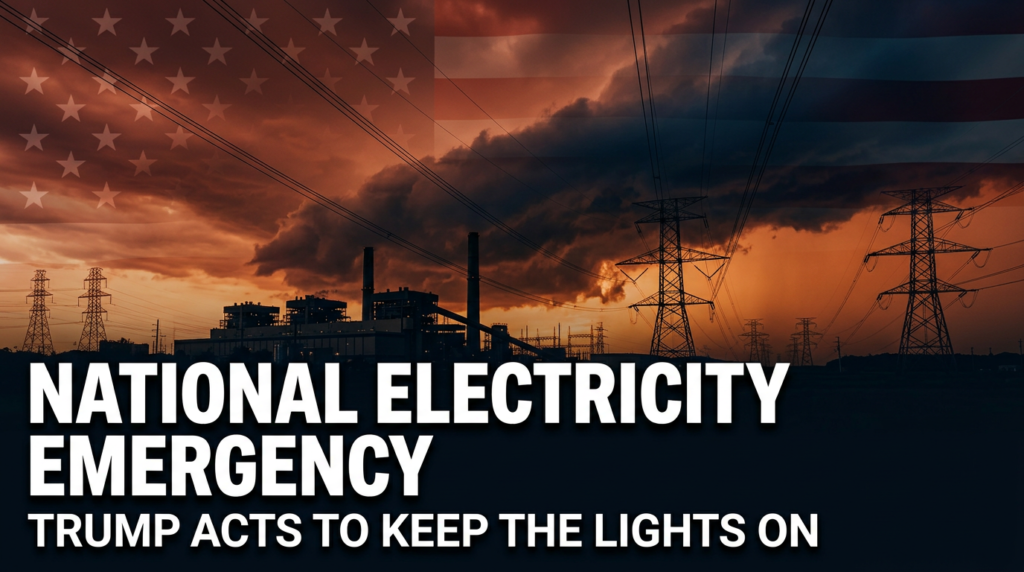
When the Lights Go Out, Government Must Answer
Imagine coming home on a winter evening, flipping the switch — and nothing happens. Not because you failed to pay your bill, but because a decade of ideologically driven energy policy stripped your region’s grid of the reliable power plants that once kept it humming. That scenario is no longer hypothetical. It is the warning embedded in President Donald Trump’s declaration of a National Energy Emergency — and the data backs him up.
On January 20, 2025, his first day back in the Oval Office, President Trump signed an executive order declaring a National Energy Emergency, citing what his administration described as the systematic dismantling of America’s reliable energy infrastructure under the previous administration. Since then, a series of bold follow-up actions — including a push for emergency power auctions and a landmark Ratepayer Protection Pledge signed in March 2026 — have made one thing crystal clear: this president intends to keep the lights on, keep costs down, and put American families first. That is not just good politics. It is responsible governance.
The Problem: A Grid Pushed to the Brink
Facts matter in policy debates, and the facts here are alarming. The PJM Interconnection — the grid operator managing electricity for roughly 65 million people across the Mid-Atlantic and parts of the Midwest — saw nearly 17 gigawatts of reliable baseload power generation forced offline during the Biden years. To put that in perspective, one gigawatt powers approximately 700,000 average American homes. And for the first time in history, PJM’s capacity auction failed to secure enough generation resources to meet basic reliability requirements.
Support Independent Local Journalism
TheTownHall.News is a non-profit reader-supported journalism. Just $5 helps us hire local reporters, investigate important issues, and hold public officials accountable across Alameda County. If you believe our community deserves strong, independent journalism, please consider donating $5 today to support our work.This is not a hypothetical risk. This is a grid being hollowed out in real time, driven not by engineering necessity or consumer demand, but by a regulatory agenda that prioritized ideological commitments over practical outcomes. Coal and natural gas plants — the backbone of reliable, around-the-clock power generation — were shuttered prematurely, without adequate replacement capacity standing by.
Energy Secretary Chris Wright said it plainly: “High electricity prices are a choice.” That choice, made by the previous administration, is now being paid for by working families who open their utility bills each month and wonder why costs keep climbing. Personal responsibility is a cornerstone conservative value — but Americans cannot be held responsible for a crisis engineered by government overreach in the first place.
Trump’s Response: Decisive Action, Market-Driven Solutions
What separates the Trump administration’s energy approach from its predecessor’s is not just the policy direction — it is the underlying philosophy. Rather than mandating outcomes from Washington, the administration has consistently sought to unleash market forces, restore reliable supply, and protect ratepayers without sticking taxpayers with the bill.
The National Energy Emergency declaration gave the federal government tools to cut through bureaucratic red tape and expedite critical infrastructure projects. Regulatory streamlining is not recklessness — it is recognizing that government permitting timelines measured in years are incompatible with grid emergencies measured in months.

The Emergency Power Auction, announced in January 2026 by Secretaries Wright and Burgum, called on PJM to temporarily overhaul its market rules to enable more than $15 billion in new, reliable baseload power generation. The plan included 15-year revenue certainty for new power plants, protections for residential ratepayers, and — critically — a requirement that data centers pay their fair share for the new generation they demand. No blank checks from taxpayers. No mandates on consumers. Costs allocated to those who create them. That is fiscal accountability in action.
The Ratepayer Protection Pledge: Big Tech Pays, Families Are Protected
Perhaps the most striking development came on March 5, 2026, when the White House hosted America’s leading AI and technology companies — Amazon, Google, Meta, Microsoft, OpenAI, Oracle, xAI, and others — who signed the Ratepayer Protection Pledge, first announced by President Trump in his State of the Union address.
The commitment is straightforward and philosophically sound: AI data centers will fully cover the cost of the new power generation they require. They will not pass those costs to American households. President Trump stated it directly: “Big Tech companies are committing to fully cover the cost of increased electricity production required for AI data centers — and that would mean prices for American communities will not go up, but in many cases, will actually come down.”
This is what limited government looks like when it works. Instead of imposing taxes or price controls, the administration created the conditions for a voluntary, market-based agreement. The Taxpayers Protection Alliance praised it as “a sensible approach” and a “market-driven solution.” When government convenes industry rather than commandeering it, good things happen.
Energy Security Is National Security
Beyond household bills, there is a larger strategic reality that conservatives understand intuitively: energy independence is national security. Trump’s emergency declaration also served as a direct response to attempts by foreign actors — including Ontario, Canada’s brief imposition of a 25% surcharge on U.S.-bound electricity in March 2025 — to use energy as economic leverage against American states.
Support Independent Local Journalism
TheTownHall.News is a non-profit reader-supported journalism. Just $5 helps us hire local reporters, investigate important issues, and hold public officials accountable across Alameda County. If you believe our community deserves strong, independent journalism, please consider donating $5 today to support our work.When Ontario threatened to squeeze New York, Michigan, and Minnesota, Trump threatened a localized electricity emergency and escalated tariff pressure. Ontario backed down. That is what happens when America projects strength rather than dependence. A nation that cannot guarantee its own electricity supply is a nation that can be held hostage — by foreign governments, by hostile regimes, or by the next ideologically driven administration willing to sacrifice reliability on the altar of green politics.
Law and order applies not just to streets, but to markets and supply chains. Reliable, affordable energy is foundational to economic order — to factories running, hospitals operating, schools staying open, and families staying warm. Defending that order is a legitimate and necessary exercise of executive authority.
What’s at Stake for American Families and the Economy
The stakes extend well beyond today’s electricity bills. America is entering an era of explosive electricity demand — driven by AI data centers, domestic manufacturing reshoring, and the electrification of industry. The nation that builds the grid to meet that demand will dominate the next century of economic growth. The nation that fumbles it will fall behind.
Interior Secretary Doug Burgum put it vividly: “This initiative will ensure we usher in the age of artificial intelligence with new power plants funded by the technology companies, not taxpayers, securing the steel of Pennsylvania, the manufacturing of Ohio, and the ships of Virginia.”
Traditional values include stewardship — of resources, of institutions, and of the inheritance we leave our children. Letting a functioning grid degrade through neglect and ideology is not stewardship. Restoring it through decisive, accountable, market-respecting action is.
Conclusion: Leadership When It Counts
History will not remember the politicians who talked about energy policy. It will remember the ones who kept the lights on.
Trump’s National Energy Emergency was not a stunt. It was a diagnosis — a clear-eyed recognition that the previous administration’s energy agenda had left America exposed — followed by a prescription grounded in conservative principles: less red tape, more reliable supply, costs borne by those who create them, and American families protected.
The Ratepayer Protection Pledge, the emergency power auction push, and the continuation of the National Energy Emergency through 2026 form a coherent, principled energy strategy. It respects the market. It demands accountability from industry. It protects ordinary Americans. And it refuses to let foreign governments hold American states hostage over electricity. That is not extremism. That is governance. And it is exactly what the moment requires.
📣 Call to Action
Don’t let the mainstream media bury this story. America’s energy future is being decided right now — and most people aren’t paying attention. Share this article with your network, subscribe to stay informed on critical policy developments, and contact your representatives to demand they support reliable, affordable energy policy. The grid that powers your home, your business, and your community is not guaranteed. Staying informed — and engaged — is how we protect it.
Sources: White House (whitehouse.gov) · U.S. Department of Energy (energy.gov) · Federal Register · Taxpayers Protection Alliance