Jamie Borne and the Roblox Scandal: When Big Tech Hides Behind Your Children
A Playground With Predators: The Roblox Crisis No One in Silicon Valley Wants to Discuss
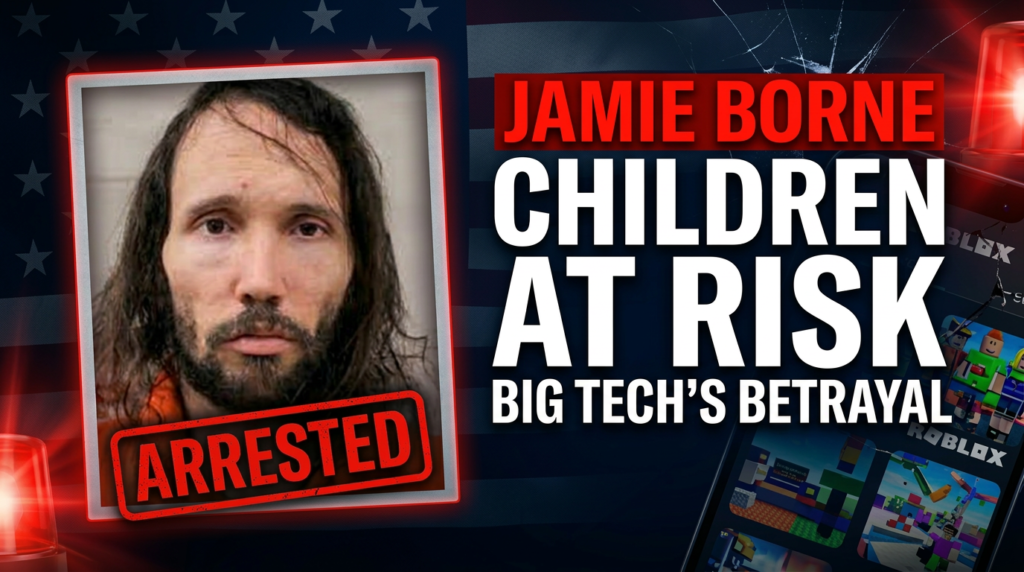
When New Orleans probation officers walked into the apartment of 30-year-old Jamie Borne on February 26, 2026, they weren’t expecting what they found. A child-sized sex doll sat on the sofa in his bedroom. When asked about it, Borne reportedly said he was “very lonely.” What investigators uncovered next was far more alarming: multiple hard drives, laptops, and phones allegedly containing 40 counts’ worth of child pornography — and a job title that sent shockwaves through the country. Borne was, according to authorities, a programmer for Roblox.
Borne was arrested and booked into the Orleans Justice Center on 40 counts of pornography involving juveniles under the age of 13 and one count of possessing, trafficking, or importing a child sex doll. The investigation was a joint effort by Homeland Security Investigations, Louisiana State Police, and the office of Louisiana Attorney General Liz Murrill.
This is not just a crime story. It is a wake-up call — one that should compel every parent, lawmaker, and citizen who believes in protecting children, upholding the rule of law, and holding powerful institutions accountable to demand answers and action.
Support Independent Local Journalism
TheTownHall.News is a non-profit reader-supported journalism. Just $5 helps us hire local reporters, investigate important issues, and hold public officials accountable across Alameda County. If you believe our community deserves strong, independent journalism, please consider donating $5 today to support our work.All persons are presumed innocent until proven guilty in a court of law.
Big Tech’s Culture of Unaccountability
Roblox is not a fringe platform. It is one of the most popular online environments in the world, with an estimated 380 million registered accounts. According to Louisiana Attorney General Liz Murrill, 60 percent of Roblox’s users are under 16 years old, and 40 percent are under 12. It is, in every meaningful sense, a children’s platform — one that has been aggressively marketed to parents as a safe, creative space for kids.
But the facts tell a different story.
In March 2026, AG Murrill filed a lawsuit against Roblox in Livingston Parish, alleging the company has failed to implement basic child safety protections while continuing to profit off its young user base. “They have created a public park and filled it with sex predators that are preying on your children,” Murrill said bluntly. She identified Roblox — alongside Discord and Snapchat — as among the platforms most frequently connected to child predation cases in Louisiana. “Every week we are arresting sex predators who are finding children on that platform and then engaging in conversations with them, grooming them, sexually exploiting them, and hurting them.”

The Georgia Attorney General launched a separate investigation into Roblox in February 2026 for reports of child exploitation. Los Angeles County filed suit the same month. Multiple states and dozens of private lawsuits have raised the same core allegation: Roblox knew, or should have known, that its platform was being weaponized against minors — and did not do enough to stop it.
Roblox, for its part, has retreated behind Section 230 of the Communications Decency Act, the federal shield that protects tech companies from liability for user-generated content. Murrill called this defense “disingenuous,” “not legally applicable,” and “morally reprehensible.” Her office argues the lawsuit is not about content posted by users — it is about Roblox’s own failures to build and enforce meaningful protections for children in the first place. That is a critical legal and moral distinction.
Parental Rights Begin With Honest Information
At the heart of this crisis is a betrayal of trust. Parents are not infallible. They cannot monitor every interaction their child has online — especially when a platform actively markets itself as safe and age-appropriate. When a company tells you that your child’s digital playground is protected and then profits from a design that leaves that child exposed to predators, it has not just failed on a corporate level. It has undermined the very foundation of parental rights and responsibility.
Parental rights mean nothing if the information parents are given is false. A parent who restricts screen time, reviews their child’s apps, and trusts a platform’s stated safety standards is not being negligent — they are being deceived. Roblox has reportedly collected billions of dollars in revenue while telling families the product is safe. That is not a free-market success story. That is a broken covenant with the families who made that success possible.
Conservatives have long championed the idea that parents — not government, not corporations — are the first and best protectors of children. That principle demands that corporations be honest, and that when they are not, they face accountability. True support for parental rights means more than opposing government overreach in schools. It means ensuring that the private entities parents must rely on are held to the same standards of transparency and responsibility.
Support Independent Local Journalism
TheTownHall.News is a non-profit reader-supported journalism. Just $5 helps us hire local reporters, investigate important issues, and hold public officials accountable across Alameda County. If you believe our community deserves strong, independent journalism, please consider donating $5 today to support our work.Law, Order, and the Limits of Corporate Immunity
The arrest of Jamie Borne illustrates a troubling pattern. This was not a random incident that no one could have anticipated. Borne was already on probation and subject to compliance checks. And yet, according to investigators, he allegedly held a library of child exploitation material on multiple devices — while employed at a company whose primary user base is children.
This raises serious questions that go beyond one individual’s criminal conduct. What vetting does Roblox do of its employees? What internal safeguards exist? What does it say about corporate culture when a programmer allegedly collecting child pornography at scale was employed to build a product for kids?
Conservatives believe in law and order — and that means law applied equally, without favoritism toward the powerful. Big Tech has enjoyed years of regulatory light-touch treatment, sheltered by Section 230 and celebrated by politicians of both parties. That deference has come at a cost. When corporations use their size and legal resources to escape accountability for harms that fall disproportionately on the most vulnerable — our children — something has gone profoundly wrong.
Fiscal Accountability and the Price of Silence
Roblox generated over $1 billion in revenue in 2023 alone, much of it through its virtual currency “Robux,” sold heavily to children and their parents. The company has the resources to build world-class safety systems. The question is whether it has had sufficient incentive to do so.
For years, the answer has been no. Section 230 immunity, a permissive regulatory environment, and a culture of innovation-first-ask-questions-later have allowed platforms like Roblox to externalize the cost of harm. The families of abused children bear that cost. Taxpayers fund the law enforcement investigations. States spend public resources pursuing legal action that companies use armies of lawyers to deflect.
This is not fiscal responsibility. This is the privatization of profit and the socialization of harm. If Roblox is to be trusted with the children of America, it must spend what is necessary to protect them — or face the full weight of legal consequences. No company should profit from children’s attention while outsourcing the danger to families and law enforcement.
A Call for Accountability, Not Big Government
To be clear: the answer here is not a sweeping federal bureaucracy regulating every corner of the internet. Overreach from Washington rarely solves the problems it targets and often creates new ones. But accountability is not overreach. Enforcing laws against child exploitation is not overreach. Holding companies to the standards they publicly claim to meet is not overreach. It is justice.
Louisiana AG Liz Murrill is doing exactly what a state-level law enforcement official should do — investigating, litigating, and shining a light on dangerous practices. Georgia’s AG is doing the same. These are conservative principles in action: states taking initiative, law enforcement doing its job, and powerful institutions being held to account.
The values of personal responsibility, law and order, and protection of the family are not in conflict here. They converge. Roblox must be held responsible for the environment it created and profited from. Parents deserve accurate information. Children deserve protection. And law enforcement deserves the tools and legal clarity to pursue these cases without corporate legal armies standing in the way.
Conclusion: The Children Can’t Wait
The arrest of a Roblox programmer in New Orleans is one case. But it sits within a pattern — one documented by law enforcement in Louisiana, Georgia, California, and beyond. Children are being groomed, exploited, and harmed through a platform that markets itself as safe while resisting accountability at every turn.
This is not a partisan issue. The protection of children is a foundational value that transcends politics. But it takes courage to hold powerful corporations accountable, to push back against the reflexive defense of Big Tech, and to stand firmly on the side of families over profits.
The children playing on these platforms today cannot wait for Silicon Valley to find it convenient to protect them. Parents deserve the truth. Law enforcement deserves support. And every American who believes in justice, responsibility, and the sanctity of childhood should be paying attention.
📣 Take Action
Stay informed. Follow your state attorney general’s office for updates on lawsuits and investigations involving child safety on digital platforms.
Get involved. Contact your state and federal representatives and urge them to support legislation that closes Section 230 loopholes exploited by platforms that knowingly expose children to harm.
Protect your family. Review the apps and platforms your children use. The National Center for Missing & Exploited Children (NCMEC) offers free resources at missingkids.org.
Share this article. The more people who understand what is happening on platforms like Roblox, the more pressure will build for the accountability these companies have so far avoided.
The most powerful thing a citizen can do is stay informed and demand better — for every child who deserves to be safe.