Lights Out in Tehran: What the US and Israel Strikes on Iran Power Grid Tell Us About Strength, Strategy, and Survival
When the Lights Go Out in Tehran
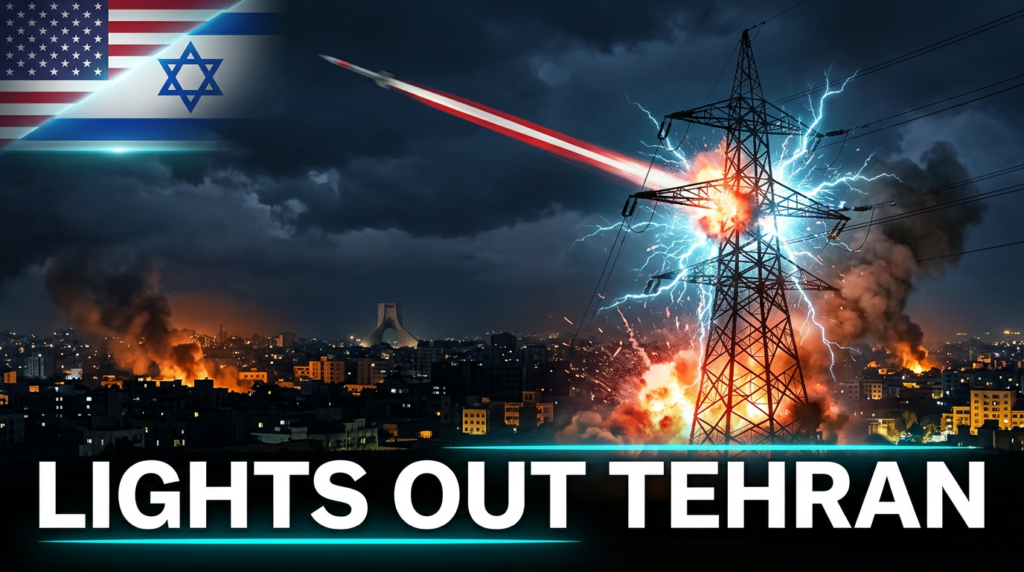
Early on the morning of March 23, 2026, residents of Tehran woke to the sound of explosions. Thick plumes of black smoke rose over the eastern skyline. Reports poured in of “terrible sounds” across five city districts. Iran’s electrical grid — a critical pillar of the regime’s command-and-control infrastructure — had been struck. Blackouts swept the capital. And for the first time in decades, the world was watching a direct military confrontation between the United States, Israel, and one of the most destabilizing regimes on earth.
For those who believe that American strength deters chaos, that leadership requires resolve, and that decades of diplomatic half-measures have only emboldened bad actors — this moment has been a long time coming.
This is not warmongering. This is accountability.
Support Independent Local Journalism
TheTownHall.News is a non-profit reader-supported journalism. Just $5 helps us hire local reporters, investigate important issues, and hold public officials accountable across Alameda County. If you believe our community deserves strong, independent journalism, please consider donating $5 today to support our work.What Led Here: A Regime Given Too Many Chances
To understand where we are today, you must understand where we have been. The 2026 Iran war — launched on February 28 — did not erupt from a vacuum. It is the culmination of decades of Iranian aggression, nuclear brinkmanship, and the systematic export of terror across the Middle East. Iran has funded Hezbollah, armed Hamas, destabilized Iraq and Yemen, and provided Russia with lethal drones used to kill Ukrainian civilians. Its Revolutionary Guard has orchestrated assassination plots on American soil. Its proxies have killed U.S. soldiers.
And through it all, Western governments responded largely with negotiations, waivers, and agreements that Iran consistently violated or abandoned.
In January 2026, Iranian security forces massacred thousands of their own citizens during the largest protests since the Islamic Revolution — men and women who took to the streets demanding freedom. President Trump issued stark warnings. Iran doubled down. Then, in a jaw-dropping turn just one day after Oman’s Foreign Minister announced a “breakthrough” nuclear deal on February 27 — an agreement in which Iran reportedly agreed to never stockpile enriched uranium and allow full IAEA verification — the U.S. and Israel launched Operation Epic Fury: a coordinated surprise strike that eliminated Supreme Leader Ali Khamenei and dismantled key military infrastructure across Iran.
The timing was deliberate. The objective was clear: end the nuclear threat, degrade the regime’s military capacity, and hold accountable a government that had spent 40 years proving it could not be trusted.

The Strait of Hormuz: Why This Matters to Every American at the Gas Pump
Critics of military action often ask: “What does this have to do with us?” The answer is straightforward — it runs through the Strait of Hormuz.
Roughly 20% of the world’s oil supply passes through this narrow waterway daily. Iran’s effective closure of the strait — enforced through harassment of commercial shipping — has already sent energy prices soaring globally. The International Energy Agency has confirmed that at least 40 energy assets have been “severely damaged” since the war began. Oil markets are rattled. Inflation risk is rising. Economies from Europe to Asia are bracing for energy shortfalls.
This is precisely the kind of leverage that rogue regimes exploit when democracies hesitate. Iran did not close the strait because it is strong. It closed it because it believed — based on years of Western diffidence — that there would be no serious consequences.
President Trump’s ultimatum, issued Saturday, gave Tehran 48 hours to fully reopen the strait. Iran refused. The US and Israel’s strikes on Iran’s power grid followed. That is not escalation for its own sake — that is cause and consequence. It is what fiscal and strategic accountability looks like on the world stage: a nation that says what it means and means what it says.
Sovereignty, Strength, and the Conservative Case for This Action
Conservatives have long argued that the first duty of government is the protection of its citizens and the defense of national interests. This principle does not waver simply because the battlefield is far from home.
Support Independent Local Journalism
TheTownHall.News is a non-profit reader-supported journalism. Just $5 helps us hire local reporters, investigate important issues, and hold public officials accountable across Alameda County. If you believe our community deserves strong, independent journalism, please consider donating $5 today to support our work.A nuclear-armed Iran — a regime that openly calls for the destruction of Israel and has declared America its eternal enemy — is not an abstract threat. It is an existential one. The previous administration spent years offering Iran carrots while Iran developed centrifuges. The result was a regime assessed to be months away from a deliverable nuclear weapon when the current conflict began.
Limited government does not mean passive government. Fiscal responsibility does not mean ignoring the long-term cost of inaction. Consider: a nuclear strike anywhere in the Middle East, or a prolonged closure of the world’s most vital oil corridor, would cost the U.S. economy trillions of dollars, send gas prices to historic highs, and trigger a global recession that every working American family would feel. The cost of strength now is far lower than the cost of weakness later.
Moreover, this action reflects a commitment to law and order on an international scale. Iran’s attacks on civilian infrastructure, hospitals, shipping routes, and American military bases are not geopolitical chess moves — they are crimes. Allowing them to continue without consequence does not preserve peace. It invites more lawlessness.
The Human Stakes: Iran’s Own People Deserve Better
It would be a mistake to frame this solely as a conflict between governments. The Iranian people are not America’s enemy. They proved that in January 2026, when they poured into the streets at enormous personal risk to demand the fall of the theocratic regime that has oppressed them for nearly half a century.
Women have been jailed, flogged, and killed for refusing to wear the hijab. Religious minorities face systematic persecution. Free speech is a criminal offense. Parental rights are overridden by a state that indoctrinates children in revolutionary ideology. Every value that American conservatives hold dear — individual liberty, family, faith, and the rule of law — is precisely what the Iranian regime has spent decades crushing.
When the United States acts to defang this regime, it acts not only in its own national interest but as a voice for the millions of Iranians who cannot speak freely. That is not imperialism. That is moral clarity.
What Comes Next: Vigilance Without Complacency
The path ahead is not simple. Iran’s threats to mine the Persian Gulf, target the UAE’s Barakah nuclear power plant, and strike power infrastructure across the Gulf region are not empty bluster — they must be taken seriously and countered with allied resolve.
China has called for a ceasefire, which is expected from a nation that profits from Iranian oil. Russia is watching closely. But America’s allies in the Gulf, Israel, and across Europe understand what is at stake. This is a moment for coalitions of the willing, not United Nations hand-wringing.
At home, the debate is already politically charged. Some in Congress are questioning the authorization for these strikes. That debate is legitimate — civilian oversight of military action is a conservative value too. But questioning the process should not shade into undermining the mission. The men and women in uniform executing these operations deserve clarity of purpose and unified national support.
Energy independence — long a conservative priority — has never been more urgently validated. Every dollar invested in American oil, gas, and nuclear energy production is a dollar that reduces our exposure to Middle Eastern instability. This crisis is a stark reminder that energy self-sufficiency is not just an economic argument — it is a national security imperative.
Conclusion: Strength Is Not a Choice — It Is a Responsibility
The lights going out in Tehran may seem, to some, like a distant event in a complicated war. But it is, in truth, a test of the oldest and most enduring question in statecraft: when a rogue regime defies the world, commits atrocities against its own people, and holds critical global infrastructure hostage — what do free nations do?
History has answered this question before. Appeasement does not produce peace. It produces Munich, 1938. It produces emboldened adversaries, bolder demands, and eventually a far more costly reckoning.
America has chosen, once again, to stand for something. To protect its citizens, its allies, and the international order that makes global commerce and human freedom possible. That is not a conservative talking point. That is the record of history.
The question now is whether we have the resolve to see it through — or whether we will flinch at the decisive moment, as we have too many times before.
✊ Call to Action
Stay informed. Stay engaged. The decisions being made right now will shape the world your children inherit.
Share this article with someone who needs to understand what is truly at stake in Iran. Subscribe to our newsletter for daily fact-based analysis. Contact your representatives — demand that they support a coherent, strong, and principled American foreign policy that puts security and freedom first.
Because freedom isn’t free — and silence is not neutrality.
Sources: Wikipedia – 2026 Iran War; Al Jazeera Live Blog, March 23, 2026; Hindustan Times Live Updates, March 23, 2026; Reuters; International Energy Agency (IEA); U.S. CENTCOM official statements; NetBlocks.