Primorsk Oil Terminal Attack: Ukraine’s Boldest Economic Strike Yet — and Why the West Must Pay Attention
The Fire You Haven’t Heard Enough About
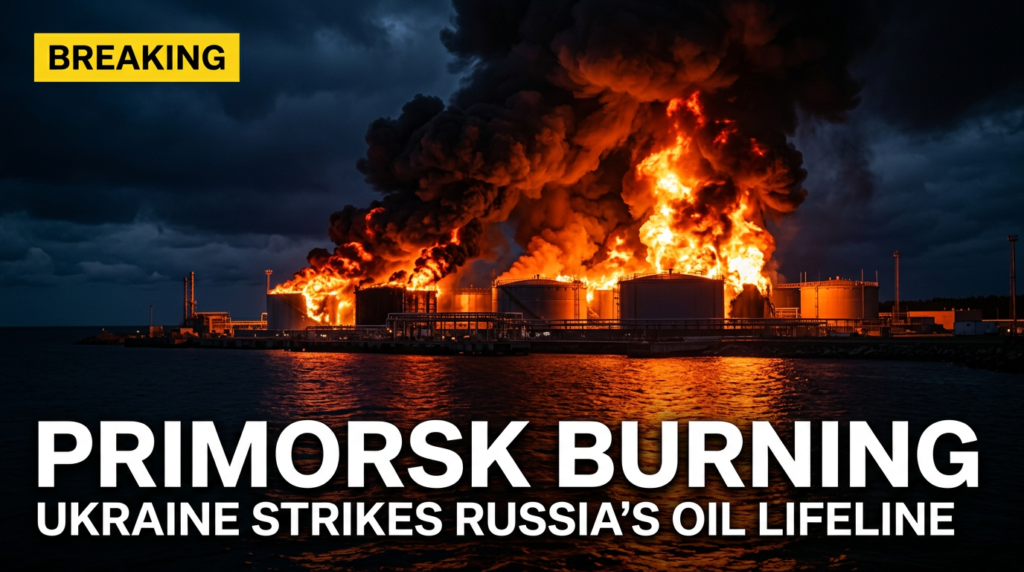
On the morning of March 23, 2026, 249 Ukrainian drones descended on Primorsk — Russia’s largest crude oil export terminal, sitting on the Baltic Sea roughly 60 miles from St. Petersburg. At least four massive fuel reservoirs were engulfed in flames. Oil loading ground to a halt. For a brief, jarring window, both Primorsk and its neighboring port of Ust-Luga — together responsible for a substantial share of Russia’s western crude exports — were simultaneously offline.
Ukraine’s Chief of General Staff confirmed the strike. The same night, Ukrainian forces also struck a major refinery in Ufa — over 1,400 kilometers inside Russian territory — and oil infrastructure at Taman port in the Krasnodar region. This was not a battlefield skirmish. This was a coordinated economic assault on the engine powering Vladimir Putin’s war machine.
The world woke up to burning oil tanks. But how many people understand what was truly set alight? This isn’t just a story about a port. It’s a story about money, accountability, and the hard choices a war-weary world must now confront honestly.
Support Independent Local Journalism
TheTownHall.News is a non-profit reader-supported journalism. Just $5 helps us hire local reporters, investigate important issues, and hold public officials accountable across Alameda County. If you believe our community deserves strong, independent journalism, please consider donating $5 today to support our work.Follow the Money: Oil Is Putin’s War Budget
Let’s be direct about what Primorsk represents. Russia earns approximately €492 million per day from fossil fuel exports, according to February 2026 data from the Centre for Research on Energy and Clean Air. Crude oil is the cornerstone of that revenue — and Primorsk, as the endpoint of Russia’s Baltic Pipeline System, is one of its primary arteries. The terminal has a nominal export capacity exceeding one million barrels per day and processed 46.6 million tonnes of oil in 2025 alone.
Strip away the diplomatic language, and the math is stark: Moscow funds its missiles, its drones, and its soldiers largely with petrodollars. Every barrel that flows through Primorsk helps pay for the next Russian strike on a Ukrainian city. Ukraine is not merely targeting infrastructure — it is targeting Russia’s payroll.
This is economic warfare in its most direct form. And it is a strategy that, frankly, deserves more credit than it typically receives in Western media coverage fixated on territorial maps and ceasefire diplomacy.
A Dual Crisis With No Modern Precedent
Here is where the story demands broader attention from every citizen who cares about fiscal responsibility and energy security.

The Primorsk attack did not occur in isolation. It coincided with the ongoing U.S.-Iran conflict and the effective closure of the Strait of Hormuz — the chokepoint through which roughly 20 percent of global daily oil consumption flows. Middle Eastern crude had already surged to near-record levels, with Dubai crude trading around $166 per barrel before the strike. Oil markets were already stretched to breaking point.
The International Energy Agency’s March 2026 report described the combined supply disruption as the most severe in decades. The European Central Bank had already warned that oil prices above $100 per barrel risk triggering stagflation — the toxic combination of rising prices and stagnant growth that devastated Western economies in the 1970s. Analysts draw comparisons to the 1973 oil embargo and the 1979 Iranian Revolution — but those were single-source shocks. What we face today is a dual shock with no clear resolution timeline on either front.
For American families already stretched by years of inflationary pressure, for European households already burdened by energy costs, and for governments already running unsustainable deficits — this is not an abstraction. This hits at the pump, on the heating bill, and ultimately in the tax burden every working citizen carries.
The Shadow Fleet and the Accountability Gap
There is another dimension to Primorsk that conservatives should find particularly troubling: the shadow fleet.
Primorsk is not merely a commercial hub — it is a primary logistical base for Russia’s network of sanctions-evading tankers. These are vessels operating under false flags, concealing ownership, and moving Russian crude to buyers in Asia in deliberate defiance of the Western sanctions regime that democratic governments have staked significant credibility on enforcing.
Support Independent Local Journalism
TheTownHall.News is a non-profit reader-supported journalism. Just $5 helps us hire local reporters, investigate important issues, and hold public officials accountable across Alameda County. If you believe our community deserves strong, independent journalism, please consider donating $5 today to support our work.Sanctions only work if they are enforced with integrity. A government that imposes restrictions on Russian energy and then watches billions in revenue flow through back channels has failed its own citizens — and rewarded bad behavior with impunity. The shadow fleet is not just a geopolitical problem. It is a fiscal accountability problem. Taxpayers in sanctioning nations are effectively subsidizing a system that undermines the very restrictions their elected representatives put in place.
Ukraine’s strike on Primorsk disrupted that shadow fleet’s hub. Whatever one’s views on the broader conflict, that is a result worth acknowledging clearly.
Washington’s Difficult Balancing Act
The geopolitical complications do not end there. In a move that raised eyebrows across Europe, the Trump administration had quietly lifted sanctions on Russian stranded oil loaded before March 12 — a concession designed to ease global supply pressures created by the Hormuz crisis. European Commission President Ursula von der Leyen publicly pushed back on the timing.
Then came the Primorsk strike, reshuffling the deck entirely.
Washington now faces a genuinely difficult choice. It can maintain the partial sanctions waiver as an energy-market stabilizer, knowing it directs revenue toward Moscow’s war chest. Or it can close that loophole and accept higher energy prices in the short term as the cost of principled fiscal accountability.
This is not a comfortable choice. But it is exactly the kind of choice that conservative governance — grounded in the principle that short-term convenience must not override long-term integrity — is best equipped to make. Fiscal discipline means accepting hard trade-offs. Accountability means not writing checks with one hand while the other hand waves in exemptions.
Energy Independence Is Not Optional — It Is National Security
The deeper lesson of Primorsk, and of the broader energy crisis now gripping global markets, is one that responsible leaders have been repeating for decades without sufficient action: energy dependence is a strategic vulnerability.
Every nation that relies on unstable, adversarial, or sanction-compromised supply chains for its energy needs is not merely paying a premium — it is ceding leverage at precisely the moments when leverage matters most. The solution is not complicated, even if it is politically inconvenient. It requires domestic energy production, investment in diversified supply, and a realistic long-term transition that does not sacrifice energy security on the altar of ideological targets.
For the United States specifically, the lesson is reinforced once again: America’s capacity to produce and export energy is not a political talking point — it is a stabilizing force for Western allies and a counterweight to authoritarian petrostates. The barrels America produces at home are barrels Europe does not need to beg Moscow or Tehran for.
Law, Order, and the Rules-Based World
There is also a matter of principle that cuts deeper than economics.
Russia’s invasion of Ukraine was a fundamental violation of the rules-based international order — the framework of sovereignty and law that prevents powerful nations from simply absorbing their neighbors by force. Tolerating that violation without meaningful consequence is not neutrality. It is an implicit endorsement of a world where strength alone defines borders, and where treaties and agreements mean nothing.
Conservatives who believe in law and order at home must also believe in it internationally. The alternative — a world where authoritarian regimes face no accountability for aggression — is a world made measurably less safe for free peoples everywhere.
Ukraine’s strikes on Primorsk are, in this context, acts of self-defense against a regime that has shown no willingness to respect any limit placed before it. They are also strategically targeted at the financial engine of that aggression — a legitimate and proportionate form of pressure that deserves a clear-eyed assessment, not reflexive dismissal.
The Engine of War Can Be Stopped
Primorsk is more than a burning fuel depot. It is a symbol of a larger truth: that modern warfare is as much about economics as it is about weapons, and that the nations most committed to fiscal accountability, energy independence, and the rule of law are the ones best positioned to shape the outcome.
The fire on Russia’s Baltic coast is a signal. The question is whether the free world has the clarity of purpose — and the political will — to read it correctly.
Stay Informed. Stay Engaged.
This story is moving fast — and the decisions being made in Washington and Brussels will affect your energy bills, your economy, and your country’s standing in the world. Don’t let it pass unexamined.
- 📢 Share this article with someone who needs to read it
- 📬 Subscribe to The Town Hall News for daily analysis grounded in conservative values
- 🗳️ Contact your representatives and demand clarity on energy policy, sanctions enforcement, and fiscal accountability
The free world doesn’t run on hope. It runs on informed citizens who hold power accountable.
Sources: Reuters (March 23, 2026) · Centre for Research on Energy and Clean Air (CREA), February 2026 Monthly Analysis · International Energy Agency, Oil Market Report (March 2026) · European Business Magazine · AInvest Market Analysis · The Moscow Times · Al Jazeera · Kyiv Post · Maritime Executive