California Sits on Billions in Oil — So Why Are You Paying $5 at the Pump?
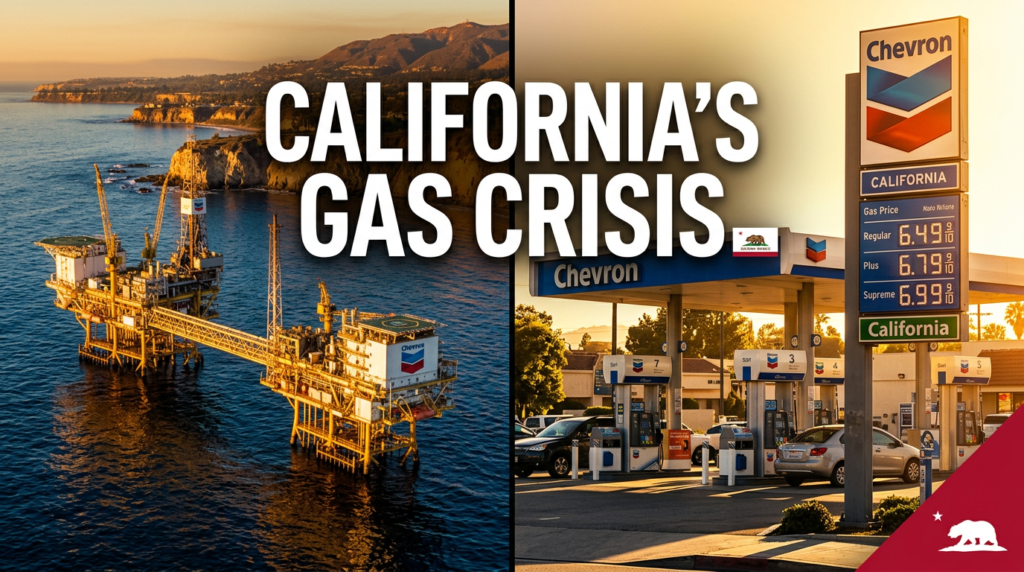
Californians are paying some of the highest gasoline prices in the nation — and it is not an accident. Now, a bold market-driven move by two American energy companies is cutting through the red tape, the regulatory warfare, and the virtue-signaling that has defined California’s energy policy for a generation.
California Pumps the Brakes — While Everyone Pays at the Pump
As of early 2026, the average price per gallon of regular gasoline in California hovered above $4.56, well above the national average. Analysts at UC Davis warned prices could spike to a staggering $8.44 per gallon by year’s end as two major in-state refineries prepare to close. Meanwhile, the state sits atop 1.7 billion barrels of proven oil reserves while importing 63% of its crude from foreign nations.
That’s not an energy crisis. That’s a policy crisis — one manufactured in Sacramento.
Support Independent Local Journalism
TheTownHall.News is a non-profit reader-supported journalism. Just $5 helps us hire local reporters, investigate important issues, and hold public officials accountable across Alameda County. If you believe our community deserves strong, independent journalism, please consider donating $5 today to support our work.On March 24, Chevron announced it will purchase crude oil from Sable Offshore Corp.’s newly restarted Santa Barbara platforms, processing it at its El Segundo refinery for California motorists. The deal starts with 20,000 barrels per day in April and is expected to ramp to 45,000–55,000 barrels per day — oil flowing through that pipeline for the first time since 2015. It is a win for American energy independence, for California consumers, and for the simple, durable principle that free markets work better than government obstruction.
What Chevron and Sable Just Did — and Why It Matters
The Santa Ynez Unit off the Santa Barbara coast was shut down in 2015 following a pipeline rupture. The infrastructure sat idle for a decade — not because it was beyond repair, but because California’s regulatory labyrinth, combined with political opposition from Sacramento, made restarting it an exercise in institutional endurance.
That changed when President Trump invoked the Defense Production Act on March 14, 2026 — a Cold War-era law allowing the federal government to prioritize the production of critical materials, including energy. Energy Secretary Chris Wright co-signed the order. Nine days later, Sable Offshore restarted the pipeline. Days after that, Chevron stepped up as a buyer.
Chevron’s president of downstream, midstream, and chemicals, Andy Walz, put it plainly:

“We’re taking American crude oil, putting it in American pipelines, running an American refinery and selling those products to American motorists — and it’s going to be cheaper than importing.”
That single sentence is a masterclass in the case for domestic energy production. No foreign entanglements. No vulnerability to Middle East price shocks. No dependence on shipping lanes. Just American resources, American workers, and American consumers benefiting from an American supply chain. This is exactly the kind of energy independence and economic self-reliance that responsible governance should be encouraging — not suppressing.
The Government That Stood in the Way
Governor Gavin Newsom didn’t congratulate Chevron or thank the workers preparing to bring energy to California families. He called Trump’s Defense Production Act order an “attempt to illegally restart the pipeline” and threatened legal action. The California Attorney General followed up, vowing to halt operations in court. The State Lands Commission called an emergency meeting. The Department of Parks and Recreation demanded the pipeline be removed from Gaviota State Park.
In other words: an all-hands-on-deck government effort to stop domestic oil from reaching California’s own refineries — the same state that imports nearly two-thirds of its oil, including from countries with far weaker environmental records than the United States.
The Newsom administration’s policies have contributed to refinery closures removing up to 20% of the state’s gasoline production capacity. In early March 2026, Chevron sent the Governor a stark warning letter stating these policies could “cripple” the state’s remaining refining infrastructure and cost thousands of jobs. The result: California’s domestic oil production has collapsed by 77% since 1986 — from approximately 1.1 million barrels per day to roughly 246,000 barrels per day — not because the oil ran out, but because policy ran it out.

Fiscal Accountability: Who Pays the Price?
The working families of California. The small business owner filling a delivery truck. The parent driving children to school. The nurse commuting two hours to a hospital shift because housing near the city is unaffordable.
Support Independent Local Journalism
TheTownHall.News is a non-profit reader-supported journalism. Just $5 helps us hire local reporters, investigate important issues, and hold public officials accountable across Alameda County. If you believe our community deserves strong, independent journalism, please consider donating $5 today to support our work.California’s gas prices aren’t just an inconvenience — they are a regressive tax on everyday life, falling hardest on working-class and middle-income households who cannot absorb the premium. When the state’s own researchers project retail gasoline potentially reaching $8.44 per gallon by late 2026, this stops being an abstract policy debate and becomes a direct threat to household budgets and economic mobility.
Fiscal accountability demands that government policies be judged not by their intentions, but by their consequences. By that standard, Sacramento’s energy agenda has failed the people it claims to serve. Domestic production — like the Sable-Chevron deal — is one of the fastest, most direct mechanisms for putting downward pressure on fuel costs without a single dollar of taxpayer subsidy.
The Rule of Law Cuts Both Ways
Intellectual honesty requires acknowledging that Sable Offshore’s path back to production has not been without controversy. The company faces 21 criminal charges filed by the Santa Barbara County District Attorney in 2025, including five felony counts related to alleged discharge of materials into waterways during pipeline repair work. The California Coastal Commission levied an $18 million fine for alleged unpermitted development work — one of the largest penalties in the agency’s history.
Sable has called the charges “politically motivated.” Those legal proceedings must run their proper course. The rule of law applies to corporations as surely as it applies to governments.
But here is the key distinction: legitimate environmental oversight and politically driven regulatory obstruction are not the same thing. Safety standards should be enforced rigorously. They should not be weaponized as a veto on energy independence. The Trump administration’s use of the Defense Production Act reflects a federal determination that California’s energy supply constitutes a national security matter — a judgment backed by the fact that supply disruptions affect not just motorists, but U.S. military operations dependent on West Coast fuel supply chains.
A Market Solution to a Government-Made Problem
What makes the Chevron-Sable deal genuinely significant is what it represents beyond the barrels: the private sector solving a problem that government policy created. No taxpayer subsidies. No government mandate. Two companies, operating within the bounds of federal authorization, making a business decision that will deliver real, tangible benefits to California consumers.
Sable’s production at full ramp is projected to represent roughly 17% of California’s domestic crude supply. That won’t solve every problem at the pump overnight, and it won’t fully offset the damage from the refinery closures Sacramento has permitted. But it is a meaningful, immediate step in the right direction — and it happened because the federal government got out of the way of American energy.
The Bottom Line: Californians Deserve Better
California is not an energy-poor state. It is a state governed by leaders who have chosen to make energy expensive, scarce, and increasingly dependent on foreign sources — all while presenting themselves as environmental stewards. The Chevron-Sable deal is a direct challenge to that narrative.
American oil, produced by American workers, refined in American facilities, and sold to American drivers, is not an embarrassment to be regulated out of existence. It is a strategic asset, an economic lifeline, and a matter of national self-reliance. When Andy Walz says this will be “cheaper than importing,” he’s describing a philosophy of governance — one that trusts markets, rewards productivity, respects the rule of law, and ultimately puts the interests of ordinary citizens above the ideological preferences of political elites.
California’s working families have been waiting a long time to hear that.
What You Can Do
Stay informed. The legal battle over the Sable pipeline is ongoing. Court decisions in the coming weeks will shape California’s energy future. Follow trusted, fact-based sources closely.
Share this article. The more Californians understand the direct connection between state energy policy and what they pay at the pump, the stronger the case for accountability becomes.
Hold your representatives accountable. Ask your state legislators: why is California importing 63% of its oil while sitting on billions of barrels of domestic reserves? Demand answers — and demand better.
The energy California needs is already here. It’s time for Sacramento to get out of the way and let it flow.
Sources: Bloomberg (March 24, 2026) · NY Post/California Post (March 24, 2026) · Los Angeles Times (March 16, 2026) · Reuters (March 16, 2026) · UC Davis Energy Institute · U.S. EIA · U.S. Oil and Gas Association · Santa Barbara County DA (Sept. 2025) · California Coastal Commission