Nebraska Is Burning — And Real America Is Answering the Call
The Land That Built America Is on Fire
Imagine watching your grandfather’s pasture — the same land your father worked, the same ground you’ve walked every morning for decades — disappear in a wall of smoke and flame. No warning. No negotiation. Just fire.
That is the reality facing hundreds of ranching families across western Nebraska right now. Since March 12, 2026, four simultaneous wildfires — the Morrill Fire, the Cottonwood Fire, the Road 203 Fire, and the Anderson Bridge Fire — have collectively scorched more than 824,000 acres of ranch and grazing land. To put that in perspective, that is an area larger than the entire state of Rhode Island, reduced to ash in a matter of days.
The Morrill Fire alone consumed 643,361 acres, making it the largest wildfire in Nebraska state history. Sparked by a downed power pole near Angora during dry, gusty conditions, it tore through some of the most productive ranching country in the American Heartland. These weren’t just fields. These were generational legacies — ranches built across multiple lifetimes, now facing an uncertain future.
Support Independent Local Journalism
TheTownHall.News is a non-profit reader-supported journalism. Just $5 helps us hire local reporters, investigate important issues, and hold public officials accountable across Alameda County. If you believe our community deserves strong, independent journalism, please consider donating $5 today to support our work.This is a catastrophe of historic proportions. But in the midst of it, something extraordinary is happening — something that no government program, no bureaucratic agency, and no political speechmaker orchestrated. The American ranching community is saving itself. And in doing so, it is reminding the rest of the country what our core values actually look like in action.
The Numbers Behind the Devastation
Before we talk about the heroes, we need to understand the scale of what was lost.
Roughly 600,000 acres of the burned land was active grazing pasture — land that sustains an estimated 35,000 cows. With that forage gone overnight, at least 40,000 head of cattle have been left without adequate feed. The timing could hardly be worse: this is calving season, the most vulnerable time of year for a cattle operation. Newborn calves are at serious risk from smoke inhalation for weeks following the fires. Ranchers are simultaneously managing their herds through crisis and fighting to keep newborns alive in compromised conditions.
One rancher in Ogallala described watching her family’s operation — built over three generations — reduced to scorched earth in an afternoon. Fencing that took decades and hundreds of thousands of dollars to build is gone. Water infrastructure is damaged. The feed supply is exhausted. These losses don’t appear on a spreadsheet. They represent the life’s work of American families who have asked for little more than the freedom to work their land and be left alone.

USDA Secretary Brooke Rollins toured the destruction firsthand and pledged that the agency would “back” Nebraska wildfire relief requests. The FSA has urged ranchers to contact local offices before rebuilding fences to preserve federal aid eligibility. USDA disaster assistance was formally made available March 20th. These are appropriate responses — and they are welcomed. But they are not what is saving these ranches right now.
The Convoy That Government Didn’t Send
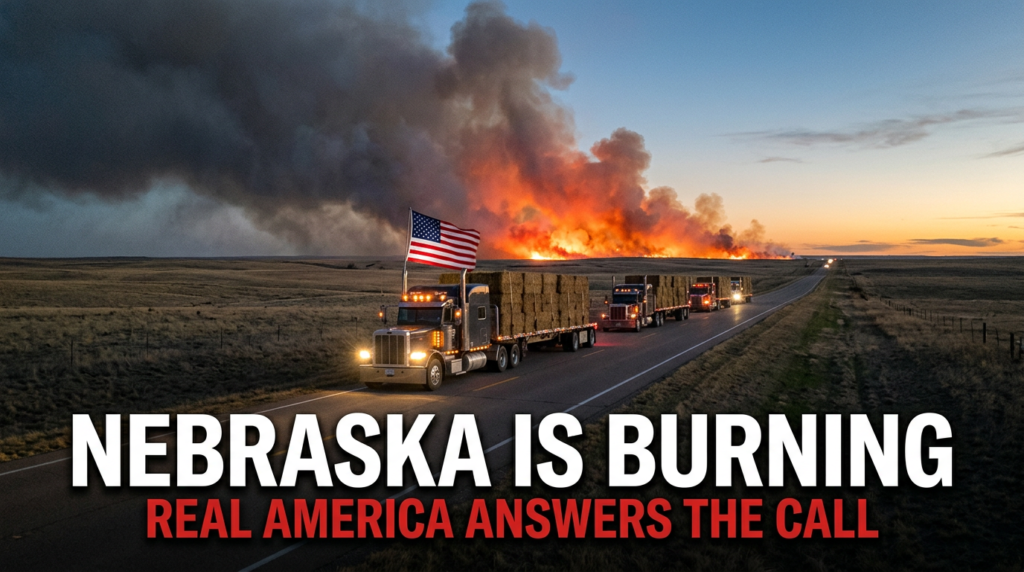
On the morning of March 23rd, a convoy of semis left eastern Nebraska heading west. They weren’t dispatched by FEMA. They weren’t organized by a federal task force. They were ordinary farmers and ranchers — who heard about the fires, looked at their own hay supply, and made a decision.
By March 24th, a convoy of 22 trucks — semis, pickups, and flatbed trailers — had reached the fire zone, delivering donated hay and supplies to six or seven ranches hit hardest by the blazes. Organizers Nick Hoffman of Clarks, Daniel Refior of Riverdale, and Jacob Dexter of Central City — all from Merrick County — spent days coordinating donations, logistics, and delivery routes. Drivers donated not just their time, but their fuel.
A separate convoy of 15+ semis carrying over 700 bales of hay rolled through Kearney with a police escort, bound for ranches near Brady and Farnam. Across all efforts combined, more than 150 truckloads of hay have been delivered — with four times that amount already committed. The goal: sustain these cattle operations through calving season.
This isn’t the first time. The same networks organized relief convoys to Kansas in 2021 and Texas in 2024. When agriculture is hit hard anywhere in America, the ranching community responds — not because they’re told to, but because that is who they are.
Support Independent Local Journalism
TheTownHall.News is a non-profit reader-supported journalism. Just $5 helps us hire local reporters, investigate important issues, and hold public officials accountable across Alameda County. If you believe our community deserves strong, independent journalism, please consider donating $5 today to support our work.Community, Not Government, Is the First Responder
There is a lesson here that politicians in Washington would do well to study.
The Nebraska wildfire relief effort is a living demonstration of the conservative principle that civil society — not the federal government — is the backbone of American resilience. Neighbors helping neighbors. Communities mobilizing before any agency finishes its paperwork. Grassroots networks like the Nebraska Sandhills Rancher Fire Relief coordinating donations in real time. The Nebraska Cattlemen Disaster Relief Fund accepting contributions from across the country. A volunteer-built portal matching ranchers who need to relocate livestock with those who have available grass and pen space.
Meanwhile, volunteer firefighters — many of them ranchers themselves — fought these blazes while managing their own calving operations. Nebraska Athletics pledged spring game ticket proceeds to volunteer fire departments. Local businesses, churches, and civic organizations from states hundreds of miles away sent money, feed, and supplies.
This is traditional American values in action: personal responsibility, community solidarity, and the understanding that when disaster strikes, you don’t wait for a bureaucrat to tell you what to do. You load the truck and drive.
Fiscal Accountability and the Long Road Back
Federal aid matters, and there is no shame in accepting it during a genuine catastrophe of this scale. But conservatives understand that government assistance is most effective when it complements — rather than replaces — individual and community effort, and when it comes with accountability and clear purpose.
Any USDA disaster assistance, FSA emergency loans, or Congressional relief packages must be structured transparently, delivered efficiently, and targeted at the families who actually work this land — not siphoned into bureaucratic overhead. These ranchers don’t want handouts. They want a fair shot to rebuild.
There is also a longer conversation to be had about infrastructure, power grid maintenance, and drought preparedness in rural America. The Morrill Fire was triggered by a downed power line during predictably dry spring conditions. Questions about utility maintenance responsibilities and wildfire-risk mitigation in agricultural regions deserve honest answers — not political deflection.
America at Its Best
There are moments that cut through the noise of political division and remind us who we actually are as a people. The sight of 22 trucks rolling across the Nebraska plains — loaded with hay, driven by men and women who had nothing to gain and everything to give — is one of those moments.
These convoys didn’t make the front page of national newspapers. Cable news largely ignored the story. But tens of thousands of Americans shared the footage online, many with tears in their eyes, because they recognized something in it: the real America. Not the America of partisan gridlock and manufactured outrage, but the America of calloused hands, unspoken duty, and faith that when things fall apart, your countrymen will show up.
The ranchers of western Nebraska are going to rebuild. It will be hard, slow, and expensive. Some operations may not survive. But the community surrounding them will not let them face it alone.
That is what traditional values look like. Not a slogan. A convoy.
What You Can Do Right Now
- Donate to the Nebraska Cattlemen Disaster Relief Fund for immediate financial support to ranching families.
- Give hay or resources through the Nebraska Sandhills Rancher Fire Relief network, actively coordinating donations and logistics.
- Contact your representatives to demand that federal disaster assistance is delivered efficiently, transparently, and without bureaucratic delay.
- Share this story. The national media has underreported this crisis. The more Americans who know what happened — and how the community responded — the stronger the support network becomes.
- Stay informed at The Town Hall News for continued coverage of stories that reflect the values and realities of working Americans.
The Heartland is burning. Real America is answering. Make sure your voice is part of that answer.
Sources: Drovers, Farm Progress, 1011 Now, Nebraska Public Media, USDA Farm Service Agency, KBEAR 92.3 Rural Radio, DTN Progressive Farmer, ABC News, RFD-TV.