Valero Refinery Explosion Exposes America’s Military Fuel Vulnerability — Are We Prepared?
A Nation That Cannot Fuel Its Military Cannot Defend Its Allies
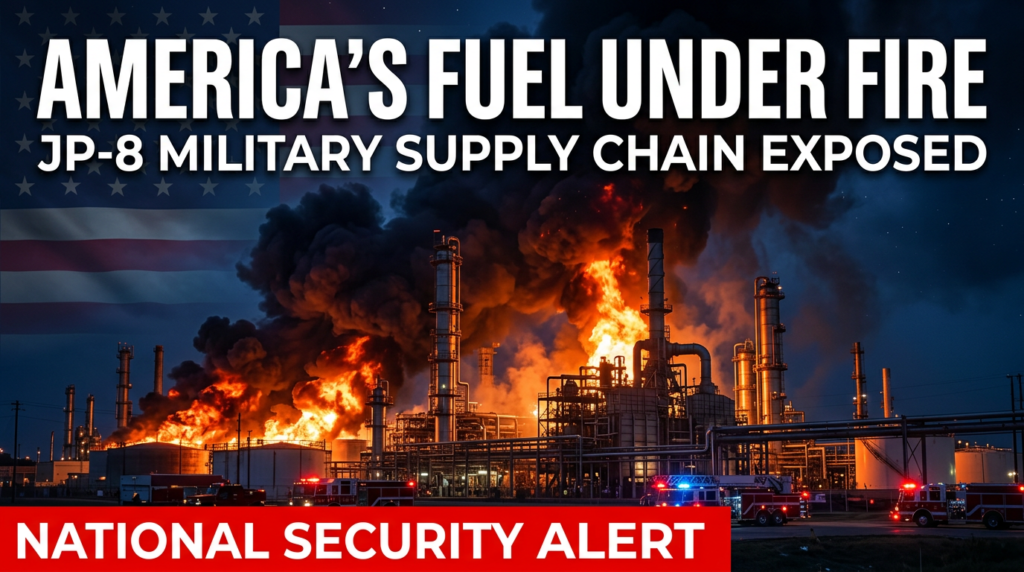
At 7:30 p.m. on Monday, March 23, 2026, a shudder ripped through Port Arthur, Texas. Residents eleven miles away felt it. Thick black smoke rolled into the night sky. Within hours, Valero Energy’s Port Arthur refinery — the company’s largest, processing 380,000 barrels of oil per day — was fully shut down. No lives were lost. But what was lost, at least temporarily, was something far more consequential than production statistics: a critical link in the chain that keeps American and allied military aircraft in the air.
This is not merely an industrial accident story. It is a national security story. And it raises questions that every American who values a strong defense, energy independence, and responsible governance should be demanding answers to right now.
What Actually Happened in Port Arthur
The facts are not in dispute. According to a filing Valero submitted to the Texas Commission on Environmental Quality (TCEQ), an “unforeseeable release of process fluid in Complex 2” triggered an ignition event inside Unit 243 — a 47,000-barrel-per-day diesel hydrotreater. The fire burned for approximately five hours before crews extinguished it by shutting off the fuel supply feeding the flames. A shelter-in-place order for west Port Arthur residents was lifted by Tuesday morning.
Support Independent Local Journalism
TheTownHall.News is a non-profit reader-supported journalism. Just $5 helps us hire local reporters, investigate important issues, and hold public officials accountable across Alameda County. If you believe our community deserves strong, independent journalism, please consider donating $5 today to support our work.Jefferson County Sheriff’s Chief Deputy Donta Miller was unambiguous: there is no evidence of deliberate sabotage. Online speculation about Iranian or Israeli agents was firmly dismissed. This was an industrial accident — one made more alarming not by its cause, but by its consequences.
As of March 25, Valero was preparing to restart the facility, though no official timeline has been confirmed. The refinery remains offline as of this writing, and with it, a significant portion of the refined fuel that moves through America’s domestic and allied military supply chains.
JP-8: The Lifeblood of Modern Military Power
To understand why this matters beyond Texas, you need to understand JP-8.
JP-8 is not your average aviation fuel. It is a militarized, specialized formulation of kerosene-based jet fuel — the standard fuel of the U.S. military and NATO — powering everything from F-16 and F-35 fighter jets to C-130 Hercules transport aircraft, AH-64 Apache helicopters, and even the M1 Abrams battle tank. What separates JP-8 from commercial Jet-A fuel is a precise cocktail of additives: corrosion inhibitors to protect sensitive fuel system components, anti-icing agents to prevent ice crystal formation at altitude, lubricity improvers to safeguard fuel pumps, antistatic agents to prevent catastrophic discharge during refueling, and thermal stability enhancers for extreme operating conditions.

These are not off-the-shelf blends. They require specialized processing — specifically the kind of hydrotreating and blending infrastructure housed in units like the one now damaged at Port Arthur.
According to research by Dutch investigative NGO SOMO, Valero’s Port Arthur facility has been a documented supplier of JP-8 aviation fuel and EN590 military-grade diesel to Israel, shipped from Corpus Christi, Texas, to the port of Ashkelon aboard tankers operated by Overseas Shipholding Group. A U.S. Defense Security Cooperation Agency notice publicly filed in December 2024 confirmed the proposed sale of JP-8 aviation fuel to Israel “to maintain the operational capability of its aircraft.” The strategic implications of that supply line going dark — even temporarily — cannot be overstated, particularly as the region remains engulfed in active conflict.
The Wider Vulnerability: A Supply Chain Built on Single Points of Failure
Here is where fiscal accountability and limited government principles intersect with hard national security reality.
For decades, American energy policy has lurched between two dysfunctional extremes: either over-regulating domestic production into near-stagnation, or outsourcing strategic dependencies without a serious plan for what happens when those dependencies fail. The Port Arthur explosion did not create this vulnerability — it merely illuminated it.
The Atlantic Council has identified an additional layer of risk: JP-8 production depends on lanthanum, a rare earth element used to stabilize catalysts in the Fluid Catalytic Cracking (FCC) units central to refinery operations. China controls the majority of global lanthanum supply and has a documented history of weaponizing rare earth exports as geopolitical leverage. A disruption — during a Taiwan Strait confrontation or South China Sea crisis — would compound exactly the kind of refinery vulnerability just exposed in Texas. America cannot secure its fuel supply while remaining dependent on a strategic adversary for the materials needed to produce it.
Support Independent Local Journalism
TheTownHall.News is a non-profit reader-supported journalism. Just $5 helps us hire local reporters, investigate important issues, and hold public officials accountable across Alameda County. If you believe our community deserves strong, independent journalism, please consider donating $5 today to support our work.This is not a hypothetical. Iran has already closed the Strait of Hormuz in retaliation for U.S.–Israeli air strikes, halting shipments that account for roughly 20% of global oil trade. Oil prices have surged past $100 per barrel. Barclays warns of a potential 13–14 million barrel-per-day global supply loss if the disruption is prolonged. Valero’s stock rose 3% on Tuesday — because tighter fuel markets benefit refiners — but American consumers and military planners are not celebrating. The refinery outage knocked out approximately 14% of Valero’s total refining capacity at the worst possible moment. That is not bad luck. That is the consequence of a nation that has consistently failed to treat energy infrastructure as the national security asset it is.
Accountability Starts at Home
Conservatives have long argued — correctly — that a strong national defense begins with a strong domestic economy and a secure industrial base. Ronald Reagan did not merely talk about peace through strength; he understood that strength requires supply chains that cannot be severed by a single accident, a hostile regime, or a foreign chokepoint.
The Port Arthur explosion should trigger a serious, sober conversation about energy infrastructure investment, domestic refining capacity, and strategic fuel reserves. The U.S. Strategic Petroleum Reserve exists precisely for moments like this — but it stores crude, not refined military-grade fuels. There is no equivalent reserve for JP-8. That gap deserves immediate congressional attention.
There is also a question of industrial accountability. While authorities confirmed the blast was not sabotage, the TCEQ filing’s description of an “unforeseeable fluid release” prompts a reasonable question: What inspection and maintenance protocols were in place? American taxpayers and military planners deserve transparency from a company whose operations are woven into national defense logistics. Personal responsibility is a conservative value — and it applies to corporations as much as to individuals.
The Geopolitical Moment Demands Clarity, Not Complacency
The Port Arthur explosion did not occur in a vacuum. It happened against the backdrop of an active U.S.–Israeli military campaign, a closed Strait of Hormuz, oil prices not seen since 2022, and a broader regional conflict that has already disrupted global LNG markets, rattled European economies, and put American forces in a posture they have not occupied in years.
In that context, the loss — even temporarily — of a major JP-8 production and supply facility is not a footnote. It is a flashing red light.
Conservatives believe in a government that does its core job well: defending the nation, securing its borders, and maintaining the conditions under which free enterprise can thrive. Energy security is not a partisan issue. It is a foundational one. And right now, America’s energy infrastructure is showing cracks that neither regulatory overreach nor wishful thinking can paper over.
The answer is not more bureaucracy. It is smarter, bolder policy: accelerated domestic refinery modernization, strategic JP-8 reserve creation, rare earth supply chain diversification away from China, and full transparency from energy companies whose facilities are embedded in military supply logistics.
Strength Requires Preparation
The fire at Port Arthur is out. The refinery is restarting. No one died, and that is genuinely good news. But the moment this story fades from the headlines is precisely the moment Washington will go back to ignoring the structural vulnerabilities it exposed.
America’s military cannot project strength on fumes. Our allies — including Israel, currently operating in an active war theater — cannot sustain air operations without a reliable, protected fuel supply. And the American people cannot afford a defense posture built on the assumption that our infrastructure will always hold.
The Valero explosion is a warning. The question is whether anyone in power is paying attention.
📢 Call to Action
Stay informed. Get involved. Share this article with your network and demand that your elected representatives address America’s military fuel supply vulnerability before the next crisis — not after it. Contact your congressman and senators and ask directly: What is the plan for domestic JP-8 reserve capacity? What safeguards exist for our military refining infrastructure? America’s strength depends on the vigilance of its citizens. Don’t let this story die with the smoke.
Sources: Reuters | TCEQ | U.S. Defense Security Cooperation Agency | Atlantic Council | Jefferson County Sheriff’s Office | SOMO | Barclays Research | OilPrice.com | Energy News (OEDigital)