Gun Manufacturer Liability Crushed by Supreme Court in Back-to-Back Unanimous 9-0 Rulings
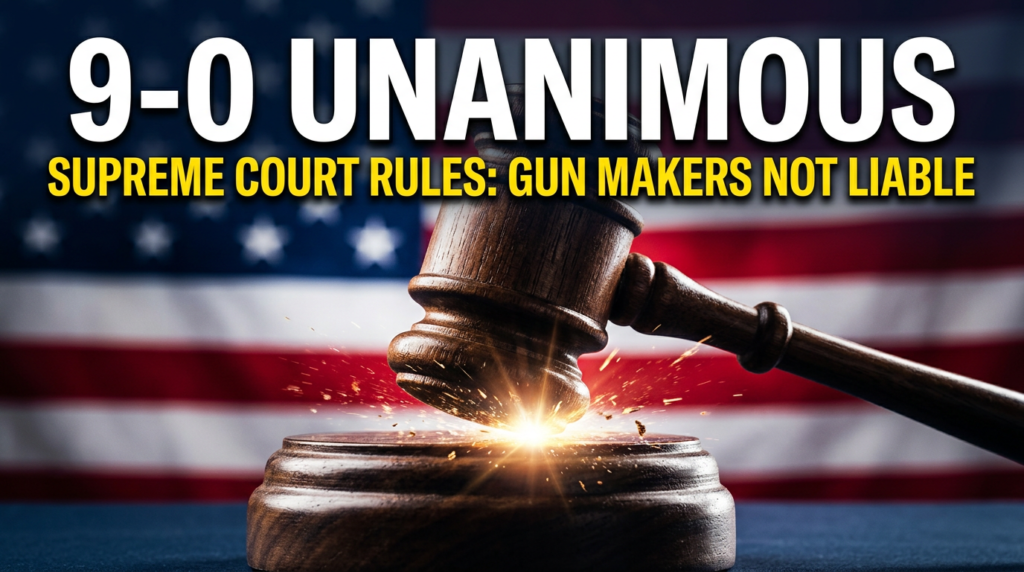
Two unanimous Supreme Court rulings — one delivered just this week — are reshaping the legal battlefield over gun manufacturer liability. The message from all nine justices is clear: in America, you don’t punish the maker for the criminal.
The American legal system just handed Second Amendment advocates back-to-back victories that could define the future of the firearms industry for a generation — and both came with zero dissent.
On March 25, 2026, the Supreme Court issued a unanimous 9-0 ruling in Cox Communications, Inc. v. Sony Music Entertainment that, while rooted in copyright law, carries enormous implications for gun manufacturers, gun retailers, and anyone who believes lawful businesses should not be held responsible for how criminals choose to use legal products. Add that to last June’s equally unanimous 9-0 decision throwing out Mexico’s $10 billion lawsuit against U.S. gun makers, and the legal architecture protecting the firearms industry has never been stronger.
Support Independent Local Journalism
TheTownHall.News is a non-profit reader-supported journalism. Just $5 helps us hire local reporters, investigate important issues, and hold public officials accountable across Alameda County. If you believe our community deserves strong, independent journalism, please consider donating $5 today to support our work.This isn’t just good news for gun owners. It’s a victory for the foundational American principle that responsibility follows the person who commits the act — not the company that made the tool.
What the Court Actually Decided in Cox v. Sony
The case on its surface had nothing to do with guns. Sony and major music labels sued Cox Communications — a large internet service provider — arguing that Cox should be held financially liable because some of its customers used its internet service to illegally download copyrighted music.
The theory was simple and aggressive: Cox provided the platform, Cox knew piracy was happening on its network, therefore Cox should pay.
Justice Clarence Thomas, writing for a unanimous Court, rejected that argument in clear terms. An internet provider is liable for a user’s illegal activity only if it intended that its service be used for that purpose. Merely providing a lawful service to the public — even knowing that some will misuse it — does not make a company a co-conspirator in those misdeeds.

“Countless people use the Internet for legal activities,” Thomas wrote, “but some use it to illegally share copyrighted material.”
That distinction — between providing a service and intending wrongdoing — is precisely the line that anti-gun litigators have spent years trying to erase.
Why This Ruling Is Massive for the Second Amendment
Attorney Mark W. Smith, a Second Amendment scholar and host of the widely followed Four Boxes Diner channel, was among the first to flag the Cox ruling’s sweeping implications for the firearms industry. His assessment: this decision is “hugely beneficial” to gun makers and sellers, even though the word “firearm” appears nowhere in the opinion.
For decades, activists and state attorneys general have pursued a parallel legal strategy against the gun industry. Unable to ban firearms outright, they have attempted to drown manufacturers and retailers in litigation, hoping to make the business of selling guns legally and financially untenable.
The playbook is always a variation of the same argument: the gun maker sold the product, the gun maker knew it could be misused, therefore the gun maker owes damages when a criminal pulls the trigger.
Support Independent Local Journalism
TheTownHall.News is a non-profit reader-supported journalism. Just $5 helps us hire local reporters, investigate important issues, and hold public officials accountable across Alameda County. If you believe our community deserves strong, independent journalism, please consider donating $5 today to support our work.Under the logic the Supreme Court just unanimously rejected, that theory collapses. A company is not liable simply because it provides a lawful product knowing that some buyers may misuse it. Applied consistently, that principle protects not just gun manufacturers, but makers of automobiles, kitchen knives, baseball bats, and virtually every other legal product ever used to cause harm.
The unanimous vote is not incidental. When all nine justices agree — liberals and conservatives alike — it sends an unmistakable signal to every lower court in the country.
The Mexico Lawsuit Defeat: PLCAA Holds Firm
The Cox ruling builds on solid ground established by the Supreme Court’s June 2025 decision in Smith & Wesson Brands, Inc. v. Estados Unidos Mexicanos.
Mexico filed a $10 billion lawsuit against seven major American gun manufacturers, arguing they designed and marketed military-style firearms in ways that made their products attractive to drug cartels. The Supreme Court — again 9-0 — threw the entire case out.
Writing for the Court, Justice Elena Kagan held that Mexico’s claims were squarely barred by the Protection of Lawful Commerce in Arms Act (PLCAA), the 2005 federal law Congress passed to stop exactly this kind of litigation.
Kagan’s opinion was precise: Mexico had not plausibly alleged that the gun makers intended to help cartels — only that they sold to everyone on equivalent terms. “Indifference” is not the same as “assistance.” The gun industry cannot be bankrupted for the choices of criminals it did not arm, did not know, and did not intend to equip.
What Critics Get Wrong
Opponents of these rulings argue that gun manufacturers profit from a culture of violence and that the absence of civil liability removes any incentive for the industry to act responsibly.
It sounds compelling until you examine the facts. The PLCAA already contains meaningful exceptions. Gun makers can still be sued for defective products, for negligent entrustment when they have specific reason to believe a sale is facilitating a crime, and for direct violations of federal or state law. This is not blanket immunity — it is immunity specifically for third-party criminal misuse.
No serious legal or ethical framework holds a manufacturer responsible for the independent choices of unrelated bad actors. Ford is not liable when a drunk driver kills someone. The principle of personal responsibility — not corporate guilt by association — is the cornerstone of both law and basic moral reasoning.
The Real Cost of Getting This Wrong
If the legal theories behind the Mexico lawsuit had prevailed, the consequences would have extended far beyond guns.
Every major industry in America would face the same exposure: sue the provider, not the perpetrator. Bankrupt the business, not the criminal. That is not accountability — it is a mechanism for weaponizing the civil justice system against industries that political actors dislike, using litigation as a substitute for legislation that could not survive democratic debate.
The Supreme Court has now said twice, unanimously: that is not how American law works.
The Takeaway
These rulings will not end the legal war over gun rights. The American Bar Association passed a resolution in early 2026 calling for the repeal of the PLCAA, and anti-gun litigators are already developing new theories to thread whatever needle the Court’s opinions leave open.
But the ground has shifted. Two unanimous Supreme Court rulings — one authored by a liberal justice, one by a conservative — have reinforced the same bedrock principle: lawful businesses are not liable for the independent criminal acts of others.
That protects the Second Amendment. It protects free commerce. And it protects the idea — still worth defending — that in America, you are responsible for what you do, not for what someone else does with something you lawfully made or sold.
The gun industry’s opponents wanted to win in court what they cannot win at the ballot box. The Supreme Court, all nine members, just said no.
💬 Key Takeaway: A lawful product manufacturer cannot be held liable every time someone misuses that product to commit a crime. The Supreme Court just said so — unanimously, twice.
Stay Informed. Stay Engaged.
These rulings matter — and so does civic awareness. Share this article with someone who needs to understand what’s really happening in the legal battles shaping your rights. Subscribe to independent journalism that covers the stories the mainstream media buries. And if you believe in personal responsibility, limited government, and the rule of law, make your voice heard.
The courts are doing their part. Make sure you’re doing yours.