Texas Wins: AG Ken Paxton Shuts Down “Sharia City” Development in Kaufman County
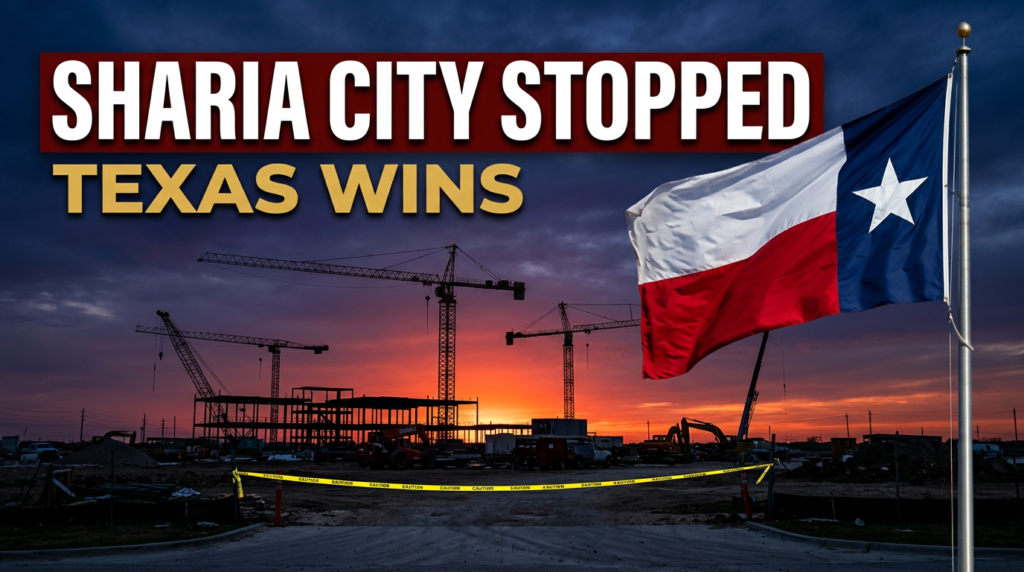
A Dubai-backed developer quietly pulled the plug on a 2,300-acre, 20,000-resident foreign enclave in rural Texas — and it took one state attorney general, one congressman, and a community that refused to stay silent to make it happen.
A foreign-based real estate company wanted to build a city inside Texas. Not a subdivision. Not a commercial complex. A city — spanning 2,300 acres in rural Kaufman County, designed to house up to 20,000 foreign nationals, modeled on communities the developer had built in the United Arab Emirates.
When Kaufman County residents found out in early February 2026, they didn’t scroll past it. They showed up. They made calls. They demanded answers. And on March 26, 2026, Texas Attorney General Ken Paxton announced what they had fought for: the project is dead.
Support Independent Local Journalism
TheTownHall.News is a non-profit reader-supported journalism. Just $5 helps us hire local reporters, investigate important issues, and hold public officials accountable across Alameda County. If you believe our community deserves strong, independent journalism, please consider donating $5 today to support our work.How a Dubai Developer Almost Built a Foreign Enclave in North Texas
The company behind the proposal was SEE Holding, a Dubai-based real estate firm. Through a U.S. subsidiary, SEE Holding had been quietly advancing plans for what it called “Sustainable City USA” — a master-planned development near Kaufman, Texas, roughly 30 miles southeast of Dallas.
On paper, the pitch sounded benign: green energy, smart infrastructure, dense residential design. But the details told a different story. SEE Holding’s overseas Sustainable City developments — built in the UAE and Oman — are purpose-built communities that prominently feature mosques, Islamic cultural centers, and housing marketed to Muslim residents. The Kaufman proposal was nearly 14 times larger than any of the company’s international projects.
When local residents connected those dots, alarm bells rang across the county.
Why Residents Were Right to Ask Hard Questions
Critics of the project were not wrong to raise concerns, and those concerns were not simply cultural discomfort. They were substantive.

First, there is the matter of national security. A foreign-based company purchasing thousands of acres of rural Texas land — with proximity to major infrastructure — and planning to house tens of thousands of foreign nationals raises legitimate questions that any government official is obligated to investigate. Those questions have nothing to do with religion and everything to do with sovereignty.
Second, there is the matter of local resources. Kaufman County is rural. Its water supply, roads, schools, and emergency services were not designed to absorb a city of 20,000 people. Residents who raised concerns about infrastructure strain were not being obstructionist — they were being responsible.
“Not in our backyard” is sometimes a reflex. In Kaufman County, it was a warning.
Third — and most critically — the project was never subjected to public zoning hearings or the normal democratic scrutiny a development of this scale demands. A foreign company does not get to quietly purchase 2,300 acres and build a city without answering to the people who already live there.
Paxton’s Investigation: What the Law Actually Says
On February 9, 2026, Attorney General Paxton announced a formal investigation and issued Requests to Examine (RTEs) to SEE Holding’s U.S. subsidiary. His office cited potential violations of Texas law and concerns about national sovereignty.
Texas law gives the Attorney General broad authority to investigate entities operating in the state, particularly when there are grounds to believe those entities may be engaged in fraudulent or unlawful conduct. Paxton’s office did not need to prove a crime had been committed to open an investigation — the potential for harm was sufficient.
Support Independent Local Journalism
TheTownHall.News is a non-profit reader-supported journalism. Just $5 helps us hire local reporters, investigate important issues, and hold public officials accountable across Alameda County. If you believe our community deserves strong, independent journalism, please consider donating $5 today to support our work.The act of investigation sent an unmistakable signal: Texas intended to scrutinize this project fully and publicly. For a foreign developer trying to execute a long-term real estate play, that kind of regulatory spotlight — combined with organized local opposition — fundamentally changed the calculus.
The Role of Congressman Lance Gooden
Paxton was not alone. Congressman Lance Gooden, the Republican representative for the district, played a direct and decisive role in the project’s collapse. Gooden confirmed in late March 2026 that he had spoken directly with SEE Holding’s representatives and advised them that the timing and location were not appropriate for their proposal.
The developers listened. According to Gooden, they chose not to move forward — a decision reported publicly on March 23, three days before Paxton’s official announcement.
This is what effective representation looks like. A congressman who picks up the phone, engages the actual decision-makers, and delivers results for his constituents without theatrics or delay.
“When government officials actually do their jobs, citizens win. Kaufman County proved it.”
What Critics Get Wrong
Opponents of Paxton’s investigation have argued that the probe was religiously motivated — that labeling the project a “sharia city” was inflammatory rhetoric designed to stoke anti-Muslim sentiment rather than address genuine legal concerns.
That argument deserves a fair hearing. Religious discrimination is real, and the language used in political fights over development can sometimes cross a line from scrutiny into scapegoating.
But here’s what the critics miss: the legal and civic concerns raised in Kaufman County were entirely separable from religion. A 2,300-acre foreign-backed development housing 20,000 people in rural Texas would raise the same questions regardless of who was building it or what faith it served. The national security implications of foreign land acquisition near major U.S. cities are not invented — they are documented, bipartisan concerns that have been raised in Congress for years.
No one has a right to build a city-scale foreign enclave in the American heartland without scrutiny. That principle does not change based on the developer’s nationality or religion.
A Pattern Worth Watching: Texas and Foreign Land Acquisition
The Kaufman County fight is not happening in a vacuum. Across the country, state legislatures have been tightening restrictions on foreign ownership of land near critical infrastructure. Texas itself has passed legislation restricting land purchases by entities tied to foreign adversary nations.
The SEE Holding case highlights a gap in those protections: not every foreign-backed development comes with obvious geopolitical red flags, and some slip through the cracks of existing law until residents sound the alarm.
The outcome in Kaufman County should serve as a model — not for reflexively opposing foreign investment, but for ensuring that large-scale developments backed by foreign capital are fully transparent, fully investigated, and fully accountable to the communities they propose to reshape.
The Takeaway: Citizens and Officials Working Together
The collapse of “Sustainable City USA” is a case study in civic accountability functioning the way it is supposed to. Residents identified a problem. Elected officials responded. Legal tools were deployed. And a foreign company that wanted to quietly plant a 2,300-acre development in rural Texas packed up and went home.
No riots. No years of litigation. The system worked because people paid attention and demanded that their representatives act.
Key Takeaway: Transparency, local engagement, and a willing attorney general stopped a foreign-backed mega-development that had never been subjected to proper democratic scrutiny. That is not government overreach — that is government doing exactly what it exists to do.
Stay Informed. Stay Engaged.
The Kaufman County story is far from the only one of its kind. Similar battles are playing out across Texas and the country — from EPIC City in Collin County to ongoing debates over foreign land ownership near U.S. military installations.
Civic wins like this one don’t happen by accident. They happen because informed citizens refuse to be passive and because independent journalism keeps the public informed when major institutions would rather look away.
Share this article with your network. Talk about it with your neighbors. And stay engaged — because the next proposal may not make the news until it’s too late to stop it.
If you value fact-based, independent reporting on the issues that matter to your community, consider supporting the journalism that makes it possible.