IDF Chief Warns Military Could Collapse — And Israel’s Government Is Ignoring Him
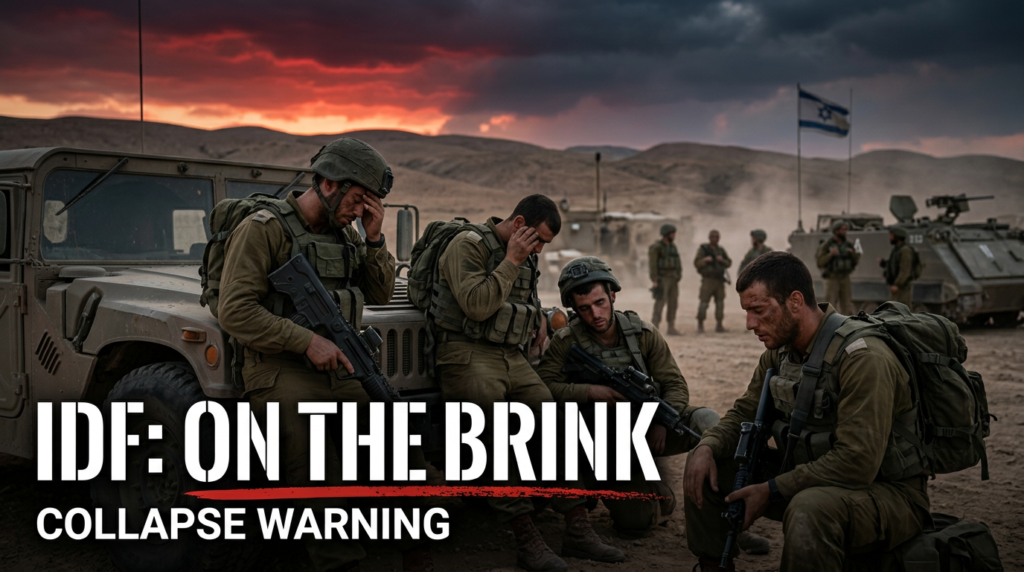
The IDF’s top general just warned that Israel’s military could “collapse in on itself.” The government’s response? Silence. This is what happens when political survival trumps national security.
Israel is fighting on five fronts simultaneously — Gaza, Lebanon, Syria, Iran, and the West Bank. It has been doing so for well over a year, grinding through one of the most complex and sustained military campaigns in modern Middle Eastern history. And yet, even as its soldiers serve sixth and seventh reserve rotations, even as exhausted families cry out, the government of Benjamin Netanyahu has failed to pass a single law to fix the manpower crisis that its own military chief says could bring the IDF to its knees.
On March 25, 2026, IDF Chief of Staff Lt. Gen. Eyal Zamir stood before Israel’s security cabinet and delivered one of the most alarming assessments in the country’s military history. “I am raising 10 red flags,” Zamir said, according to reports confirmed by the Times of Israel and the Jerusalem Post. “The IDF is going to collapse in on itself. Before long, the IDF will not be ready for its routine missions and the reserve system will not last.” Neither Prime Minister Netanyahu nor a single cabinet minister reportedly responded.
Support Independent Local Journalism
TheTownHall.News is a non-profit reader-supported journalism. Just $5 helps us hire local reporters, investigate important issues, and hold public officials accountable across Alameda County. If you believe our community deserves strong, independent journalism, please consider donating $5 today to support our work.The Crisis Is Real — And the Numbers Don’t Lie
The scale of Israel’s manpower problem is staggering. The IDF is currently short approximately 12,000 combat-ready recruits, according to military officials who have repeatedly briefed lawmakers on the shortage. Former Prime Minister Naftali Bennett, citing broader figures, put the deficit even higher — at 20,000 soldiers.
Meanwhile, by Bennett’s own accounting, there are approximately 100,000 young ultra-Orthodox (Haredi) men of prime military age in good health who have not been drafted. As Bennett bluntly stated: “What on earth are you waiting for? Recruiting just one-fifth of those 100,000 would solve the problem.”
The arithmetic is not complicated. The political will is what’s missing.
Israel’s mandatory service length, rather than being extended to meet the crisis, is actually scheduled to be reduced — from 32 months to 30 months in January 2027 — unless the Knesset acts. Zamir has urged legislators to extend it to 36 months. The government has stalled. The military is being asked to do more with less, indefinitely.

When Duty Falls Only on Some, Morale Falls for All
At the core of this crisis lies one of the most corrosive inequities in Israeli civic life: the systematic exemption of ultra-Orthodox men from military service. While secular and national-religious Israelis serve mandatory terms and are repeatedly called back as reservists — some for the sixth or seventh time — a large segment of the population shelters behind religious study deferments that have no enforceable legal framework.
Israel’s Supreme Court has ruled that blanket Haredi draft exemptions are unconstitutional. Yet enlistment orders issued to ultra-Orthodox men have gone largely unenforced. In February 2026, Israeli police formally told the IDF they would not assist in the arrest of ultra-Orthodox draft dodgers — a stunning institutional abdication that opposition leaders called a betrayal of the rule of law.
When the burden of national defense is borne only by a willing few, the social contract that holds a nation together begins to fray.
Former IDF Chief of Staff Gadi Eisenkot was unambiguous: “The political leadership will not be able to claim it did not know.” Opposition leader Yair Lapid accused the government of ignoring the military chief’s warnings to protect coalition partners. Avigdor Lieberman called it “the most severe manpower crisis in the IDF’s history” and demanded universal conscription.
The Government’s Calculation — And Why It’s Dangerous
To understand why Netanyahu has not acted, follow the coalition math. His governing coalition depends on ultra-Orthodox political parties whose core constituents are the very men the military needs. Passing a meaningful conscription law would fracture the coalition. So it hasn’t happened.
Support Independent Local Journalism
TheTownHall.News is a non-profit reader-supported journalism. Just $5 helps us hire local reporters, investigate important issues, and hold public officials accountable across Alameda County. If you believe our community deserves strong, independent journalism, please consider donating $5 today to support our work.Netanyahu and Finance Minister Bezalel Smotrich announced earlier this year that legislation granting broad draft exemptions would not advance — a partial concession to public pressure. But that announcement has not translated into enforcement on the ground. Draft orders go out; no one shows up; nothing happens.
Meanwhile, the cabinet simultaneously approved the legalization of dozens of new West Bank outposts — a move Zamir himself warned will require deploying additional battalions to protect settlers, further stretching a force already at its limit. The military is being handed new missions while being denied the people to carry them out.
What Critics of the Alarm Get Wrong
Some argue that Israel’s military warnings are a perennial negotiating tactic — that the IDF routinely overstates threats to squeeze political concessions from the government. There is a degree of institutional truth to this; defense establishments everywhere tend to protect their influence.
But this moment is different. The warnings are not coming from anonymous officials or think tanks. They are coming from the sitting Chief of Staff, in a classified cabinet meeting, on the record, naming specific structural failures: no conscription law, no updated reserve duty law, no service extension. These are not vague appeals for more funding. They are legislative demands — and they are being ignored.
Furthermore, the operational evidence backs the alarm. Reservists are on their sixth and seventh rotations. Refusal rates are climbing measurably. These are not signs of managed messaging — they are signs of an institution under genuine, compounding stress.
The Principle Behind the Problem
What is unfolding in Jerusalem is a case study in what happens when political short-termism overrides institutional accountability — when leaders prioritize their own survival over the civic obligations they were elected to uphold.
The principles at stake are universal: shared civic responsibility, equal application of the law, and the obligation of leadership to make hard decisions even when politically costly. A society cannot sustain the expectation that some of its members will carry the full weight of collective defense while others are permanently excused.
“The reserves will not hold,” Zamir warned. If the government won’t listen to its own military chief, the question is no longer whether the IDF is in crisis. The question is how deep the damage will go before someone acts.
The Takeaway
Israel’s military crisis is a leadership crisis. The IDF Chief of Staff has raised the alarm — publicly, formally, and urgently. Former prime ministers, opposition leaders, and former chiefs of staff have all confirmed the severity. The data on manpower shortages, reserve exhaustion, and unenforced conscription laws all point in the same direction. What is missing is not information. What is missing is political courage.
For those who believe in the rule of law, civic duty, and the principle that no one is above their obligations to their country — this story demands attention. Read it. Share it. And hold your leaders to the same standard they claim to uphold.