Swiss Blood Nanofilter Could Change Alzheimer’s Treatment But Don’t Ignore the Fine Print
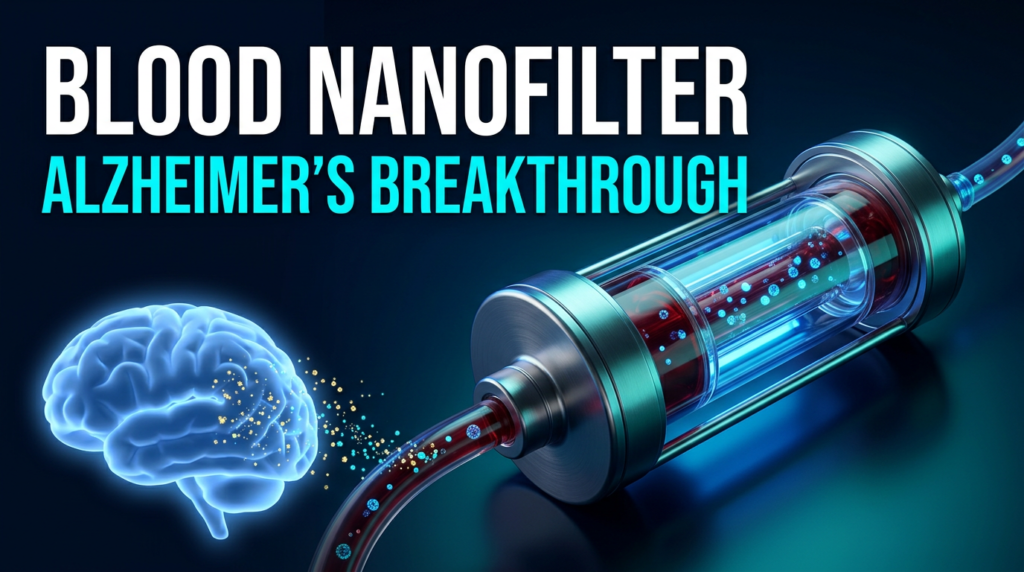
re testing a device that filters toxic proteins from the blood to fight cognitive decline. The science is genuinely exciting — and families deserve the full picture before the headlines mislead them.
Researchers are testing a device that filters toxic proteins from the blood to fight cognitive decline. The science is genuinely exciting — and families deserve the full picture before the headlines mislead them.
Imagine a device about the size of a dialysis machine that could filter the toxic proteins responsible for stealing your memory — not in months, not after years of pharmaceutical regimens, but potentially within hours of a single session. That is the promise being tested by researchers in Switzerland, where a blood-filtration system targeting amyloid beta — the protein most closely linked to the progression of Alzheimer’s disease — is generating serious attention in medical and scientific circles.
Support Independent Local Journalism
TheTownHall.News is a non-profit reader-supported journalism. Just $5 helps us hire local reporters, investigate important issues, and hold public officials accountable across Alameda County. If you believe our community deserves strong, independent journalism, please consider donating $5 today to support our work.For the millions of families who have watched a parent or spouse lose themselves to cognitive decline, the news arrives like a lifeline. And the underlying science is not fringe. It is grounded in legitimate, peer-reviewed research on how toxic proteins accumulate in the brain and how the body’s own drainage system might be re-activated to fight back. But this is also a moment that demands something too often missing in modern health reporting: honesty about where the science actually stands.
Why This Issue Matters Right Now
Alzheimer’s disease is not just a medical crisis — it is a social and economic one. According to the Alzheimer’s Association, the condition is among the leading causes of death in the developed world, and the financial toll on families who become full-time caregivers is enormous. It strips people of their independence, their dignity, and their ability to participate in family and civic life.
For decades, pharmaceutical companies and government-funded research programs have poured billions into drug-based treatments, with results that have been, at best, modest. The FDA approval of lecanemab in 2023 marked a turning point — the first drug to demonstrably slow cognitive decline by targeting amyloid plaques — but it is expensive, requires clinical administration, and carries serious side effects including brain swelling and bleeding. It is not a cure. It is a partial brake on an accelerating disease.
That is precisely why the concept of blood filtration is drawing so much interest. Rather than trying to chemically disrupt the brain’s chemistry from the outside, this approach works with the body’s own biology. If you reduce the concentration of amyloid beta in the bloodstream, the brain’s natural clearance system — a transport mechanism involving a protein called LRP1 — can begin removing its own buildup of toxic waste more effectively. Think of it as unclogging a drain rather than flooding the room with chemicals.

“The science isn’t fringe — but families deserve the full picture before headlines turn experimental hope into medical certainty.”
What the Research Actually Shows
The most substantive peer-reviewed work in this space comes from a landmark October 2025 study published in Signal Transduction and Targeted Therapy, a Nature-indexed journal. Researchers at the Institute for Bioengineering of Catalonia (IBEC), in collaboration with scientists in China and the United Kingdom, reported results that genuinely warrant the word “breakthrough” — though with an important caveat.
The team engineered supramolecular nanoparticles — not passive drug carriers, but active therapeutic agents — that mimic the brain’s own LRP1 protein. When introduced into the body, these particles bind to amyloid beta and help shuttle it across the blood-brain barrier and into the bloodstream for removal. In mouse models engineered to overproduce amyloid beta, just three doses produced a 50 to 60 percent reduction in brain amyloid beta within one hour. In longer-term trials, a mouse treated at an age equivalent to 60 in human terms showed the cognitive function of a healthy animal at the equivalent of 90.
These are extraordinary numbers. “Our study demonstrated remarkable efficacy in achieving rapid Aβ clearance, restoring healthy function in the blood-brain barrier and leading to a striking reversal of Alzheimer’s pathology,” said researcher Lorena Ruiz Perez of IBEC.
⚠️ Editorial Note: This research is currently at the preclinical stage — results are from animal models. Human clinical trials have not yet been formally announced or registered. The Swiss blood nanofilter device circulating on social media has not been independently verified through peer-reviewed publication as of this writing.
The “Sink Effect” — The Science Behind the Strategy
To understand why this approach is scientifically plausible, it helps to understand the “peripheral sink” hypothesis. The brain does not operate in isolation from the bloodstream. There is a constant exchange across the blood-brain barrier — a highly selective membrane that controls what enters and leaves the brain. Under normal conditions, LRP1 acts as a transporter, grabbing amyloid beta in the brain and moving it into the blood. But in Alzheimer’s disease, this system breaks down. Too much amyloid accumulates, LRP1 becomes overwhelmed and degrades, and the clearance cycle collapses.
Support Independent Local Journalism
TheTownHall.News is a non-profit reader-supported journalism. Just $5 helps us hire local reporters, investigate important issues, and hold public officials accountable across Alameda County. If you believe our community deserves strong, independent journalism, please consider donating $5 today to support our work.By reducing amyloid levels in the blood — either through filtration or through nanoparticle-mediated transport — researchers believe they can restore the concentration gradient that drives this natural clearance. The brain, in effect, is encouraged to drain itself. It is an elegant concept, and it explains why rapid improvements in protein levels may indeed be observable within hours, as some researchers have suggested.
What Critics Get Wrong — and What They Get Right
Skeptics of this research tend to make two arguments. The first — and most reasonable — is that mouse models of Alzheimer’s disease have a poor track record of translating to human treatments. The history of Alzheimer’s drug development is littered with therapies that worked brilliantly in rodents and failed in people. This is a genuine concern and a legitimate scientific limitation that any responsible report must acknowledge.
The second criticism — increasingly common in some regulatory and institutional quarters — is that novel, non-pharmaceutical approaches to disease treatment require greater scrutiny and slower approval timelines. This is where the debate becomes as much about policy as it is about science. Families watching a loved one deteriorate do not have the luxury of waiting a decade for regulatory consensus. The argument for cautious, controlled trials is sound. The argument that those trials should be deliberately slowed or that families should be denied access to emerging options is far less convincing.
Individual researchers, private biotech firms, and patient advocacy groups — not government agencies with bloated timelines — have historically driven the most important breakthroughs in medical science. That pattern is worth defending.
“Families watching a loved one deteriorate don’t have the luxury of waiting a decade for regulatory consensus.”
How This Affects Families and Communities
There are roughly 55 million people living with dementia worldwide, and that number is expected to triple by 2050. In practical terms, cognitive decline does not just affect the individual — it restructures entire families. Parents become dependents. Spouses become caregivers. Adult children put careers and their own health on hold to manage a condition that current medicine can only partially slow.
A non-invasive, blood-based intervention that could meaningfully preserve cognitive function in the early stages of decline would not just be a medical breakthrough. It would be an economic and social one. It would allow individuals to remain productive members of their communities for longer. It would reduce the caregiving burden on families. And it would do so without the side-effect profiles of current pharmaceutical options.
That is why research like this deserves widespread, informed public attention — not sensationalized headlines, not dismissive institutional skepticism, but honest, clear reporting that empowers families to understand what is coming and to advocate for access when it arrives.
Where Things Stand — and What Comes Next
The Swiss blood nanofilter device being discussed on social media has generated significant excitement, but independent verification through published clinical data remains pending. What is confirmed is that the scientific framework it operates on — peripheral amyloid clearance to activate the brain’s natural drainage — is supported by peer-reviewed research and is being actively pursued by multiple serious research groups. The IBEC study of October 2025 is the most substantiated example to date, and it has laid a credible foundation for the next stage: human trials.
Researchers involved in this space have indicated that the translation from preclinical to clinical application is the next priority. Given the speed of results observed in animal models and the non-invasive nature of the filtration approach — which mirrors technologies already used in dialysis and plasmapheresis — the path to human application may be shorter than for traditional drug development pipelines.
Key Takeaways
- Swiss researchers and international teams are actively developing blood-based filtration and nanoparticle approaches to Alzheimer’s treatment.
- The scientific basis — peripheral amyloid sink theory and LRP1 transport — is peer-reviewed and credible.
- The most substantiated results (50–60% amyloid reduction within one hour) are from animal models as of early 2026.
- Human clinical trials have not yet been formally registered or published for this specific device.
- The approach is non-invasive and builds on existing medical filtration technology, suggesting a plausible path to clinical use.
- Families should remain informed, ask their physicians about emerging trial opportunities, and support research advocacy.
The Bottom Line
This research represents one of the most promising shifts in Alzheimer’s science in years — not because it promises a cure, but because it proposes a fundamentally different and more natural approach to a problem that conventional medicine has struggled to solve. The idea that we might work with the body’s own clearance systems, rather than against the disease with blunt pharmaceutical instruments, is a genuinely new direction.
But families deserve more than hope. They deserve precision. The social media version of this story — rapid cures in Swiss hospitals, miraculous improvements within hours — outpaces the verified evidence. What the verified evidence shows is still impressive: a scientifically sound mechanism, extraordinary preclinical results, and a technology that is plausibly close to human trials. That is a story worth telling accurately.
Support the research. Demand transparency from institutions and regulators. Stay informed. And when this technology reaches clinical availability, make sure the families who need it most can access it without bureaucratic delay.
📢 Know a family affected by Alzheimer’s? Share this article — accurate information saves lives and shapes policy.
Stay Informed. Stay Independent. The Town Hall News covers health, science, and policy without the institutional filter. Subscribe for weekly updates — and share this article to support independent journalism that puts families first.