Iran Strikes U.S. Troops in Saudi Arabia: What Operation Epic Fury Means One Month In
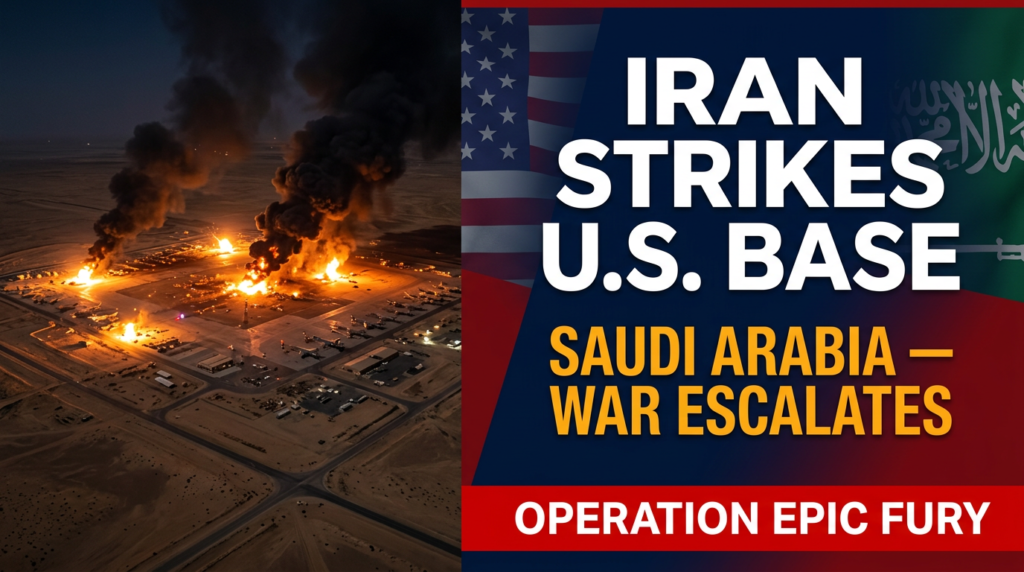
One month into Operation Epic Fury, the war against Iran has reached a dangerous new threshold. Here’s what it means — and why American strength, not appeasement, is the only path forward.
The missiles that slammed into Prince Sultan Air Base in Saudi Arabia on March 27, 2026, didn’t just wound 12 American service members. They crossed a line. For the first time since the U.S. and Israel launched Operation Epic Fury on February 28, Iran directly struck a U.S. military base on the sovereign soil of America’s most critical Gulf partner. That is not an act of desperation from a weakened adversary. That is an escalation — and the world is watching how Washington responds.
The attack is a stark reminder that the Iranian regime, even as it faces military devastation, has not surrendered its willingness to draw American blood. Thirteen U.S. troops have now been killed in this conflict. More than 300 have been wounded. The American people deserve clarity about what their military is fighting for, what it is achieving, and what happens next.
Support Independent Local Journalism
TheTownHall.News is a non-profit reader-supported journalism. Just $5 helps us hire local reporters, investigate important issues, and hold public officials accountable across Alameda County. If you believe our community deserves strong, independent journalism, please consider donating $5 today to support our work.One Month In: What Operation Epic Fury Has Actually Accomplished
The scale of what the United States and Israel have done in 30 days is historically significant. CENTCOM Commander Admiral Brad Cooper confirmed that 92% of large ships in Iran’s navy have been eliminated — “the largest elimination of a Navy over a three-week period since World War II.” The IRGC Navy Commander, Admiral Alireza Tangsiri, was killed in a precision Israeli airstrike at Bandar Abbas. Supreme Leader Ali Khamenei was killed in the initial strikes on February 28. Iran has lost critical nuclear facilities and military infrastructure worth decades of investment.
The U.S. military has demonstrated a level of precision and coordinated lethality rarely seen in modern warfare. Secretary of State Marco Rubio put it plainly: the American people must understand what was at stake. Iran, he said, was building a missile capable of hitting the U.S. homeland “within months, not years.” President Trump made a decision that cost American lives — but that may have prevented a catastrophe far greater.
Iran had a nuclear weapon countdown measured in months. Trump stopped that clock.
Saudi Arabia’s Calculated Pivot — and What It Really Means
The narrative that Saudi Arabia has formally joined the military campaign alongside U.S. and Israeli forces is not yet verified by credible sources. Saudi officials have, in fact, publicly denied certain characterizations of their role. But what is verified — and what matters — tells a story of profound regional realignment.

According to a New York Times report based on briefings from American officials, Crown Prince Mohammed bin Salman privately urged President Trump to press on with the war, calling the campaign a “historic opportunity” to reshape the Middle East. MBS is not neutral. He is a man watching Iranian missiles land on his own country’s oil infrastructure. Iran has struck Saudi targets, killing Saudi citizens and wounding 16 more. The kingdom activated a defense pact with Pakistan. It has authorized retaliation.
Trump confirmed MBS’s posture publicly, stating the Crown Prince is “fighting with us.” Whether Saudi Arabia formally enters the conflict militarily in the coming weeks, it has already made a strategic choice: the Iranian regime’s elimination is preferable to its survival. That shift in the Arab world’s most powerful monarchy should not be underestimated.
Iran’s Rejection of Peace — and What That Tells Us
On March 26, Iran officially rejected a 15-point U.S. ceasefire proposal, calling the terms “excessive.” The regime simultaneously lowered the minimum age for recruiting fighters to 12 years old — a sign not of strength, but of desperate manpower depletion. Iran’s President Pezeshkian is now publicly thanking Vladimir Putin. The foreign minister is comparing the Strait of Hormuz to Israel’s Gaza blockade. These are not the statements of a government ready to negotiate in good faith.
Meanwhile, the Houthis entered the conflict on March 28, confirming their first missile attack on Israel. UAE air defenses have intercepted 372 ballistic missiles and over 1,800 UAVs since the war began. A missile intercepted near Abu Dhabi’s KEZAD industrial zone on March 28 wounded six civilians. The arc of this conflict is broadening, and the cost of stopping prematurely is rising.
Trump has paused the destruction of Iranian energy infrastructure for 10 days — until April 6 — to allow talks to continue. Ten oil tankers allowed through the Strait of Hormuz were cited as Iran’s “show of good faith.” Whether that gesture amounts to genuine diplomacy or stalling tactics, as Special Envoy Steve Witkoff warned — the Iranians “were there to buy time until a weaker president arrived” — will be determined in the days ahead.
Support Independent Local Journalism
TheTownHall.News is a non-profit reader-supported journalism. Just $5 helps us hire local reporters, investigate important issues, and hold public officials accountable across Alameda County. If you believe our community deserves strong, independent journalism, please consider donating $5 today to support our work.What Critics Get Wrong
Critics from Senate Democrats have seized on one specific decision — the Trump administration’s easing of certain Iranian oil sanctions — as evidence of strategic incoherence. Senators Schumer, Warren, and Warner argue the U.S. is handing Iran billions in oil revenue while simultaneously waging war against it.
It’s a fair question that deserves an honest answer. The administration’s rationale appears to be keeping energy markets stable enough to prevent a domestic economic spiral while the conflict continues — a difficult but real trade-off. War is never clean, and fiscal criticism from a party that spent four years ignoring Iran’s nuclear advances carries limited moral authority.
What is not in dispute: Iran has been militarily degraded at a scale not seen in decades. NATO refused to assist with the Strait of Hormuz — prompting Trump to warn it “will cost them dearly.” The cost of this war, already at $12.7 billion in its first six days and rising toward a $200 billion Pentagon supplemental request, demands rigorous congressional oversight. That oversight is not anti-war. It is pro-accountability — and it is exactly what the American system requires.
What Happens If America Blinks Now
History offers a clear lesson: when America projects strength, adversaries recalibrate. When America retreats, adversaries reload. Iran’s playbook for four decades has been to escalate until the other side exhausts its political will. The strike on Prince Sultan Air Base is a test of that thesis.
American troops were attacked on allied soil. A response that is ambiguous, delayed, or politically hedged would signal to every adversary — Iran, China, North Korea — that American military deployments are not protected by genuine deterrence. That is a signal no responsible administration should send.
The path forward is not a rapid escalation into ground war — Secretary Rubio was right that U.S. goals can be achieved without boots on the ground. But it requires sustained pressure, credible diplomacy backed by force, and a clear articulation of what victory looks like. Not regime chaos. Not endless bombardment. A verifiably non-nuclear Iran with a leadership structure that cannot reconstitute a terror network.
Strength and smart alliances are not slogans. Right now, they are the only strategy that works.
The Takeaway
One month into the most consequential U.S. military action since Iraq, here is what the evidence shows: Iran has been severely degraded but not broken. Saudi Arabia is aligned with American strategic interests, whether or not it formally co-signs joint operations. The ceasefire window is open — but Iran is testing it. American troops are still in harm’s way, and the cost of this war — in lives, dollars, and geopolitical consequence — demands the full attention of an informed citizenry.
This is not the moment for triumphalism. It is not the moment for retreat. It is the moment for clear eyes, honest reporting, and civic engagement from an American public that deserves the truth about what is being done in its name.
Stay informed. Share this article. Support independent journalism that holds the powerful accountable — on all sides. And remember: the decisions being made in Washington this week will shape the Middle East for a generation.