IDF Destroys Saint Peter Shrine in Lebanon — Where Is the International Accountability?
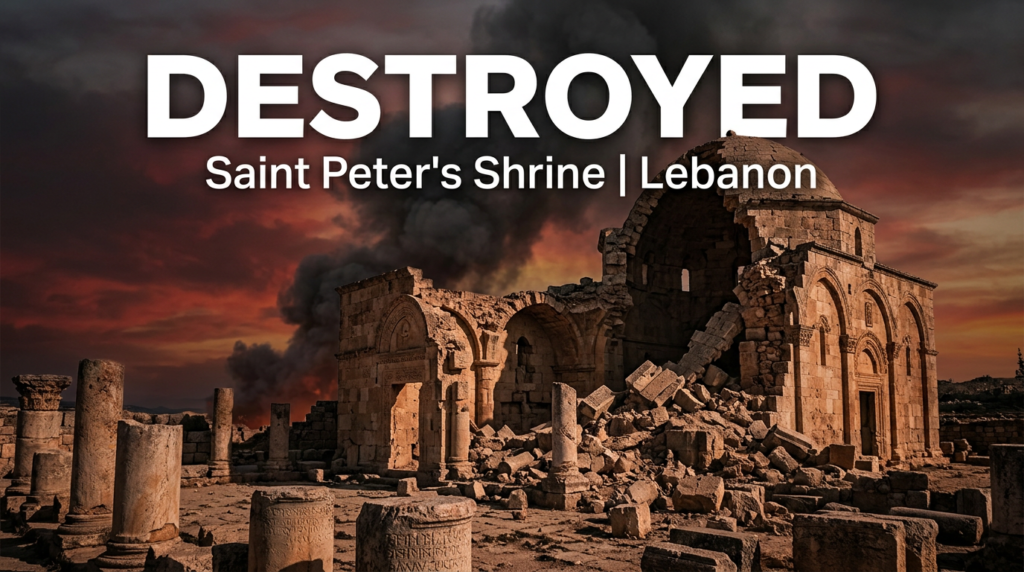
The deliberate demolition of one of Christianity’s most ancient sites raises urgent questions about accountability, international law, and the West’s silence in the face of irreversible cultural destruction.
When Israeli forces detonated explosives inside the Maqam Shamoun Al-Safa — the ancient shrine believed to hold the burial place of Saint Peter, apostle of Jesus Christ — in the Lebanese village of Chamaa on November 15–17, 2024, they didn’t just destroy stone and mortar. They erased nearly two millennia of shared human history. And much of the Western world barely flinched.
The shrine, which archaeological evidence dates to the 1st century CE, sits on a hilltop overlooking Tyre in southern Lebanon. It had survived the Crusades, centuries of war, and even heavy damage in the 2006 Lebanon conflict — only to be blown up with military-grade explosives during Israel’s 2024 ground incursion. CNN verified footage showing plumes of smoke rising from the complex. The grave appeared looted. A 900-year-old adjacent medieval castle was also destroyed. The silence from world leaders was deafening.
Support Independent Local Journalism
TheTownHall.News is a non-profit reader-supported journalism. Just $5 helps us hire local reporters, investigate important issues, and hold public officials accountable across Alameda County. If you believe our community deserves strong, independent journalism, please consider donating $5 today to support our work.Why This Site Matters Beyond Religion
The Maqam Shamoun Al-Safa is not merely a religious landmark — it is a civilizational artifact. Revered by both Shia Muslims (who know Saint Peter as Sham’un as-Safa, “Simon the Pure”) and Christians, it represents one of the rare places on earth where multiple faith traditions share a common heritage. The Fatimid dynasty restored it in 1097 CE; its minaret bears an inscription from that era. Local Shia scholar Yusuf al-Bahrani documented pilgrimages there after 1750. A scholar, a pilgrim, a stonemason — generation after generation — each contributed to a site that predated most of Europe’s cathedrals.
The destruction of heritage sites is not a byproduct of war. It is a message. It says: your history does not matter. When that message is delivered against sites sacred to Christianity — in a region where Christianity was literally born — it demands a response from people of conscience, regardless of political affiliation.
What the Law Actually Says
Under international humanitarian law, specifically the 1954 Hague Convention for the Protection of Cultural Property in the Event of Armed Conflict, the deliberate destruction of cultural and religious heritage is prohibited. The Rome Statute of the International Criminal Court (Article 8) classifies intentional attacks on religious, educational, and historic monuments as war crimes — even in the context of active military operations.
Israel is not a signatory to the 1954 Hague Convention. That loophole matters. But it does not change the moral and legal architecture that the rest of the civilized world has built over 70 years of post-war reckoning. The destruction of the Saint Peter shrine was not collateral damage — it was, according to reporting from the Middle East Monitor, carried out with deliberately placed explosive charges. That is a choice, not an accident.

When a government uses precision explosives to level a 2,000-year-old Christian shrine, the question isn’t whether it happened — it’s why so few people in power are demanding answers.
The Pattern No One Wants to Name
The Chamaa shrine did not fall in isolation. A Euro-Med Human Rights Monitor report from March 2026 documented that Israeli forces have destroyed over 93% of cemeteries in the Gaza Strip. In early 2026, satellite imagery confirmed the bulldozing of the Gaza War Cemetery — a Commonwealth-era burial site containing graves of British, Australian, and other Allied soldiers from World War I. The Israeli military confirmed the damage, attributing it to tunnel-dismantling operations.
What emerges is not a series of isolated incidents but a pattern of cultural and historical erasure that extends across multiple theaters of operation. Whether one supports Israel’s right to self-defense or not — and reasonable people can — the systematic destruction of irreplaceable heritage sites demands independent accountability. Supporting law and order means supporting it universally, not selectively.
What Critics Get Wrong
Some will argue that the Chamaa shrine was located in a combat zone and that Hezbollah’s use of civilian and religious infrastructure as cover makes such damage inevitable. It’s a fair point worth engaging honestly.
Military necessity is a recognized principle in the laws of war. But “military necessity” has legal limits — it cannot justify the deliberate placement of explosives in a historic shrine when there is no documented evidence of that specific structure being used as a weapons cache or command post. The IDF’s own description of the operation frames it as part of a broader scorched-earth approach to deny Hezbollah operational space near the border. That is a policy — and policies have architects, and architects have accountability.
Acknowledging complexity is not the same as excusing what happened. A functioning rule-of-law society — which Western democracies claim to champion — demands that the same standards apply to allies as to adversaries.
Support Independent Local Journalism
TheTownHall.News is a non-profit reader-supported journalism. Just $5 helps us hire local reporters, investigate important issues, and hold public officials accountable across Alameda County. If you believe our community deserves strong, independent journalism, please consider donating $5 today to support our work.The Restoration Effort and What It Tells Us
By November 2025, exactly one year after the destruction, workers were photographed on-site beginning the painstaking restoration of the Maqam Shamoun Al-Safa. Xinhua documented the process in Chamaa. Lebanese communities, rather than waiting for international institutions, took it upon themselves to rebuild.
That image — laborers piecing together ancient stone with their own hands — is more than a human interest story. It is a rebuke. It demonstrates that communities value their heritage enough to fight for it even when their governments cannot, and even when the international bodies tasked with protection have failed them.
The people of Chamaa are rebuilding Saint Peter’s shrine with their bare hands. The least the rest of the world can do is bear witness.
How This Affects Every Believer — and Every Citizen
For Christians specifically, the destruction of a site tied to Saint Peter — the apostle upon whom Christ declared he would build his church — should register as something visceral. Imagine the reaction if a church in Rome or Canterbury were leveled by a foreign military using deliberate explosives. The global response would be immediate and overwhelming.
The geographic distance of Lebanon should not diminish the moral urgency. The same civic instinct that demands governments protect churches, synagogues, and mosques at home — that insists on law, order, and respect for sacred spaces — must extend to ancient sites abroad. Consistency is the bedrock of principle.
Key Takeaway
The destruction of the Saint Peter shrine in Chamaa is not just a Middle East story. It is a test of whether the West’s commitment to the rule of law, cultural heritage, and religious freedom applies universally — or only when politically convenient.
Conclusion: Accountability Has No Expiration Date
The rubble in Chamaa is being cleared. The shrine is being rebuilt. But the questions it raises — about accountability, international law, and the price of silence — will not be rebuilt away.
We live in an era that loudly champions the protection of cultural heritage when the perpetrators are enemies of Western alliance structures. The challenge for honest citizens and honest journalists alike is to apply that same standard without exception. Not because it is politically popular, but because it is right.
The rule of law is only as strong as the will to enforce it consistently. And history’s ledger has a long memory.