Taybeh: Israeli Settlers Seize Factory in Last Christian Village of the West Bank
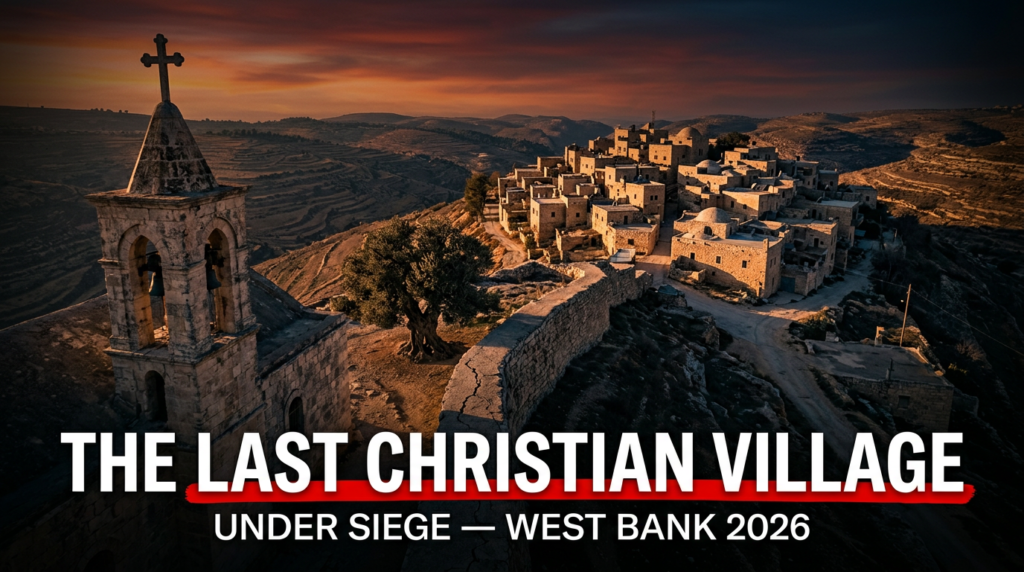
Radical settlers are systematically dismantling the last fully Christian Palestinian community in the West Bank. When a community’s right to exist is erased in plain sight, silence becomes complicity.
On the morning of March 19, 2026, more than 30 Israeli settlers entered a privately owned stone quarry and cement factory on the outskirts of Taybeh — a small Palestinian town of roughly 1,200 to 1,500 people nestled in the West Bank hills north of Jerusalem. They performed religious rituals on the grounds, pitched tents, posted guards to prevent workers from accessing the site, and hoisted an Israeli flag atop one of the plant’s storage tanks.
The factory’s owner, Roland Bassir, attempted to enter his own property. He was physically attacked and turned away. Two decades of hard work, his family’s livelihood, seized in a single morning. No court order. No due process. No accountability. Just raw, coordinated force — and so far, almost no consequences.
Support Independent Local Journalism
TheTownHall.News is a non-profit reader-supported journalism. Just $5 helps us hire local reporters, investigate important issues, and hold public officials accountable across Alameda County. If you believe our community deserves strong, independent journalism, please consider donating $5 today to support our work.Why Taybeh Matters to Every Person of Faith and Principle
Taybeh is not simply another dateline in an already exhausting conflict. It is, by any credible account, the last entirely Christian Palestinian town in the West Bank — a community with roots predating the modern nation-state system, home to Latin Catholics, Greek Orthodox, and Melkite Greek Catholics who have inhabited this land for centuries.
In a region where Christian populations have been quietly declining for decades, Taybeh has stood as a rare symbol of endurance. Its ancient St. George Church ruins date to the 5th century. Its residents have, generation after generation, chosen to stay, build, and worship — not out of stubbornness, but out of a deep belief that their presence matters.
That presence is now under coordinated assault.
A Pattern of Escalation, Not Isolated Incidents
To characterize what is happening in Taybeh as spontaneous violence would be to misread the evidence entirely. This is a documented, escalating campaign.

In July 2025, armed settlers set fire to the surroundings of the historic St. George Church ruins, spray-painted threatening graffiti, and destroyed olive groves. Attacks on homes followed in November and December 2025. In January 2026, settlers carried out violent incursions on private land. By February 5, coordinated raids struck multiple sites in a single day.
Now the town is encircled. According to reports confirmed by the Latin Patriarchate, six settler outposts have been established around Taybeh since 2025 — three to the west, three to the east. A yellow gate controls access on the main road. Soldiers determine who enters. The Khoury family’s famous Taybeh Brewery — a point of pride and economic lifeline — has lost outside visitors, with merchandise shipments to Jerusalem and Bethlehem routinely blocked.
This is not chaos. It is a strategy.
The Government Policy Enabling the Violence
Settler violence does not operate in a vacuum. On February 8, 2026, the Israeli security cabinet approved a sweeping series of measures that dramatically ease Israeli land acquisition in the West Bank. The moves include repealing the longstanding restriction on land sales to Israelis, declassifying land ownership registries so that settler groups can identify and target specific parcels, removing the transaction-permit requirement for purchases, and establishing a government mechanism for large-scale state land acquisitions.
Finance Minister Bezalel Smotrich and Defense Minister Yisrael Katz have stated openly that the objective is to “bury the idea of a Palestinian state.” These are not fringe voices — they are cabinet ministers shaping law.
Support Independent Local Journalism
TheTownHall.News is a non-profit reader-supported journalism. Just $5 helps us hire local reporters, investigate important issues, and hold public officials accountable across Alameda County. If you believe our community deserves strong, independent journalism, please consider donating $5 today to support our work.When government policy clears the legal road, private actors will run down it. The settlers occupying Bassir’s quarry are not operating in defiance of the Israeli state. In a very real sense, they are operating in alignment with it.
The Israel Policy Forum, a nonpartisan research organization, noted that these decisions “carry broad implications for West Bank governance and stability” and represent a significant step toward de facto annexation of territory that Israel has never formally incorporated.
What Critics Get Wrong
Some analysts argue that the violence is exaggerated or that property disputes in conflict zones are inevitable. It is a tempting framing — but it collapses under basic scrutiny.
A Peace Now report published in February 2026 documented more than 1,800 settler attacks across the West Bank in 2025 alone. In those attacks, 838 Palestinians were injured and 9 were killed. Twenty-two Palestinian communities were displaced, with thousands of families evicted from tens of thousands of dunams of land. These are not property disputes. These are dispossessions.
Others suggest that reporting on Palestinian Christians is politically motivated. But the voices raising alarm here are not fringe activists — they are Latin Patriarch Pierbattista Pizzaballa and Greek Orthodox Primate Theophilus III, both of whom made personal solidarity visits to Taybeh following the quarry seizure. The United Nations Alliance of Civilizations issued a formal press statement condemning the attacks on Taybeh’s Christian community in 2025. Aid to the Church in Need, a pontifical foundation, has pleaded publicly: “Do not let Palestinian Christians become a memory of the past.”
When leaders of this stature speak in unison, dismissal is not skepticism — it is willful ignorance.
The Human Cost: Families Fleeing a Town That Should Not Have to Fight to Exist
Since October 2023, 16 families and 10 individuals have emigrated from Taybeh. In a town of 1,200 people, that is not a statistic — it is a hemorrhage.
Father Bashar Fawadleh, the Catholic parish priest of Christ the Redeemer Church, has been remarkably candid: he cannot guarantee his parishioners’ physical safety. His answer has been to preach what he calls “resistance in faith” — a dignified refusal to surrender hope in the face of intimidation. But faith, however strong, does not unlock a factory gate seized by a settler mob.
Roland Bassir’s family built that quarry over 20 years through honest work. They employed local workers. They contributed to a community that had already absorbed more than its share of hardship. His business was not collateral damage. It was the target.
When a man cannot enter his own business without being physically attacked, something fundamental about law and order has broken down.
What Must Be Done
The international community has, broadly, failed Taybeh. Statements of concern are issued and quickly forgotten. The U.N. Office of the High Commissioner for Human Rights released a report in March 2026 confirming that Israel has “accelerated unlawful settlement expansion and annexation,” but formal accountability mechanisms remain paralyzed.
For those who believe in property rights, the rule of law, and the dignity of communities built through faith and labor, the situation demands more than passive observation. The February 8 cabinet decisions must be recognized for what they are: government-enabled dispossession, carried out in increments precisely to avoid triggering the sharp international response that a single dramatic act would provoke.
The residents of Taybeh are not asking for foreign armies. They are asking for something far more basic — the right to go to work, tend their land, worship in their churches, and raise their children in the community their ancestors built. That is not a political demand. It is a human one.
Key Takeaway
Taybeh is a test case for the world’s stated commitments to property rights, religious freedom, and the rule of law. If a 1,500-year-old Christian community can be encircled, its businesses seized, its families driven out — and the world responds with press releases — then those commitments are worth less than the paper they’re printed on.
Stay Informed. Speak Up. Make It Matter.
This story deserves more than one news cycle. Share this article, discuss it with your community, and hold your elected representatives accountable for the positions they take — or fail to take — on what is happening in the West Bank right now. Independent journalism depends on readers who refuse to look away. If this reporting matters to you, support The Town Hall News and help keep critical stories like this one in the public eye.