Trump Uses Defense Production Act to Restart California Oil Production — Exposing a Decade of Failed Energy Policy
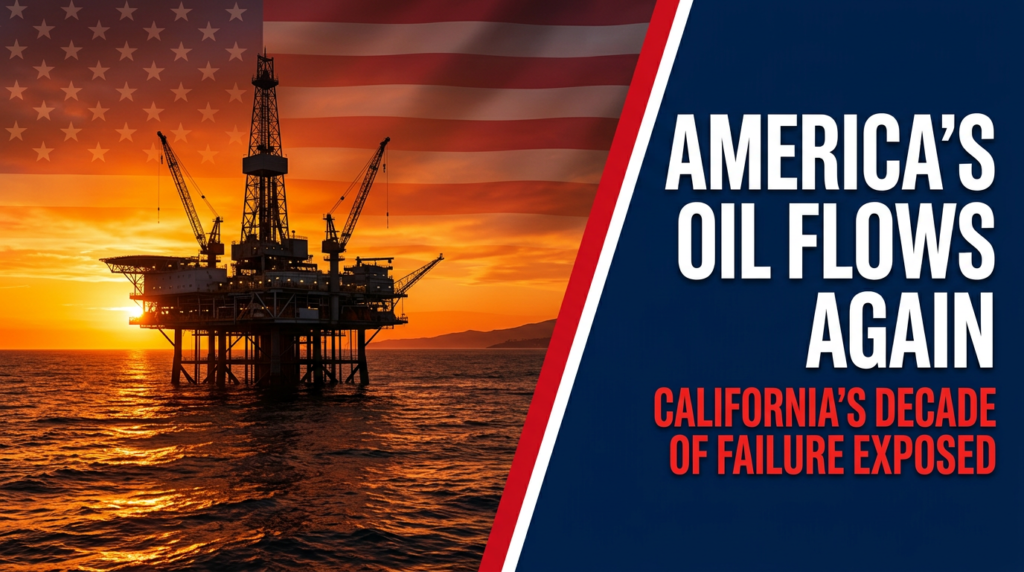
California was paying $5.77 a gallon while sitting on top of untapped offshore oil. Now, for the first time in over a decade, that oil is flowing again — and Sacramento has no one to blame but itself.
California has long prided itself on being a global leader in climate policy. But pride has a price — and right now, drivers across the Golden State are paying it at the pump. As global oil markets reel from the Iran conflict and California’s gas prices surge more than $1.20 per gallon in a single month, a quiet but seismic shift just occurred off the Santa Barbara coast. American oil is flowing again through the Santa Ynez Pipeline System — and it took a presidential executive order to make it happen.
On March 13, 2026, President Trump signed an executive order invoking the Defense Production Act (DPA) — a Cold War-era emergency statute — directing Energy Secretary Chris Wright to order Sable Offshore Corp. to restart operations at the Santa Ynez Unit (SYU). By March 14, oil was moving. By March 29, first commercial sales had begun, with crude flowing directly to Chevron. The pipeline had been idle since a 2015 spill shut everything down. That’s over ten years of domestic oil left in the ground while California shipped tankers in from abroad.
Support Independent Local Journalism
TheTownHall.News is a non-profit reader-supported journalism. Just $5 helps us hire local reporters, investigate important issues, and hold public officials accountable across Alameda County. If you believe our community deserves strong, independent journalism, please consider donating $5 today to support our work.How California Became Dependent on Foreign Oil
The story of California’s energy vulnerability didn’t happen overnight. It was built, policy by policy, regulation by regulation, over the past decade. According to the California Energy Commission, in 2025, 61.1% of the crude oil processed at California refineries was imported from abroad. The state’s top suppliers included Brazil, Iraq, Guyana, Canada, and Ecuador — an ocean away from a coastline sitting atop significant domestic reserves.
Meanwhile, Sacramento spent those years systematically making domestic production harder. Permitting delays, aggressive litigation backed by state officials, and a 2020 federal consent decree requiring California State Fire Marshal approval before any pipeline restart — all combined to keep American oil in the ground. The result was a state structurally exposed to any disruption in global supply chains.
When U.S.-Israeli airstrikes on Iran closed the Strait of Hormuz in early 2026 and global crude prices spiked, California had no buffer. No domestic pipeline access from other states. No reserve production capacity. Just vulnerable refineries scrambling for replacement barrels from Asia.
The Pipeline That Sacramento Didn’t Want Restarted
Sable Offshore Corp., which acquired the Santa Ynez Unit from ExxonMobil in 2024, had spent years trying to legally restart the offshore platforms and pipeline. The infrastructure — Platforms Harmony, Heritage, and Hondo — was fully repaired and hydrotested by May 2025. Sable had done the work. What it couldn’t do was navigate California’s bureaucratic and legal blockade.

A Santa Barbara County Superior Court judge ordered the pipeline to remain shut as recently as February 2026. A separate legal challenge to the federal pipeline permit was already winding through the 9th U.S. Circuit Court of Appeals. Every avenue for a restart was met with another legal wall.
Then the Iran crisis hit — and the walls came down. Not through Sacramento’s goodwill, but through federal emergency authority. The DPA order bypassed the state-level obstacles and directed Sable to immediately resume operations. Sable complied within 24 hours.
“American oil, from American soil, through an American pipeline, to an American refinery — for American consumers and the United States military.” That’s how Sable CEO Jim Flores described the first sales to Chevron on March 29. It’s hard to argue with that framing.
What This Means for California Consumers
The numbers tell a stark story. California’s average gas price hit $5.77 per gallon in late March 2026, compared to a national average of $3.90 — a gap of nearly two dollars. Chevron publicly urged Governor Newsom to declare a state of energy emergency. Chevron executive Andy Walz put it plainly: “California has had very poor energy policy. They’ve put a climate agenda ahead of reliable and affordable energy, and the consequences are that energy in California — any form of it — is unaffordable.”
The Sable restart is expected to add roughly 50,000 barrels of oil per day to California’s supply — a 17% increase in domestic crude entering the state’s market. Platform Harmony is already producing approximately 22,000 barrels per day. Platform Heritage has cleared its final federal safety inspection. Platform Hondo is expected to add another 10,000 barrels per day by end of Q2 2026.
Support Independent Local Journalism
TheTownHall.News is a non-profit reader-supported journalism. Just $5 helps us hire local reporters, investigate important issues, and hold public officials accountable across Alameda County. If you believe our community deserves strong, independent journalism, please consider donating $5 today to support our work.That’s real supply. That’s real relief. And it took an executive order to unlock it.
What Critics Get Wrong
California officials have pushed back hard. Attorney General Rob Bonta filed a federal lawsuit on March 30, arguing the Trump administration overstepped its authority and that no genuine energy emergency exists. “The U.S. already produces significantly more oil and gas than we use,” Bonta said.
Governor Newsom’s office called the restart a drop in the bucket — claiming it represents just 0.05% of total U.S. oil production and would have no impact on global prices. There’s a kernel of truth buried in the political spin: oil is traded globally, and one pipeline won’t reset world markets overnight.
But that argument cuts both ways. If domestic production doesn’t matter, why has California spent a decade fighting so hard to prevent it? Why are California refineries now scrambling for replacement barrels from Asia when infrastructure capable of producing 50,000 barrels a day sat idle off their own coastline? The real cost of California’s energy policy isn’t measured in barrels per day — it’s measured in the $5.77 Californians pay every time they fill up.
Energy Security Is National Security
The Defense Production Act exists for exactly this kind of moment. Energy Secretary Chris Wright framed the order around a hard reality: California policies had left both civilian consumers and U.S. military forces dependent on foreign oil. That’s not hyperbole. West Coast military installations depend on California refineries. Those refineries depend on crude supply. When global supply chains tighten, military readiness follows.
Producing domestic oil is not just an economic issue — it is a defense issue. And when a state’s regulatory framework creates a strategic vulnerability, the federal government has not only the authority but the obligation to act.
There is nothing wrong with caring about the environment. Responsible energy production and environmental stewardship are not mutually exclusive. The Santa Ynez platforms operated safely for decades before 2015. Sable completed its full pipeline repair program by May 2025. Federal safety regulators cleared Platform Heritage just days before it came back online. The infrastructure is sound. What wasn’t sound was allowing legal obstruction and regulatory inertia to keep domestic energy offline indefinitely while the state quietly became one of the most foreign-oil-dependent regions in the country.
A Decade of Decisions, Now Coming Due
California’s oil production decline was not accidental. It was a managed retreat driven by deliberate policy choices — made by elected officials who decided that environmental optics mattered more than energy independence and supply chain resilience.
Now, the consequences of those decisions are visible in real time: at the pump, in the courts, and in a tense standoff between Sacramento and Washington playing out in federal court in San Francisco. California filed its lawsuit. The oil is flowing anyway.
Key Takeaway
California’s energy crisis isn’t a natural disaster. It’s a policy disaster — years in the making, now impossible to ignore. The Trump administration’s use of the Defense Production Act wasn’t political aggression. It was a response to a state that chose ideology over infrastructure and has been asking its own residents to pay the price ever since. Fifty thousand barrels of American oil per day are now flowing again off the California coast.
The only question worth asking is: why did it take an executive order to get here?
This story matters — share it with someone who deserves the full picture. Subscribe to The Town Hall News for independent, fact-based reporting that cuts through the noise. Follow us and engage in the civic conversation your community needs.