Santa Clara Sanctuary Policy Let a Killer Walk Free — Now a Mother, Kembery Chirinos-Flores, Is Dead
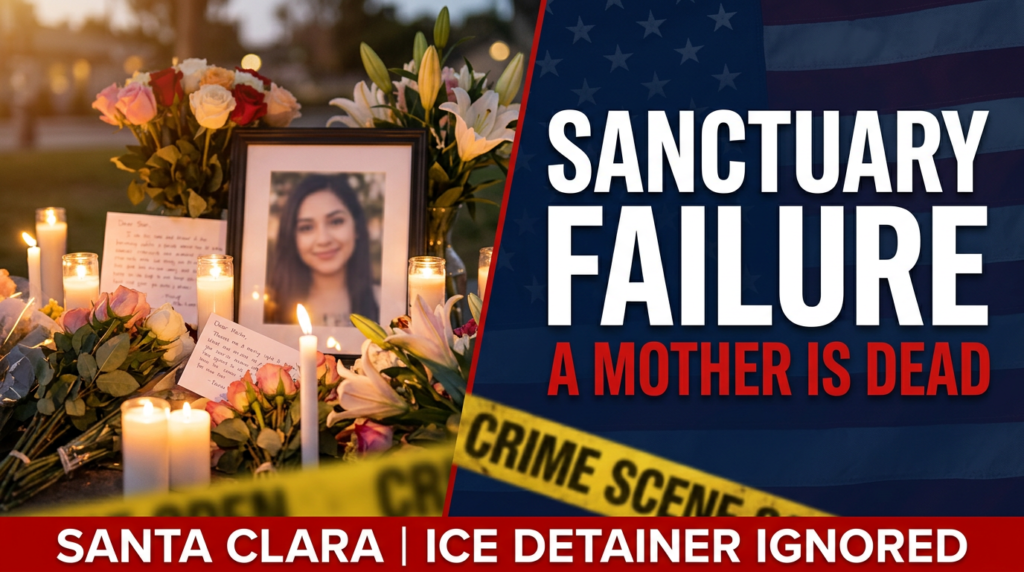
When a California county refuses to honor federal immigration detainers, the consequences aren’t political abstractions — they’re measured in lives. Kembery Chirinos-Flores paid for that policy with hers.
Kembery Chirinos-Flores was 24 years old. She was working two jobs. She was raising a 5-year-old son. On the evening of January 7, 2026, she was shot multiple times inside a car in Sunnyvale, California, and pronounced dead at the scene. Her little boy was in the vehicle. He survived.
Two men have since been arrested for her murder: Gerzon Jose Chirinos-Munguia — the father of her child — and Franquin Inestroza-Martinez, his alleged accomplice. Both are Honduran nationals who entered the United States illegally. Both had criminal histories that should have triggered federal immigration action. And both were living freely in Santa Clara County because local officials chose their sanctuary ideology over public safety.
Support Independent Local Journalism
TheTownHall.News is a non-profit reader-supported journalism. Just $5 helps us hire local reporters, investigate important issues, and hold public officials accountable across Alameda County. If you believe our community deserves strong, independent journalism, please consider donating $5 today to support our work.A System That Failed Kembery at Every Turn
The facts of this case are not in dispute. According to a formal statement released by the Department of Homeland Security on March 30, 2026, ICE had issued arrest detainers for Chirinos-Munguia following two separate prior arrests — once in April 2018 for battery and false imprisonment, and again in September 2019 for domestic battery and threatening behavior with intent to terrorize.
Santa Clara County ignored both detainers. He was released from local custody each time without ICE being notified. He went on to allegedly murder the mother of his own child.
His co-defendant’s record is equally damning. Inestroza-Martinez had been deported from the United States twice — in June 2013 and again in February 2018. He re-entered the country illegally a third time. By the time Kembery was killed, he was already wanted on an outstanding murder warrant from New Jersey, where authorities allege he shot and killed a 55-year-old man in March 2025. That case was still unresolved when he allegedly took another life in California.
This was not a failure of intelligence. Federal authorities knew who these men were. The system had the tools to act. Local officials simply refused to use them.

California’s “Values Act” — and Who Pays the Price
At the center of this tragedy is California’s Senate Bill 54, known as the California Values Act. Signed into law in 2017, it prohibits local law enforcement from inquiring about immigration status during routine interactions and strictly limits cooperation between local agencies and federal immigration authorities, including the honoring of ICE detainers.
Proponents argue it builds trust between immigrant communities and local police. The theory is that if people fear deportation, they won’t report crimes. It’s a reasonable concern — on paper.
But this law did not keep Kembery Chirinos-Flores safe. It kept her killer on the street.
DHS Acting Assistant Secretary Lauren Bis put it plainly in a statement released this week: “Instead of cooperating with ICE, Santa Clara sanctuary politicians refused to honor ICE’s arrest detainer and will not notify ICE when these murderers are released from jail. This insanity of refusing to turn cold-blooded killers over to ICE must end.”
There is no policy framework in which releasing a man with two domestic violence arrests and an active ICE detainer constitutes community protection.
Support Independent Local Journalism
TheTownHall.News is a non-profit reader-supported journalism. Just $5 helps us hire local reporters, investigate important issues, and hold public officials accountable across Alameda County. If you believe our community deserves strong, independent journalism, please consider donating $5 today to support our work.The Law and Order Argument Isn’t Partisan — It’s Practical
Critics of federal immigration enforcement frequently describe ICE detainers as a form of overreach — a tool of political pressure rather than legitimate law enforcement. But a detainer is not a political statement. It is a formal request, based on documented criminal history, asking a local jurisdiction to hold an individual for a defined period so federal authorities can take custody.
Santa Clara County is not a passive bystander in this story. It made an active choice, twice, to release a man with a violent criminal record back into the community over federal objections. That is not civil disobedience in defense of the vulnerable. That is government negligence with lethal consequences.
The personal responsibility argument cuts both ways: we rightly hold individuals accountable for their actions. But elected officials who craft and enforce policies that predictably enable violence must also be held accountable — at the ballot box, in the courts, and in the court of public opinion.
What the Counterargument Gets Wrong
Defenders of sanctuary policy will note, correctly, that the California Values Act has survived multiple legal challenges. The Trump administration’s lawsuits against SB 54 were dismissed at the district level and failed on appeal. The Supreme Court declined to hear the case in 2020.
They will also argue that the vast majority of immigrants — documented or not — do not commit violent crimes, and that broad enforcement damages trust in ways that ultimately make cities less safe.
These are legitimate points, and they deserve serious engagement.
But they do not answer the specific question this case poses: What justification exists for releasing an individual with multiple violent arrests and an active federal detainer? The California Values Act itself includes provisions allowing — though not requiring — local agencies to communicate with ICE about the release of violent offenders. Santa Clara County exercised its discretion. It chose not to.
That choice had a name: Kembery Chirinos-Flores.
A Child Left Behind, A Policy Left Unchanged
Kembery’s 5-year-old son is now in the custody of child protective services. He has no mother. The man who allegedly arranged her killing is his father. That child’s entire world was upended not by an unpreventable tragedy, but by a series of institutional decisions made by adults who were supposed to protect their community.
Congress is currently considering legislation to change the dynamic. Senator Lindsey Graham introduced the End Sanctuary Cities Act of 2026, which would impose criminal penalties on local officials who willfully obstruct ICE enforcement. The House Judiciary Committee has also advanced the Shut Down Sanctuary Policies Act of 2026, which would condition federal funding on compliance with immigration detainer requests.
Whether those bills can overcome political opposition in the current Congress remains to be seen. But the pressure is building — case by case, victim by victim.
The Real Cost of Sanctuary Politics
Sanctuary policies are not free. They carry a cost — one that is not distributed equally. It is not Santa Clara County commissioners who live in neighborhoods where violent recidivists are recycled back into the community. It is not they whose children are left without parents.
The people most harmed by the failure to enforce immigration law are often those in the closest proximity to the individuals the system refuses to remove — frequently, as in this case, members of the same immigrant communities these policies claim to protect.
Law and order is not a slogan. For Kembery Chirinos-Flores, it was a matter of life and death — and the government failed her.
What You Can Do
This story will not stay in the headlines forever. But the policy will remain in place until enough Americans demand change through civic engagement. Stay informed on sanctuary legislation moving through Congress. Contact your federal representatives. Share this story so others understand what these policies mean in practice — not in theory.
Independent journalism that covers these cases without flinching depends on readers who care enough to share, engage, and push back. If this story moved you, make sure others see it.
DHS’s VOICE Office — which supports victims of crimes committed by illegal aliens — can be reached at 1-855-488-6423.
Key Takeaway
Santa Clara County had two documented opportunities to remove a violent repeat offender from the community. It declined both times, citing a state sanctuary law. A 24-year-old mother is dead. Her son has no parent. These are not statistics — they are the direct, traceable consequences of a political choice.