Iran Nuclear Weapons Program Suffers Another Blow as Senior Scientist Dr. Dariush Navid Ali Killed in Karaj
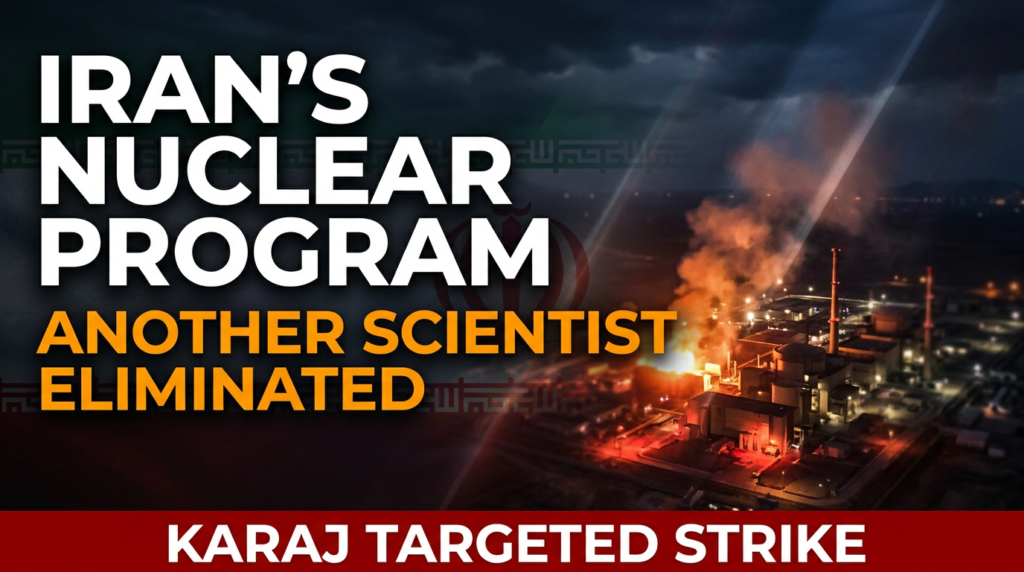
The targeted killing of Dr. Dariush Navid Ali in Karaj is the latest in a methodical campaign to dismantle the Islamic Republic’s secret nuclear weapons apparatus — and it is working.
The message from Karaj, Iran, arrived without fanfare but carried enormous strategic weight: Dr. Dariush Navid Ali, a senior figure in the Islamic Republic’s clandestine nuclear weapons development program, is dead. Killed in a targeted strike in the city northwest of Tehran that has long served as a hub for Iran’s most sensitive defense research, Navid Ali joins a growing list of scientists whose expertise helped sustain one of the world’s most dangerous nuclear weapons programs — a program built on deception, hidden from international inspectors, and funded by the Iranian people at enormous cost.
This is not an isolated incident. It is the latest chapter in the most consequential campaign against nuclear proliferation in modern history — and the stakes for global security could not be higher.
Support Independent Local Journalism
TheTownHall.News is a non-profit reader-supported journalism. Just $5 helps us hire local reporters, investigate important issues, and hold public officials accountable across Alameda County. If you believe our community deserves strong, independent journalism, please consider donating $5 today to support our work.Why Karaj Is Ground Zero for Iran’s Nuclear Ambitions
To understand the significance of this killing, you have to understand Karaj. Located roughly 20 miles west of Tehran, the city is home to a cluster of nuclear and defense-industrial facilities that form the operational backbone of Iran’s weapons research. It is not a coincidence that the city has been targeted repeatedly in the past year.
Iran’s Organization of Defensive Innovation and Research, known by its Persian acronym SPND, is the institutional successor to the Amad Plan — the covert program through which Iran pursued nuclear weaponization before officially “halting” it in 2003 under international pressure. The regime never truly stopped. The SPND kept the knowledge alive, the personnel employed, and the research moving — all under the cover of “defensive” research and bureaucratic obfuscation.
Dr. Navid Ali was described as one of the main faces of this secret apparatus. His death, in a city already scarred by precision strikes, represents not just the loss of one individual, but the continued unraveling of an institutional network that has spent decades lying to the world about its intentions.
The 12-Day War Changed Everything
The watershed moment came in June 2025. Israel’s military campaign — what analysts now call the 12-Day War — dramatically accelerated the decapitation of Iran’s nuclear weapons human capital. According to the Institute for Science and International Security (ISIS), approximately 20 nuclear scientists were killed during that campaign, the majority drawn from the SPND and veterans of the Amad Plan. These were not peripheral figures. They were specialists in multipoint initiation technology, warhead design, high-explosives research, and weapons-grade uranium handling — the precise skill set required to build a bomb.

Israel’s strikes also destroyed the Nour complex, SPND’s headquarters, in a blow the regime struggled to absorb. The White House confirmed that U.S. Tomahawk missiles collapsed the entrances to Isfahan’s underground tunnel complex, where highly enriched uranium was being stored. In March 2026, further strikes targeted SPND’s rebuilt leadership facilities at Lavisan 2/Mojdeh in northeast Tehran — just as Iranian engineers were attempting to reconstitute what had been destroyed.
“Iran’s nuclear weapons program was not dismantled by paperwork and diplomacy — it was dismantled by precision, resolve, and accountability.”
The killing of Dr. Navid Ali in Karaj fits this pattern precisely. Each targeted scientist represents not just a biography ended, but years — sometimes decades — of irreplaceable institutional knowledge removed from the equation.
What the Iranian Regime Doesn’t Want You to Know
Here is what Tehran’s information machine would prefer you ignore: the Islamic Republic has spent billions of dollars — money extracted from ordinary Iranians already crushed by sanctions and mismanagement — on a nuclear weapons program it consistently and publicly denied existed.
Iran International, the Persian-language outlet that has been dogged in its coverage of SPND activities, reported that when Ali Fouladvand — the head of research at SPND and a U.S. State Department–sanctioned figure — was killed in airstrikes in March 2026, Iranian state media described him merely as “an ordinary citizen.” A research chief of a covert nuclear weapons organization. An ordinary citizen.
That is the level of gaslighting the international community has tolerated for thirty years. That tolerance is now over.
Support Independent Local Journalism
TheTownHall.News is a non-profit reader-supported journalism. Just $5 helps us hire local reporters, investigate important issues, and hold public officials accountable across Alameda County. If you believe our community deserves strong, independent journalism, please consider donating $5 today to support our work.The regime’s secrecy wasn’t just a diplomatic inconvenience — it was a direct threat to every nation within range of an Iranian ballistic missile. The program was built on lies told to the IAEA, lies told to European negotiators, and lies told to the Iranian people, who deserved to know where their national treasure was being buried.
What Critics of These Strikes Get Wrong
Critics — particularly those in Western academic and diplomatic circles — have raised objections to targeted strikes on nuclear personnel, arguing they violate international norms, risk escalation, or are ultimately futile because Iran can rebuild. These concerns deserve honest engagement.
The escalation argument is the most serious. Military action always carries risk, and the 2026 Iran conflict has demonstrated that the costs of confrontation are real. No serious analyst dismisses this.
But the alternative these critics implicitly endorse — endless rounds of negotiations with a regime that has repeatedly cheated on every agreement it has signed — carries its own catastrophic risk calculus. The JCPOA, hailed as a diplomatic triumph in 2015, failed to permanently halt Iran’s enrichment program and provided no meaningful mechanism to stop SPND’s weapons work. Iran used the sanctions relief to fund exactly the kind of covert research it was theoretically prohibited from pursuing.
The ISIS threat assessment published in early 2026 concluded that Iran’s ability to build a nuclear weapon in the short term had been “severely damaged.” That is not the outcome of diplomatic cables. That is the outcome of credible, sustained action.
“Every scientist who helped build Iran’s secret bomb was a choice — made by the regime, funded by the people, and hidden from the world. That choice has consequences.”
The Karaj Model: Accountability in Practice
What is unfolding in Karaj, Tehran, Natanz, and Isfahan is, at its core, a story about accountability — the kind that diplomacy consistently failed to deliver.
For decades, the international community operated on the assumption that Iran’s leadership could be persuaded, incentivized, or shamed into transparency. It could not. The regime’s nuclear ambitions were not a negotiating position — they were a survival strategy, a deterrent against regime change, and a source of national prestige within the ideological framework of the Islamic Republic.
The targeted elimination of key personnel — scientists like Dr. Navid Ali who chose to serve that program — represents the enforcement mechanism that treaties and resolutions never provided. It is imperfect. It is costly. But it is producing results that thirty years of diplomacy could not.
The Foundation for Defense of Democracies, analyzing the March 2026 strikes, noted that Israel tracked Iranian nuclear scientists to a secret underground site in northeast Tehran — a facility quietly constructed after the June 2025 campaign precisely to reconstitute capabilities. The response was swift. The message was clear: there is no safe harbor for those who build weapons of mass destruction under cover of state lies.
Key Takeaway
The death of Dr. Dariush Navid Ali is not an isolated news event. It is one data point in a strategic campaign that has, in less than a year, dismantled more of Iran’s nuclear weapons infrastructure than three decades of multilateral diplomacy. The Islamic Republic built its bomb program in secret, maintained it with lies, and funded it with the labor of a population it simultaneously impoverished. The reckoning now underway is not vengeance — it is consequence.
Conclusion: History Will Judge by Results, Not Intentions
There will be those who mourn the erosion of international norms. There will be editorials lamenting the “cycle of violence” and calling for a return to the negotiating table. These voices are not without principle. But they must be weighed against a hard reality: the negotiating table produced the JCPOA, and the JCPOA produced a more advanced Iranian nuclear program, not a safer world.
The killing of Dr. Navid Ali in Karaj, the destruction of SPND’s headquarters, the strikes on Natanz and Isfahan — these are not the opening moves of a reckless adventure. They are the closing moves of a decades-long confrontation that the world’s democracies finally chose to finish.
Iran’s nuclear weapons dream is not yet dead. But it has never been closer to burial. And the free world should be clear-eyed about what made that possible: not goodwill, not diplomacy, not patience — but resolve.
Stay informed. Share this article. Support independent journalism that holds power accountable — wherever that power resides.