Iran War Civilian Infrastructure Strikes Cost $1 Billion a Day And Congress Has No Answers
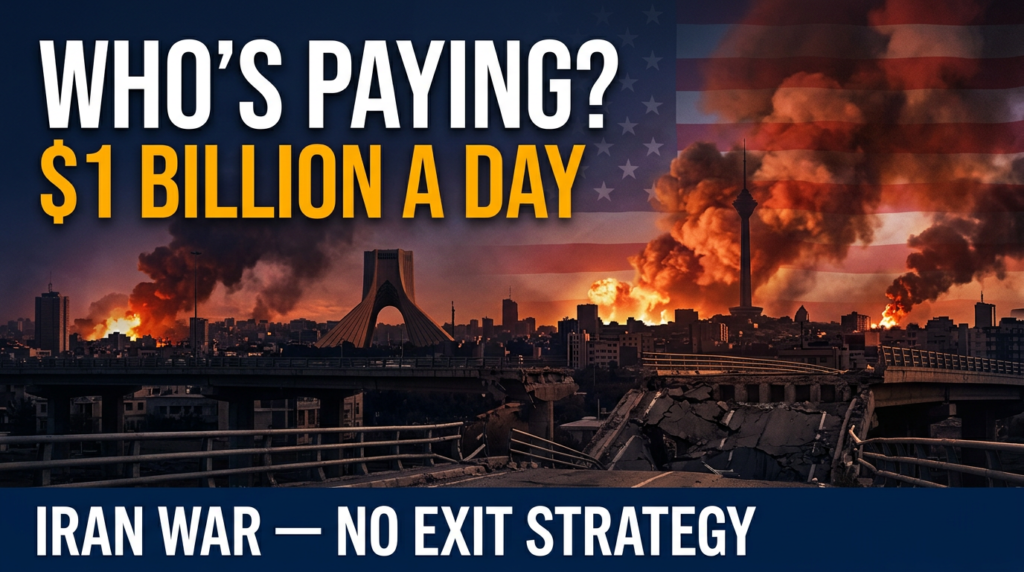
When a military campaign runs out of strategic targets and starts hitting schools, water plants, and cement factories, the American public has every right to ask: what exactly are we paying for — and who authorized it?
Thirteen American service members are dead. The Pentagon is burning through nearly $1 billion a day in taxpayer money. And on Saturday, April 4, U.S.-Israeli forces struck a cement plant, a petrochemical zone, a border crossing, and — for the fourth time — Iran’s Bushehr Nuclear Facility. The World Health Organization issued an urgent alert reporting “multiple attacks on health facilities” in Iran.
This is not the surgical, precision campaign the American public was sold. This is what strategic drift looks like — and it is being funded by you.
Support Independent Local Journalism
TheTownHall.News is a non-profit reader-supported journalism. Just $5 helps us hire local reporters, investigate important issues, and hold public officials accountable across Alameda County. If you believe our community deserves strong, independent journalism, please consider donating $5 today to support our work.A War Without a Clear Mission Statement
The joint U.S.-Israeli campaign against Iran began on February 28, 2026, with nearly 900 strikes in 12 hours. The stated objectives were clear enough: eliminate Iran’s ballistic missile program, degrade its nuclear capability, and pressure the regime toward a negotiated settlement. Those are legitimate national security goals that serious people can debate.
What is far harder to defend is what has happened since.
More than 2,000 Iranian civilians have been killed, according to Iranian government figures — across strikes that have hit a girls’ elementary school in Minab (170 dead, most of them children aged 7 to 12), multiple university campuses, a desalination plant serving 30 villages, and the South Pars gasfield, the largest natural gas reservoir on Earth. A Bank Sepah branch in Tehran was struck in March, killing several employees.
When a military campaign’s target list starts resembling an economic strangulation strategy rather than a counter-proliferation mission, Americans should demand that their elected representatives ask the hard questions — loudly and on the record.

The Fiscal Reality Congress Is Avoiding
The first six days of the Iran war cost U.S. taxpayers $11.3 billion, according to Pentagon figures reported to Congress. By mid-March, the daily burn rate had reached approximately $891 million per day, according to defense policy analysts. The Trump administration is expected to ask Congress for as much as $200 billion in additional war funding in the coming weeks.
For a political movement that rightly demands fiscal discipline — that fought tooth and nail over domestic spending bills, that demanded offsetting cuts for every dollar of new expenditure — the relative silence on Capitol Hill regarding this war’s price tag is striking. Republican lawmakers have largely shrugged, as Politico reported in March. That is not fiscal conservatism. That is fiscal convenience.
The American taxpayer is not an open checkbook. A war that costs nearly a billion dollars a day, with no congressional declaration, no defined victory condition, and an ever-expanding target list, demands the same rigorous accountability we would apply to any other government program.
“A war that costs $1 billion a day with no exit strategy isn’t strength — it’s a blank check written in American blood and borrowed money.”
What the Law Says — And Why It Matters to Everyone
More than 100 international law experts — including faculty from Harvard, Yale, Stanford, and Columbia — signed an open letter published this week warning that American strikes on Iran constitute a “clear violation of the United Nations Charter” and raise “serious concerns about potential war crimes.” The letter specifically called out Defense Secretary Pete Hegseth’s stated preference for “lethality over legality” and his dismissal of rules of engagement as “stupid.”
United Nations Secretary-General António Guterres was more direct: targeting energy infrastructure, he stated, gives “reasonable grounds to think they might constitute a war crime.”
Support Independent Local Journalism
TheTownHall.News is a non-profit reader-supported journalism. Just $5 helps us hire local reporters, investigate important issues, and hold public officials accountable across Alameda County. If you believe our community deserves strong, independent journalism, please consider donating $5 today to support our work.These are not fringe voices. This is the international legal architecture that American diplomats spent decades building — precisely to protect American soldiers and American credibility when future conflicts arose. Dismantling that framework does not make the United States stronger. It makes every future American service member more vulnerable to prosecution, retaliation, and the absence of reciprocal legal protections.
Law and order is not a value that stops at the water’s edge. It is either a principle or it is a posture.
The Regime-Change Gamble No One Voted On
The campaign’s original architects framed it as targeted deterrence. But multiple reports, including analysis from the House of Commons Library, confirm the stated goal has since expanded to regime change — the forced removal of Iran’s governing structure.
Regime change is among the most consequential foreign policy decisions a democracy can make. It requires public debate, legislative authorization, and — crucially — a plan for what comes next. The American public watched what happened in Iraq and Libya when regime change was pursued without those guardrails. The instability those vacuums created cost trillions of dollars, thousands of American lives, and produced regional chaos that persists to this day.
There is no evidence that a post-regime Iran has been planned for, resourced, or even seriously debated in public. The administration has issued threats, set 48-hour ultimatums, and promised more destruction. That is not a strategy. That is improvisation with lethal consequences.
What Supporters of the War Get Right — and Where They Overstep
It is fair to acknowledge what legitimate national security arguments exist here. Iran’s ballistic missile program posed a real threat. Its nuclear ambitions were accelerating. Its proxies destabilized Lebanon, Syria, Yemen, and Gaza for years. A serious, lawful, congressionally authorized campaign to degrade Iran’s military capability is a defensible proposition.
But there is a meaningful difference between degrading military capability and destroying a country’s water supply, schools, and financial institutions. The former is a strategic instrument. The latter is collective punishment — a concept prohibited under the Geneva Conventions regardless of the target nation’s government or ideology.
Supporting American strength does not require supporting every decision made in America’s name. In fact, genuine patriotism demands the opposite: holding power accountable precisely because the stakes are high.
The Questions Every American Should Be Asking
Thirteen service members have given their lives. Two aircraft have been shot down. The Pentagon has spent tens of billions of dollars. Iran has retaliated with missile salvoes, drone strikes on Gulf infrastructure, and threats to close the Strait of Hormuz — a chokepoint through which roughly 20% of the world’s oil supply passes.
What is the definition of victory? When does this end? Who authorized the expansion of targets to include civilian infrastructure? What is the plan for post-conflict Iran?
These are not defeatist questions. They are the questions a functioning democracy asks of every military engagement it funds. They are the questions a responsible press must keep asking, and that engaged citizens must keep demanding their representatives answer.
“Supporting the troops means demanding a strategy worthy of their sacrifice — not writing blank checks and hoping for the best.”
Key Takeaway
The Iran war is consuming American lives and nearly a billion dollars in taxpayer money every single day — with an expanding civilian body count, no declared war authorization, no defined victory condition, and a target list that now includes water plants, schools, and cement factories. Americans who value accountability, fiscal discipline, and the rule of law have not just the right but the responsibility to demand answers from Washington.
Stay Informed. Stay Engaged.
This story is developing rapidly and the stakes — financial, legal, and human — could not be higher. Share this article with anyone who believes in government accountability and the responsible use of American power. Subscribe to The Town Hall for independent journalism that asks the questions the political establishment would rather you didn’t. And contact your congressional representative — because on a war of this scale, your silence is a vote.
Independent journalism depends on readers like you. If this article informed you, share it.