Tulsi Gabbard DNI Firing Rumors Expose a Crisis of Intelligence Integrity in Washington
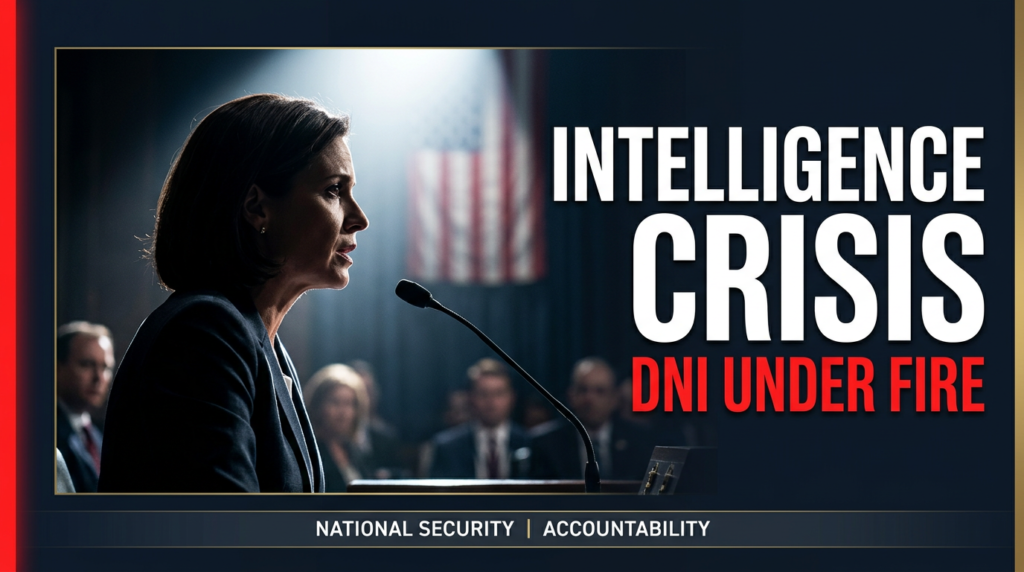
The woman tasked with delivering honest intelligence to the President reportedly skipped over inconvenient facts in Senate testimony. Now her own job is on the line. This story isn’t about one official — it’s about whether America’s intelligence community still answers to the truth.
In the middle of an active war, with American gas prices surging and global shipping routes in crisis, the Director of National Intelligence sat before Congress and chose silence over candor.
On March 18, 2026, Tulsi Gabbard appeared at the Senate Intelligence Committee’s annual worldwide threats hearing. She arrived with written remarks that directly contradicted President Trump’s public claims about Iran’s nuclear program. Then, on live camera, she skipped over those remarks entirely. By early April, The Guardian had confirmed that Trump was privately polling Cabinet members about whether to replace her. A White House that calls the story “fake news” while issuing emergency confidence statements is not a White House at ease. Something is broken — and the American people deserve to understand what it is.
Support Independent Local Journalism
TheTownHall.News is a non-profit reader-supported journalism. Just $5 helps us hire local reporters, investigate important issues, and hold public officials accountable across Alameda County. If you believe our community deserves strong, independent journalism, please consider donating $5 today to support our work.What Happened at the Senate Hearing
The March 18 testimony should be understood for what it was: a senior government official caught between factual reporting and political loyalty, in full public view.
Gabbard’s prepared written remarks — posted on the Senate Intelligence Committee’s own website — stated that Iran had not attempted to rebuild its uranium enrichment capability following U.S. air strikes. That finding came from the intelligence community’s own assessment. It also directly contradicted President Trump, who publicly maintained that Iran was actively rebuilding its nuclear program.
When she delivered her oral remarks, she skipped that paragraph. When Sen. Mark Warner asked why, she replied that “the time was running long.” Sen. Jon Ossoff put it plainly: “You’re evading a question because a candid statement would contradict the White House.”
Seated next to her, CIA Director John Ratcliffe offered no such ambiguity — stating Iran “posed an immediate threat” to the United States. The contrast was a split-screen image of institutional loyalty versus honest analysis. The Director of National Intelligence was on the wrong side of it.

The Joe Kent Resignation: When Principle Meets Politics
The day before Gabbard’s testimony, the crisis had already begun. Joe Kent — a decorated Army veteran, former Special Forces officer, and Director of the National Counterterrorism Center — resigned in protest.
In his resignation letter addressed directly to President Trump, Kent wrote that Iran “posed no imminent threat” and that “it is clear that we started this war due to pressure” rather than intelligence. Kent and Gabbard were ideological allies — both veterans, both skeptics of open-ended foreign engagements. When Gabbard declined to either endorse or repudiate him in testimony, she satisfied no one.
Trump, asked about Kent’s departure at the Oval Office, was blunt: “I always thought he was weak on security. It’s a good thing he’s out.” Asked about Gabbard on April 6, Trump offered a notably lukewarm endorsement — “yeah, sure” — adding she is “a little bit different in her thought process than me, but that doesn’t make somebody not available to serve.”
That is not a ringing defense. That is a president keeping his options open.
When the person responsible for America’s most sensitive intelligence starts filtering facts through a political lens, the entire foundation of informed decision-making collapses.
Support Independent Local Journalism
TheTownHall.News is a non-profit reader-supported journalism. Just $5 helps us hire local reporters, investigate important issues, and hold public officials accountable across Alameda County. If you believe our community deserves strong, independent journalism, please consider donating $5 today to support our work.A Pattern of Disruption Without Accountability
The Iran testimony was not an isolated incident. It was the latest chapter in a tenure marked by aggressive personnel moves that repeatedly outpaced institutional coordination.
In May 2025, Gabbard fired Mike Collins, acting chair of the National Intelligence Council, and his deputy, Maria Langan-Riekhof — both career professionals with more than 25 years of experience. The dismissals followed the NIC’s release of a declassified memo finding no coordination between the Venezuelan government and the Tren de Aragua gang — a conclusion that contradicted the Trump administration’s justification for invoking the Alien Enemies Act to deport Venezuelan immigrants. Gabbard’s office cited their “opposition to President Donald Trump” as the grounds for removal.
Then, in August 2025, Gabbard revoked security clearances for 37 current and former national security officials — without notifying the White House in advance. Revoked clearances included those of congressional aides. According to The Guardian, the White House only discovered the congressional aide revocations after the fact — a breach that reportedly accelerated internal frustration with her leadership.
These actions came without transparent public rationale, independent review, or congressional notification. That is not reform. That is unilateral institutional restructuring without checks.
What Critics Get Wrong — and What They Get Right
Critics have been quick to characterize every Gabbard personnel move as authoritarian overreach. That framing deserves scrutiny.
The intelligence community has a documented history of institutional self-interest — selective leaking, bureaucratic resistance to oversight, and assessments shaped toward consensus rather than honest analysis. The 2002 Iraq WMD failures were not produced by rogue actors. They came from a system under pressure to deliver a predetermined answer. Challenging that culture is not only legitimate — it is overdue.
But the remedy for a politicized intelligence community cannot itself be politicization in the opposite direction. Firing career analysts because their findings contradict White House talking points replicates the exact problem under new management.
The principle must be non-negotiable: intelligence analysis must follow the evidence, not the policy agenda — regardless of which party holds power.
Why Every American Should Care About This
This story is not confined to Washington. It has direct consequences for ordinary Americans.
The war with Iran, which began February 28, 2026, has effectively disrupted the Strait of Hormuz — one of the most critical commercial shipping passages in the world. Gas prices have spiked. Supply chains face new pressure. These are kitchen-table consequences of decisions made in Washington based on intelligence assessments now in dispute within the administration itself.
Americans who believe in limited government and fiscal accountability should ask a direct question: if the intelligence that justified an active war is being contested by the intelligence community’s own professionals — and those professionals are being fired for saying so — what is the real cost of that war, and who is bearing it?
The men and women in uniform deserve to know that the decision to send them into harm’s way was based on fact, not convenience.
The Bigger Standard: Intelligence Integrity Is Non-Negotiable
The Office of the Director of National Intelligence was created after September 11 to prevent the intelligence failures that cost thousands of American lives. Its founding mandate is clear: provide the President with coordinated, honest, unvarnished analysis — free from political interference in either direction.
That mandate doesn’t shift based on who occupies the Oval Office. It is the bedrock of informed governance in a constitutional republic.
If Gabbard is omitting inconvenient paragraphs in Senate testimony because they contradict the administration she serves, that is a dereliction of her core duty. If she is being pushed out because she won’t endorse an intelligence picture she believes is inaccurate, that raises an even graver concern about who controls what the President is told.
Either way, the American public is not being well served.
Conclusion: Accountability Must Apply at Every Level
As of this writing, Tulsi Gabbard remains Director of National Intelligence. The White House publicly denies the firing reports. But the pattern — the NIC firings, the unauthorized clearance revocations, the Senate testimony, the Iran war dissent — tells a story that no press statement fully erases.
The question is not whether Gabbard survives. The question is whether the institutions designed to keep government honest — an independent intelligence community, an informed Congress, and an engaged citizenry — are functioning as designed.
Informed citizens are not spectators in a democracy. They are the final check. Stay engaged. Ask questions. Demand transparency from every level of government — not just from the officials you disagree with.
Key Takeaway: The Gabbard crisis is not a partisan story. It is a stress test of whether America’s intelligence institutions can withstand political pressure from any direction — and whether the public will hold them accountable when they can’t.
If you believe independent journalism and government accountability matter, share this article. Follow The Town Hall News for ongoing coverage of national security, civic governance, and the issues that shape American life.