California’s EDD Paid $4.6 Million for Unused Phones — And Nobody Noticed for 4½ Years
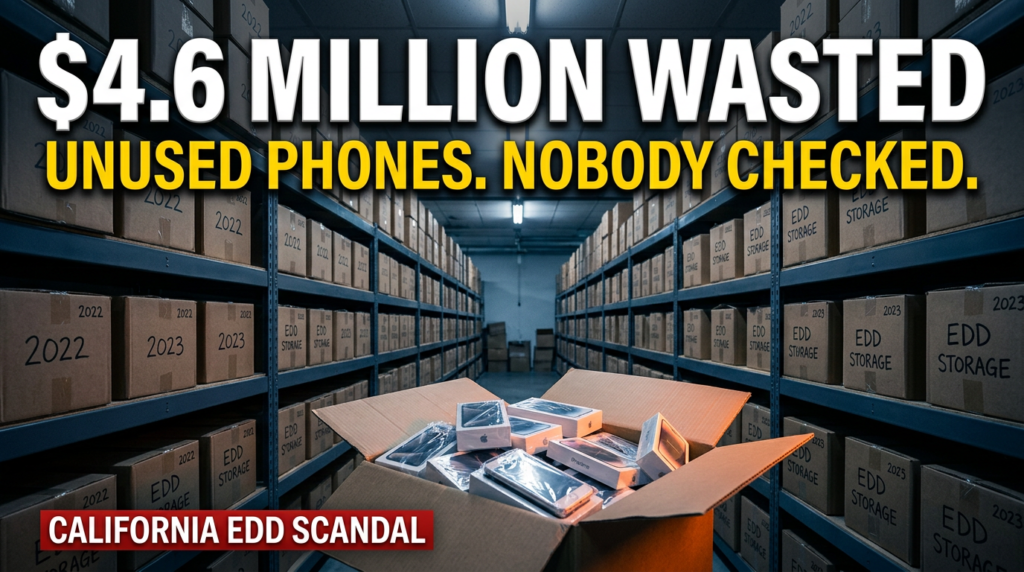
While California faces a $20 billion budget deficit, its own unemployment agency quietly burned through millions in taxpayer dollars on cellphones collecting dust in a storage room. This is what government without accountability looks like.
Somewhere in a California government storage room, hundreds of cellphones sat in labeled cardboard boxes — sealed, unused, and still running up monthly bills paid by taxpayers. The boxes were marked 2022. Then 2023. The bills kept coming. Nobody stopped them.
This is not a minor accounting error. It is a case study in what happens when a government agency grows unchecked during a crisis and faces zero consequences for years of financial negligence. The California Employment Development Department wasted at least $4.6 million in public funds on mobile devices its workers never used — and the agency’s leadership says it didn’t even know.
Support Independent Local Journalism
TheTownHall.News is a non-profit reader-supported journalism. Just $5 helps us hire local reporters, investigate important issues, and hold public officials accountable across Alameda County. If you believe our community deserves strong, independent journalism, please consider donating $5 today to support our work.What the Audit Actually Revealed
In December 2025, the California State Auditor released a report confirming what a whistleblower had suspected: EDD had been paying monthly service fees to Verizon for thousands of unused cellphones and wireless hotspots for over four years — without anyone reviewing the bills.
Auditors reviewed 54 months of invoices dating back to November 2020, when EDD acquired 7,224 mobile devices to support call center workers who shifted to remote work during the COVID-19 pandemic. By the time auditors completed their review, the numbers were staggering.
Half of all acquired devices went unused for at least two years. A quarter sat untouched for three years or more. Ninety-nine phones were never activated once. As of April 2025 — nearly five years after the original purchase — EDD had 1,787 call center employees actively working, but was paying monthly service fees on 5,097 devices. That is nearly three phones per employee, with thousands sitting idle.
The audit photos tell the story: shelves stacked floor to ceiling with sealed cardboard boxes, devices still in original packaging, handwritten notes dated 2022 and 2023. The bills were still running.

“We Were Unaware” — The $4.6 Million Excuse
When confronted by auditors, EDD officials offered a response that should outrage every California taxpayer: they said they were simply “unaware” of the spending.
This was not a purchase hidden in a buried line item. Verizon submitted monthly invoices — month after month, for 54 consecutive months — that clearly identified which devices had zero voice calls, zero messages, and zero data usage. The information was there. Nobody looked.
The State Auditor’s office made no effort to soften its criticism: “We would have expected EDD management to have reconsidered the need to pay the monthly service fees for so many unused devices, especially post-COVID-19.”
The $4.6 million wasn’t stolen. It was simply abandoned — left to bleed out through pure institutional indifference.
This is the definition of government without accountability: systems that spend automatically, managers who monitor nothing, and a culture in which no one is ultimately responsible for anything.
Support Independent Local Journalism
TheTownHall.News is a non-profit reader-supported journalism. Just $5 helps us hire local reporters, investigate important issues, and hold public officials accountable across Alameda County. If you believe our community deserves strong, independent journalism, please consider donating $5 today to support our work.Why This Matters Beyond the Dollar Amount
California is staring down a $20 billion operating deficit heading into the 2026–27 fiscal year, according to the same State Auditor’s report. The governor and legislature are engaged in a painful debate about where to cut services, which programs to reduce, and how to balance competing obligations to millions of residents. Schools, public safety, and infrastructure are all on the table.
And yet a single state agency — already notorious for failing to prevent billions of dollars in fraudulent unemployment claims during the pandemic — was quietly draining the public treasury for unused phones. Not for one month. For four and a half years.
When government agencies cannot perform elementary financial oversight, the taxpayers who fund them deserve to know why. Every dollar spent on a device collecting dust is a dollar unavailable for the services Californians actually need.
A Whistleblower Had to Sound the Alarm
One of the most revealing details in the audit is how it was triggered: not by internal EDD monitoring, not by a routine management review, not by the vendor flagging the anomaly — but by a whistleblower tip.
Someone inside the system saw what was happening, understood it was wrong, and reported it to the State Auditor’s office. Without that tip, the billing would likely have continued indefinitely.
This raises serious questions. If it takes a whistleblower to uncover $4.6 million in waste at a single agency, how many other contracts and service agreements are running on autopilot across California’s government — paid month after month with no one in authority ever reviewing them?
When the only check on government waste is a single brave employee willing to speak up, the system has already failed.
California’s whistleblower laws exist precisely for moments like this. But the better answer is leadership that doesn’t require employees to serve as the last line of defense against basic financial mismanagement.
What Critics Get Wrong
Some will argue that EDD’s original decision was defensible — that buying phones in bulk during a pandemic was a reasonable response to an unprecedented emergency, and that the agency has since taken corrective action. Both claims are partially true.
Procuring mobile devices in early 2020, when millions of Californians were suddenly filing for unemployment and call centers had to pivot to remote work almost overnight, was understandable. Emergency situations demand rapid responses. No reasonable observer faults the original purchase.
But the original purchase is not the issue. The issue is what happened next. The crisis ended. The phones stayed. The bills kept coming. Through two budget cycles, multiple legislative sessions, and a worsening statewide fiscal crisis, not a single EDD manager reviewed the Verizon invoice and asked a fundamental question: Are we actually using these?
Buying 7,000 phones during a crisis is a decision. Paying for 5,097 idle devices across 54 months without review is a failure — one that belongs entirely to the agency’s leadership.
What Happens Now — And What Still Hasn’t
Since auditors flagged the issue in early 2025, EDD has taken some corrective steps. In April 2025, the agency canceled service plans for 2,825 devices. It has since implemented a policy requiring that service contracts be terminated for any device unused for 90 consecutive days.
These are welcome steps — steps that should have been standard practice the moment the pandemic emergency ended. The 90-day policy is not innovative management. It is basic fiscal hygiene that every responsible institution practices as a matter of routine.
Whether anyone at EDD will face real accountability remains an open question. The audit falls under California’s Whistleblower Protection Act, which identifies improper activities but does not compel personnel consequences. Whether the legislature will hold hearings or simply accept the findings and move on will determine whether this produces lasting reform — or becomes another footnote.
Key Takeaway
The EDD phone scandal is not an isolated incident. It is a symptom of an accountability deficit embedded in California’s government — agencies that spend first, check never, and reform only when forced. With a $20 billion shortfall demanding sacrifice from millions of residents, the state cannot keep treating preventable waste as a bureaucratic miscalculation without consequence.
The Bottom Line: Accountability Is Not Optional
Every dollar wasted on a phone sitting untouched in a labeled cardboard box is a dollar that cannot fund a classroom, repair a road, or support a Californian in genuine need. When agency officials say they simply “didn’t know” about $4.6 million in unnecessary charges, they are not offering an explanation. They are proving the case for fundamental reform.
California’s budget crisis will require hard choices. It should also require answers from the people who were entrusted with managing public resources — and failed to manage even a phone bill.
The phones sat untouched. The bills kept coming. Nobody checked. That is the story. And until California’s leaders demand genuine accountability — not just corrective memos issued after the auditors leave — it will keep happening.
If you believe government agencies should be held to the same financial standards as every family and business in California, share this article. Stay informed on government accountability issues, support independent journalism, and make your voice heard with your elected representatives. Civic engagement is the most effective check on institutional waste.