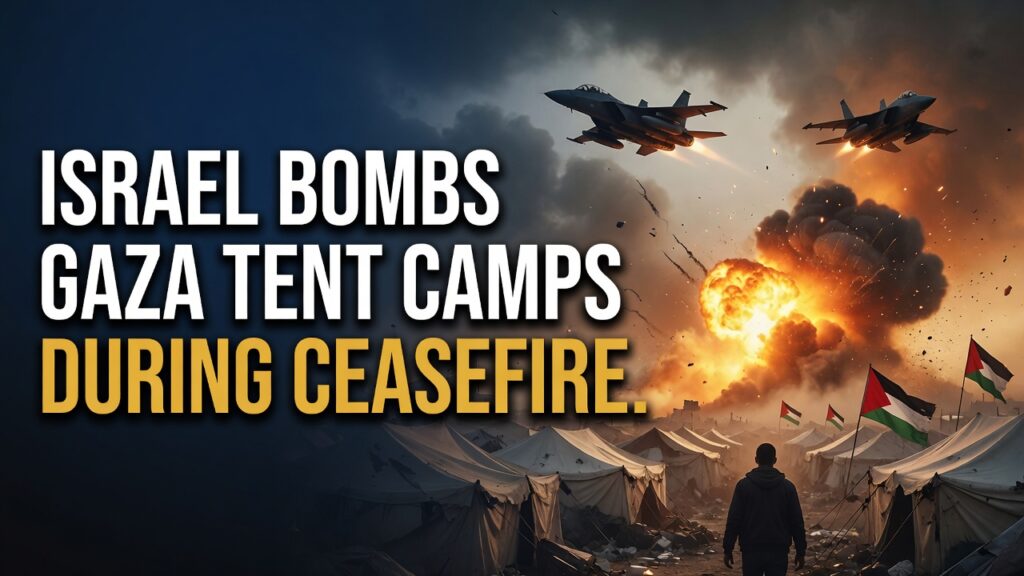
Israel Bombs Gaza Tent Camps During Ceasefire: What Is Happening in Al-Mawasi and Who Is Being Killed?
A child was carrying a watermelon when the missile hit. His father knelt on the hospital floor, sobbing, arms wrapped around his son’s body. This is what a ceasefire looks like in Gaza.
Ahmed Al-Raqab was 11 years old. He was playing outside his family’s tent on the sandy coastline of Al-Mawasi, in southern Gaza, on the afternoon of June 25, 2026. An Israeli missile struck the group of children directly.
“The children were playing and they fired a missile directly on them,” his father, Sabri Al-Raqab, told reporters at Nasser Hospital, his face pressed against his son’s blood-caked cheek. “He was carrying a watermelon. What was this child’s crime? He picked up a watermelon and they fired at him. Is he a fighter? He’s not a fighter. He’s a child.”
Support Independent Local Journalism
TheTownHall.News is a non-profit reader-supported journalism. Just $5 helps us hire local reporters, investigate important issues, and hold public officials accountable across Alameda County. If you believe our community deserves strong, independent journalism, please consider donating $5 today to support our work.Ahmed was not a combatant. He was not near a weapons cache. He was on a beach, in a tent, in an area that Israel itself had designated a civilian “safe zone.”
That is the story of the Gaza ceasefire, now in its 262nd day of violations.
What Is Actually Happening in Al-Mawasi?
Al-Mawasi is a narrow coastal strip in southern Gaza. When Israel ordered mass evacuations of Khan Younis and Rafah during its ground offensive, it directed civilians to Al-Mawasi — telling them it was a designated humanitarian safe zone. Hundreds of thousands of displaced Palestinians obeyed. They built tent cities on the beach out of plastic sheeting and canvas, with no electricity, no running water, and no protection.
Israel has now bombed that same zone repeatedly.

On the night of June 24–25, Israeli forces issued a warning of an imminent airstrike on the coastal encampment west of Gaza City — giving families minutes to flee toward the sea. Then the missile struck, destroying several tents and carving a massive crater into the sand.
“We were sleeping, it was night,” one resident told Drop Site News. “We heard sounds of commotion and disturbance so we went outside to see what was happening, and we found that everyone, in the whole quarter, the whole encampment, was evacuating.”
The next morning, the Yassin family sat on the rubble of what had been their shelter. They had already been displaced from their five-story home in the Al-Zeitoun neighborhood. They had fled south, been displaced again, returned north after the ceasefire announcement, and ended up in a tent on a beach.
“This area here was made up of tents sheltering civilians — displaced people, people who lived through oppression, humiliation, famine, war and siege,” Rana Yassin said. “And the whole place was bombed, the entire area was destroyed.”
The Numbers Behind the Pattern
This is not an isolated incident. This is a pattern.
Support Independent Local Journalism
TheTownHall.News is a non-profit reader-supported journalism. Just $5 helps us hire local reporters, investigate important issues, and hold public officials accountable across Alameda County. If you believe our community deserves strong, independent journalism, please consider donating $5 today to support our work.According to Al Jazeera’s tracking of the ceasefire, Israel has attacked Gaza on 231 out of 256 days since the ceasefire came into effect on October 10, 2025. That leaves just 25 days in nearly nine months during which no violent attacks, deaths, or injuries were recorded.
The Gaza Government Media Office reports 3,338 documented ceasefire violations between October 10, 2025 and June 20, 2026 — through air attacks, artillery, direct shootings, and home demolitions.
Since the ceasefire began, more than 1,041 Palestinians have been killed and 3,372 wounded, according to Gaza’s Health Ministry. By comparison, five Israeli soldiers have been killed since the truce.
The cumulative death toll since October 7, 2023, now stands at 73,054 Palestinians killed and 173,480 wounded. A UN Commission of Inquiry, reported in June 2026, found that children account for approximately 30 percent of reported fatalities — and that children had been deliberately targeted during the conflict, a finding the Commission said was relevant to its assessment of genocidal intent.
Over 73,000 dead. Over 1,000 killed during what is officially still called a ceasefire. And the tents keep burning.
“There Is No Safety. Whatever They Do, Wherever They Go.”
UN Human Rights High Commissioner Volker Türk put it plainly in April 2026: “Palestinians have no blueprint for survival: whatever they do or don’t do, wherever they go or don’t go, there is no safety or protection afforded to them. It is hard to square this with a ceasefire.”
The pattern described by international observers is consistent and documented:
- Israel designates an area as a safe zone and orders civilians to relocate there.
- Civilians comply, building makeshift encampments out of whatever materials remain.
- Israel subsequently bombs those same encampments — sometimes issuing evacuation warnings minutes before, sometimes not.
- Survivors, with nowhere left to go, remain in the rubble.
UN experts formally stated in April 2026 that “targeting areas known to shelter displaced civilians is a grave breach of international humanitarian law,” and described what they called a pattern of “forcible transfer” amounting to ethnic cleansing, with 92 percent of Gaza’s housing stock destroyed and the population displaced multiple times over.
Israel maintains it is targeting Hamas militants embedded among the civilian population. The Israeli military said of the Ahmed Al-Raqab strike that it was looking into the incident.
A Ceasefire in Name Only
The October 2025 ceasefire deal — brokered by the United States, Egypt, Qatar, and Turkey — required full humanitarian aid to flow immediately into Gaza and set out a phased withdrawal of Israeli forces. Neither has happened.
According to the Gaza Government Media Office, only 36 percent of the aid trucks allocated under the ceasefire agreement have actually entered Gaza. Israel has blocked meat, dairy, and vegetables while allowing through snacks and soft drinks. Kerem Shalom remains the only operational crossing for cargo.
The consequences are now systemic. Gaza’s Health Ministry warns that nearly half of all dialysis machines have stopped functioning due to shortages of a medical supply that costs less than one dollar per use. Infant formula for children ages one and two has completely run out at Nasser Medical Complex. Health officials are warning that 650 kidney patients are on the edge of death.
More than one million tons of accumulated waste are piling up across the enclave. Families in tents report outbreaks of scabies and rodent infestations. The water system has nearly collapsed. UNRWA reports some Palestinians have resorted to digging their own wells by hand outside their tents.
This is the infrastructure of a slow extermination, running parallel to the bombs.
The Counterargument: What Israel Says
The Israeli government’s position has remained consistent throughout the conflict. It argues that Hamas systematically uses civilian infrastructure — hospitals, schools, tent camps — for military operations, making those locations legitimate military targets under the laws of war. It states that its warnings before strikes demonstrate good-faith efforts to minimize civilian casualties.
Israel also argues that the ceasefire has been violated by Hamas — pointing to attacks that killed five Israeli soldiers since October — and that it retains the right to strike militants regardless of the ceasefire’s nominal status. The Qassam Brigades have denied involvement in some of those incidents.
It is worth noting that the Gaza Health Ministry, which provides casualty figures, does not distinguish between combatants and civilians. United Nations agencies and independent experts have consistently described its records as generally reliable.
What is harder to explain away is the geometry: missiles landing on children carrying watermelons, on tents in areas Israel itself designated safe, in a coastal strip with nowhere left to run.
Key Questions
Has the ceasefire collapsed in practice while remaining intact on paper? With 3,338 documented violations and 1,041 killed, international observers are openly asking whether the October 2025 agreement functions as anything more than a rhetorical framework.
What accountability mechanisms exist? The International Court of Justice issued an advisory opinion in 2024 urging Israel to end its occupation. The UN Security Council has endorsed the ceasefire framework. Neither has produced enforcement. The International Criminal Court has ongoing proceedings. No enforcement action has followed.
How long can the humanitarian system survive? With dialysis machines failing, infant formula gone, and aid at 36 percent of agreed levels, health officials are using the phrase “slow killing tool” to describe the water crisis alone.
What does “safe zone” mean if it can be bombed? This is not a rhetorical question. It is a legal one. International humanitarian law prohibits attacks on civilian displacement sites. Repeated strikes on areas designated by the attacking party itself as safe zones raise questions that courts, not headlines, may ultimately have to answer.
What a 13-Year-Old Girl Tells Us
On June 28, 2026, a 13-year-old girl named Elaine Al-Farra died at Nasser Medical Complex from severe head wounds caused by Israeli artillery shrapnel near the Bani Suheila roundabout in Khan Younis.
She was not a combatant. She was a child in a tent in a war zone with no exit. On the same day, Israeli forces struck the Tabariyya displacement camp in Al-Mawasi, struck a tent shelter in the Dobait area of Gaza City, demolished homes around the Al-Batsh graveyard in the Tuffah neighborhood, and opened heavy fire in Beit Lahiya in the north.
The ceasefire was in its 262nd consecutive day of violations.
When a 13-year-old girl dying from shrapnel in a displacement camp can be called a routine update, something has gone catastrophically wrong — not just in Gaza, but in how the world is choosing to respond to it.
The Town Hall News covers federal, California, and international accountability. Sources for this article include reporting by Drop Site News, Al Jazeera, PBS NewsHour/AP, NPR, Middle East Monitor, IMEMC News, the UN Office for the Coordination of Humanitarian Affairs, UNRWA Situation Reports, UN OHCHR, and Amnesty International.