$30 an Hour? Alameda County Minimum Wage Gamble Could Cost Small Businesses Everything
A Bold Promise With a Heavy Price Tag
The cost of living in the Bay Area is brutal. That’s not in dispute. Rent is punishing, groceries are expensive, and child care can cost more than a mortgage. So when a coalition called the “Living Wage for All” campaign announced this month that it’s collecting signatures to put a $30-per-hour minimum wage on Alameda County’s November ballot, many residents may have nodded along. Who doesn’t want workers to earn more?
But good intentions don’t balance a small business’s books. And when government mandates — not market forces, not productivity gains, not negotiated contracts — dictate how much every employer in Alameda County must pay, the consequences for the very workers this measure claims to help can be severe, swift, and irreversible.
This is a debate that deserves honesty, not sloganeering. Let’s have it.
Support Independent Local Journalism
TheTownHall.News is a non-profit reader-supported journalism. Just $5 helps us hire local reporters, investigate important issues, and hold public officials accountable across Alameda County. If you believe our community deserves strong, independent journalism, please consider donating $5 today to support our work.What the Measure Actually Proposes
The initiative, organized primarily by the Black Organizing Project and One Fair Wage — a national labor advocacy group — would raise Alameda County’s countywide minimum wage from its current level of approximately $16 per hour to $30 per hour. That is nearly a 90% increase.
The phase-in timelines depend on business size. Large businesses with more than 100 employees and over $1 million in revenue would be required to reach $30 by 2030 — just four years away. Smaller businesses with fewer than 25 workers would have until 2035 to 2037. The county measure would apply to unincorporated areas of the county, while a companion measure targets the City of Oakland directly.
Organizers claim polling by Lake Research Partners shows more than 70% of Alameda County voters support the gradual increase and that economic analysis backs the proposal. But polling support for an idea and the economic reality of implementing it are two very different things.
The Small Business Reality Check
Alameda County is not thriving commercially. Oakland — the county’s largest city — is grappling with a persistently high commercial vacancy rate, a struggling downtown, and the lingering scars of pandemic-era business closures. The City Council itself recently endorsed a measure to give small businesses a tax break — an acknowledgment that local businesses are under enormous financial strain.

Now imagine being the owner of a neighborhood restaurant, a dry cleaner, a small retail shop, or a childcare center in this environment. You are already navigating high rents, rising food and supply costs, and post-pandemic staffing challenges. Under this measure, your labor costs would nearly double within four to ten years.
The economic literature on large, rapid minimum wage increases is far from the settled consensus supporters claim. A landmark study by economists at the University of Washington examining Seattle’s minimum wage increases found that while higher-wage workers benefited, lower-wage workers — the exact workers the policy targets — saw their hours cut and take-home pay reduced. A 2019 study published by the National Bureau of Economic Research found that each 10% minimum wage increase reduces teen employment by 3–5%. When the cost of labor rises steeply, businesses respond — through automation, reduced hours, layoffs, or closure.
The organizers say “it can be done without businesses closing.” But saying it doesn’t make it so.
Government Mandates Are Not a Substitute for Economic Growth
Here is the conservative case stated plainly: the best path to higher wages is a growing, competitive economy — not government-imposed price floors on labor.
When businesses compete for workers, wages rise naturally. When regulations, taxes, and mandates make it harder to operate, businesses leave, contract, or automate. The result is fewer jobs, not better ones.
Support Independent Local Journalism
TheTownHall.News is a non-profit reader-supported journalism. Just $5 helps us hire local reporters, investigate important issues, and hold public officials accountable across Alameda County. If you believe our community deserves strong, independent journalism, please consider donating $5 today to support our work.California already has one of the highest costs of doing business in the United States. It ranks near the bottom of most business climate indices. Alameda County would be, as supporters proudly note, “the first county in the nation” to pass a $30 minimum wage. That is not a badge of honor — it is a warning sign. There is a reason no other county has done this. The economic risks are real.
Personal responsibility and free enterprise are not just abstract principles. They are the mechanisms by which ordinary people build better lives — through work, skill, entrepreneurship, and honest competition. A mandate that prices entry-level workers out of the job market does not build opportunity. It destroys the first rung of the ladder.
Who Pays? The Hidden Costs of Wage Mandates
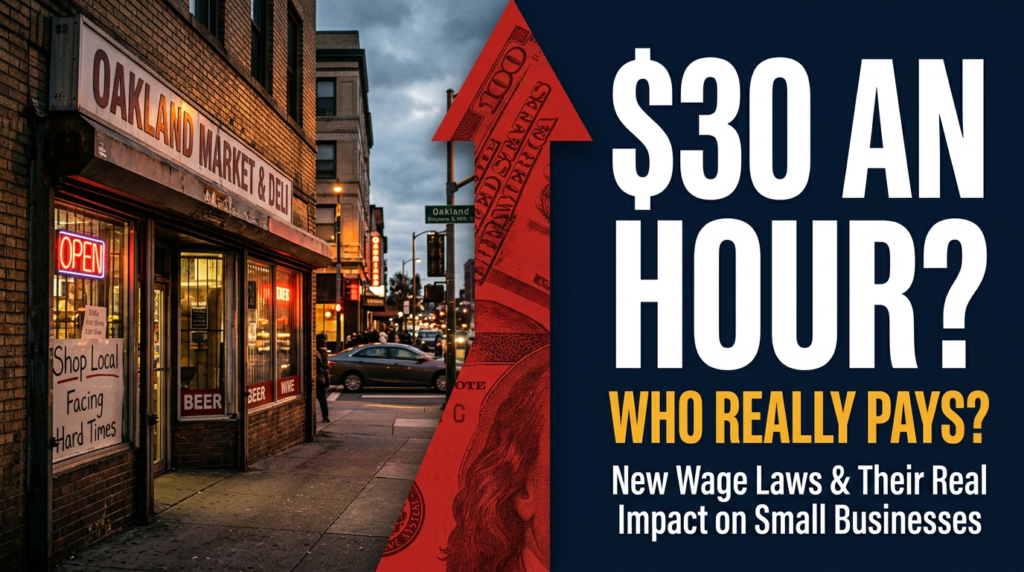
Supporters frame this as a fight between workers and “billionaires.” But the businesses most affected by a $30 minimum wage are not Fortune 500 corporations. They are the taqueria on East 14th Street, the hair salon in San Leandro, the family-owned grocery in Hayward, and the daycare center in Fremont.
When labor costs jump dramatically, these businesses have limited options:
- Raise prices — passing the cost to consumers, many of whom are also working-class residents
- Cut hours — reducing the very income workers were promised
- Lay off staff — replacing workers with self-checkout kiosks, automated ordering, or simply fewer employees
- Close — leaving a vacancy in a neighborhood that already has too many of them
The coalition promises tax credits and technical support to help small businesses comply. But government support programs are notoriously slow, bureaucratic, and underfunded. Asking a small business owner to bet their livelihood on a government support promise is not a plan — it is a gamble with someone else’s savings.
Fiscal Accountability Starts at the Local Level
There is also a broader fiscal question that rarely gets asked: what happens to county and city revenues when businesses close or relocate? Sales tax receipts fall. Property values in commercial corridors decline. The very social services that low-income residents depend on — and that local government funds — become harder to sustain.
Fiscal accountability means thinking beyond the next election cycle. It means asking not just “does this feel good?” but “what are the long-term consequences for the community’s economic health?” A county that drives out small businesses in the name of helping workers may find itself with fewer workers, fewer businesses, and less revenue to fund the services it promised.
The Right Way to Help Working Families
None of this means that the struggles of low-wage workers in Alameda County are not real. They are. The cost of living here is genuinely crushing for families living paycheck to paycheck. The answer, however, is not to impose a blanket wage mandate that ignores the diversity of businesses, industries, and economic conditions across the county.
Better approaches include:
- Targeted tax relief for small businesses that voluntarily raise wages
- Reducing regulatory burdens that make it expensive to hire and retain workers
- Expanding workforce development and job training programs so workers can compete for higher-paying jobs
- Reining in housing costs — the single biggest driver of financial stress for Bay Area workers — through sensible land use reform and permitting streamlining
These solutions respect both the dignity of workers and the freedom of employers. They grow the pie rather than mandate how it’s sliced.
Conclusion: Vote With Your Eyes Open
The Living Wage for All campaign will tell you this measure is about justice, dignity, and economic survival. And the workers supporting it are not wrong to want more. But good policy requires more than good intentions. It requires an honest accounting of consequences.
An almost 90% wage increase mandated by government fiat, imposed on small businesses already struggling to survive in one of the most expensive and over-regulated states in America, is not a path to prosperity. It is a political promise that working families — and small business owners — may end up paying for with their livelihoods.
Alameda County voters deserve the full picture before they sign a petition or cast a ballot. The stakes are too high for slogans.
Call to Action
Stay informed. Get involved. Make your voice heard.
If you own a small business, employ workers, or simply care about the economic future of Alameda County, now is the time to pay attention. The signature-gathering phase has begun — organizers have 180 days to qualify this measure for the November ballot.
Talk to your neighbors. Share this article. Attend a city council or county supervisor meeting. Contact your elected representatives and ask them where they stand. And when the time comes, vote with full knowledge of what this measure will actually cost — not just what its supporters promise it will deliver.
Democracy works best when citizens are informed. Don’t let this one slip by unexamined.
Sources: KTVU FOX 2, The Oaklandside, NBC Bay Area, University of Washington Minimum Wage Study, National Bureau of Economic Research, MIT Living Wage Calculator.