Alameda County Flooding Reveals Infrastructure Failures—Where Did the Money Go?
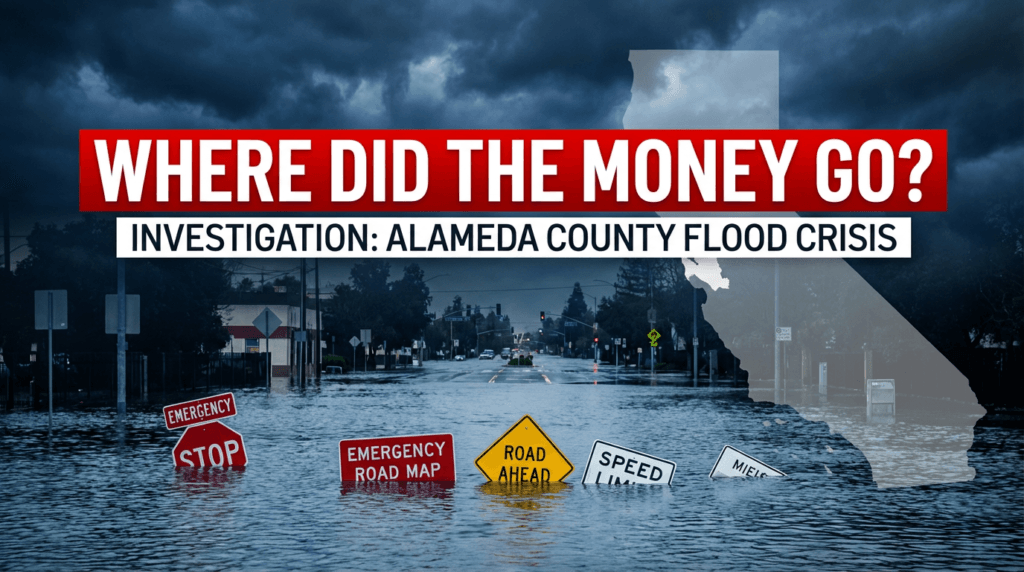
As residents across Alameda County woke up Sunday morning to flood advisories and waterlogged streets, many asked the same question: How did we get here? The combination of record-breaking king tides and persistent rainfall has created dangerous conditions throughout the Bay Area, with coastal flooding reported across multiple counties and roadways submerged from Sausalito to San Rafael. While weather events are inevitable, the scale of disruption reveals a deeper problem—one that should concern every taxpayer who values fiscal accountability and effective governance.
California has spent billions on flood control and infrastructure over the past decade, yet communities continue to face the same vulnerabilities year after year. The current flooding in Alameda County isn’t just a natural disaster; it’s a failure of government priorities, planning, and stewardship of public resources. For conservatives who believe in limited but effective government, this situation exemplifies everything wrong with California’s approach to public infrastructure: bloated budgets, misplaced priorities, and a chronic inability to deliver results that protect citizens and their property.
The Real Cost of Neglect
The Alameda County Flood Control District has been sounding alarm bells for years. Following the January 2023 storms that caused $67 million in damage to the county’s public infrastructure, district officials openly admitted they lack sufficient funding to maintain and upgrade critical flood control systems. Yet California’s 2025-26 state budget allocates $228.9 billion in general fund spending—a staggering sum that raises an obvious question: If we can’t protect communities from predictable weather events with this level of spending, what exactly are we paying for?
Support Independent Local Journalism
TheTownHall.News is a non-profit reader-supported journalism. Just $5 helps us hire local reporters, investigate important issues, and hold public officials accountable across Alameda County. If you believe our community deserves strong, independent journalism, please consider donating $5 today to support our work.Governor Newsom’s budget proposal includes $1.2 billion from Proposition 4 climate bonds for various environmental projects, with nearly $890 million designated for water projects. An additional $173.1 million is earmarked specifically for flood management projects. These aren’t small numbers. For perspective, that’s enough money to build world-class infrastructure that could withstand not just king tides and winter storms, but the challenges of the next several decades.
The problem isn’t a lack of funding—it’s how that funding is allocated and managed. When government grows too large and priorities become too diffuse, essential services like flood control get lost in a sea of competing interests, each with their own constituency and political backing. This is precisely why conservatives advocate for focused, accountable government that does a few things exceptionally well rather than many things poorly.
Personal Responsibility Meets Government Accountability
Conservatives believe strongly in personal responsibility, and that principle applies equally to government. When public agencies receive taxpayer dollars to perform specific functions—like maintaining flood control infrastructure—they have a responsibility to deliver results. The current flooding situation suggests a fundamental breach of that responsibility.
Consider what’s at stake for ordinary citizens. Homeowners who pay property taxes, insurance premiums, and various fees expect that government will maintain basic infrastructure to protect their investments. Small business owners who contribute to the local economy through taxes and job creation deserve functional drainage systems and maintained waterways. These aren’t unreasonable expectations; they’re the core functions of local government.
Yet when flooding occurs, it’s individual property owners who bear the immediate costs: water damage, lost business revenue, vehicle repairs, and the time and stress of dealing with insurance claims. Meanwhile, the government agencies responsible for prevention face little direct accountability. Budgets may be adjusted, reports may be written, but the same vulnerabilities persist year after year.
This imbalance violates a fundamental conservative principle: those who control resources must be accountable for results. If private contractors performed this poorly, they’d lose their contracts. If businesses failed this consistently, they’d go bankrupt. Government agencies, insulated from market forces and competition, continue operating regardless of performance.
Infrastructure vs. Ideology
One revealing aspect of California’s budget priorities is how infrastructure spending competes with ideological projects. While the Alameda County Flood Control District struggles with insufficient funding for basic maintenance, California allocates substantial resources to programs that advance political agendas rather than protect citizens.
The state’s emphasis on climate bonds and environmental programs often prioritizes long-term climate adaptation over immediate infrastructure needs. While planning for sea level rise has merit, communities need functional flood control systems today, not decades from now. This represents a failure to prioritize—a common problem when government tries to solve every problem simultaneously rather than focusing on core responsibilities.
Conservatives understand that government must make choices. Resources are finite, even in a state with California’s massive budget. The question is whether those choices reflect the genuine needs and priorities of citizens, or whether they serve the preferences of politicians and special interests. When roads flood, businesses close, and families evacuate their homes while billions flow to other initiatives, the answer becomes clear.
Support Independent Local Journalism
TheTownHall.News is a non-profit reader-supported journalism. Just $5 helps us hire local reporters, investigate important issues, and hold public officials accountable across Alameda County. If you believe our community deserves strong, independent journalism, please consider donating $5 today to support our work.The Path Forward: Accountability and Reform
Addressing Alameda County’s flooding vulnerability requires more than additional spending—it demands structural reform of how infrastructure projects are planned, funded, and executed. Several principles should guide this reform:
Transparent Performance Metrics: Flood control districts and water management agencies should publish clear, measurable goals with regular public reporting. Taxpayers deserve to know whether their investment is reducing flood risk or simply funding bureaucracy.
Competitive Contracting: Where possible, infrastructure maintenance and improvement should involve competitive bidding from private contractors. Competition drives efficiency and innovation while reducing costs.
Local Control and Flexibility: Communities understand their specific vulnerabilities better than distant state agencies. Local flood control districts should have greater autonomy to address their unique challenges without excessive state-level mandates.
Maintenance-First Budgeting: Before funding new initiatives, agencies must demonstrate they’re adequately maintaining existing infrastructure. Neglecting current systems to build new ones is fiscally irresponsible and ultimately more expensive.
Liability and Consequences: When agencies fail to maintain infrastructure that leads to preventable damage, there should be meaningful consequences—whether through leadership changes, budget adjustments, or other accountability measures.
Beyond Flood Control: A Broader Lesson
The flooding in Alameda County represents a microcosm of broader governance challenges facing California and other high-tax, high-regulation states. Despite collecting enormous tax revenue, these governments often struggle to deliver basic services effectively. Roads deteriorate, schools underperform, crime rises, and infrastructure crumbles while budgets balloon and new programs proliferate.
This isn’t an argument against all government spending or public infrastructure investment. Rather, it’s a call for government to focus on its core responsibilities and execute them with excellence. When government does fewer things but does them well, everyone benefits. When it attempts everything, essential functions suffer.
For conservatives, this principle extends beyond flood control to education, public safety, transportation, and other fundamental services. Limited government isn’t about doing nothing—it’s about doing important things effectively and being accountable for results.
Conclusion: Demanding Better
As floodwaters recede and Alameda County residents assess the damage, they have every right to demand answers and accountability. The combination of king tides and rainfall was predictable; the inadequate response was preventable. Billions in state spending should translate into resilient infrastructure that protects communities, not bureaucratic expansion that leaves citizens vulnerable.
Conservative principles—fiscal accountability, limited but effective government, and personal responsibility—offer a framework for addressing these failures. Taxpayers shouldn’t accept endless spending increases without corresponding improvements in service delivery. Citizens shouldn’t tolerate government agencies that prioritize political agendas over core functions. And communities shouldn’t remain vulnerable to predictable weather events when they’re paying premium prices for protection.
The flooding in Alameda County is more than a weather story—it’s a governance failure that demands reform. The question is whether California’s political leadership will acknowledge the problem and implement real solutions, or whether they’ll simply request more funding for the same broken system.
Call to Action
If you’re frustrated by seeing the same infrastructure failures year after year despite ever-increasing government spending, it’s time to make your voice heard. Contact your local representatives and demand transparent accountability for flood control spending. Attend Alameda County Flood Control District meetings and ask tough questions about budget priorities and performance metrics. Share this article with neighbors and fellow taxpayers who deserve to know where their money is going—and why it’s not protecting their property.
Stay informed about local infrastructure issues by following your county flood control district’s public meetings and budget reports. Support candidates who prioritize core government functions over ideological pet projects. And most importantly, remember that government accountability starts with engaged citizens who refuse to accept poor performance and broken promises.
The next storm is coming. The question is whether we’ll be better prepared—or whether we’ll repeat the same cycle of flooding, damage, and excuses. The answer depends on whether citizens demand better and hold their government accountable for delivering it.