Alameda County Homeless Count: Why This Two-Year Headcount Matters More Than Ever
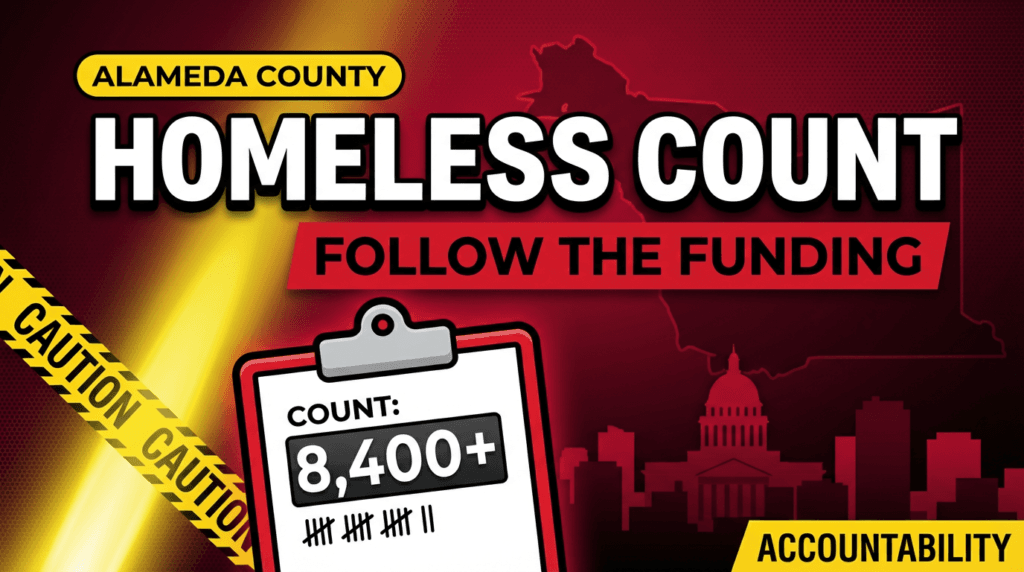
On a single night in Alameda County, hundreds of volunteers and public officials fan out across streets, shelters, and encampments to do something that sounds simple but carries huge consequences: count how many people are homeless.
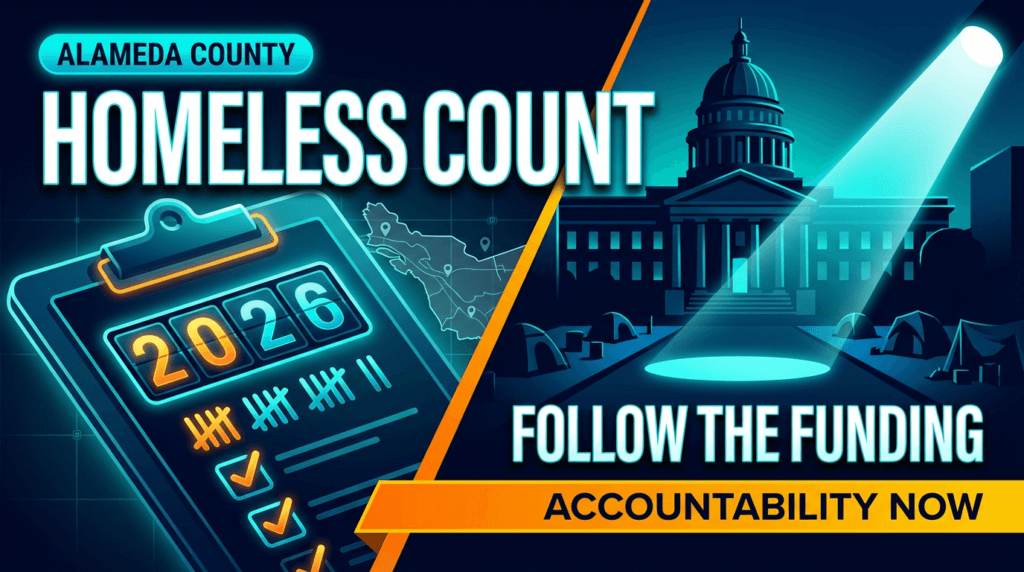
NBC Bay Area reports Alameda County began its biennial homeless count on Thursday, Jan. 22, 2026, with county leaders and volunteers meeting at Hayward City Hall before heading out. The county hopes to see a decrease like it did two years ago, and the stakes aren’t merely symbolic: the federal government requires these counts every two years and uses them to help determine how much funding local jurisdictions receive. In short, this count is not just a statistic—it’s a financial and policy lever.
Source: NBC Bay Area
For a news-and-opinion audience that values fiscal accountability, limited government, law and order, and personal responsibility, this is a moment worth pausing on. Because if we can’t accurately measure the problem—or honestly evaluate which approaches reduce suffering and restore public order—we will keep paying more for outcomes no one should accept.
Support Independent Local Journalism
TheTownHall.News is a non-profit reader-supported journalism. Just $5 helps us hire local reporters, investigate important issues, and hold public officials accountable across Alameda County. If you believe our community deserves strong, independent journalism, please consider donating $5 today to support our work.What the Homeless Count Is—and What It’s For
The “point-in-time” count typically aims to measure the number of people who are homeless on a given night, including those in shelters and those living outdoors. Alameda County’s count, according to NBC Bay Area, is conducted because the federal government requires the headcount every two years to help determine funding levels.
Source: NBC Bay Area
That requirement should immediately raise two questions taxpayers are right to ask:
- Does the count reflect reality well enough to justify the spending it triggers?
- Are we using the resulting funds in ways that actually reduce homelessness—and restore safe, usable public spaces?
These are not anti-compassion questions. They are pro-compassion and pro-results questions. A system that spends billions while leaving vulnerable people on sidewalks is not compassionate; it’s institutionalized neglect dressed up as virtue.
The Conservative Case: Help People—But Measure Outcomes and Enforce Standards
A conservative approach starts with an unfashionable truth: human dignity includes expectations. It includes the right of families to use parks without fear, the right of small businesses to operate without harassment, and the right of residents to walk through their neighborhoods without stepping over needles or dodging erratic behavior.
At the same time, it also includes the duty to help people in crisis in ways that restore stability, not merely manage decline.
That’s why the count matters. It is a rare, official moment when government must look at the results of its choices. If homelessness is down, we should ask why—and replicate what worked. If it’s up, we should stop pretending that the next budget increase will magically fix what the last budget increase couldn’t.
Fiscal Accountability: Counting Should Lead to Auditing
Because the count influences funding, it should also trigger a parallel process: a public, plain-English accounting of what the county has funded and what outcomes followed.
Taxpayers deserve a clear ledger:
- How much went to shelter beds, mental health treatment, substance-use treatment, street outreach, encampment management, and housing placement?
- How many people moved from the street into stable housing?
- How many returned to homelessness within 6–12 months?
- How many declined services repeatedly?
- What portion of spending went to administration versus direct services?
None of this is cruel. It’s basic stewardship. Families have to balance budgets; counties should too. If the count is used to justify more money, it should also be used to justify more transparency.
Support Independent Local Journalism
TheTownHall.News is a non-profit reader-supported journalism. Just $5 helps us hire local reporters, investigate important issues, and hold public officials accountable across Alameda County. If you believe our community deserves strong, independent journalism, please consider donating $5 today to support our work.A limited-government mindset doesn’t mean “do nothing.” It means do what works, stop funding what doesn’t, and tell the truth about both.
Law and Order: Compassion Requires Public Standards
The hardest conversation is also the most necessary one: public disorder isn’t merely an aesthetic problem—it’s a safety problem, a public health problem, and a quality-of-life problem.
When encampments expand, communities often see:
- Increased calls for service
- Fires and hazardous conditions
- Theft, intimidation, and property crime
- Unsanitary conditions and environmental damage
A humane system can’t accept a permanent “campground city” as normal. And it doesn’t have to. The conservative principle here is straightforward: public spaces are for everyone, and government’s first responsibility is to maintain basic order so normal life can function.
That means Alameda County and its cities should pair services with clear boundaries:
- Offer shelter and treatment.
- Enforce laws against violence, theft, vandalism, public drug use, and illegal dumping.
- Require accountability when public resources are offered—and refused—over and over.
You can’t rehabilitate a community by giving up on standards.
Personal Responsibility: Services Should Be a Bridge, Not a Lifestyle
Many people experiencing homelessness are dealing with serious trauma, mental illness, job loss, or addiction. The moral response is to offer real help. But real help is not the same as indefinite enablement.
A conservative framework insists on a distinction:
- Temporary assistance that stabilizes people and connects them to work, treatment, and family supports.
- Permanent dependency where the system becomes a revolving door—expensive, demoralizing, and ultimately inhumane.
The point of shelter, transitional housing, and treatment is to be a bridge back to stability. When agencies are rewarded for “serving” more people without measuring how many regain independence, the incentives are backward.
The homeless count is a chance to reset those incentives. If the number isn’t improving, it’s time to ask whether our policies are actually moving people out of homelessness—or merely documenting it.
Parental Rights and Traditional Values: Safe Communities Are Not Optiona
Parents should not have to accept needles near playgrounds as “the price of compassion.” Schools should not have to manage encampments near student routes as a routine operational issue. Families should not feel unsafe using public transit or walking to the store.
A community that can’t protect its children’s everyday spaces is a community failing one of government’s most basic duties.
Traditional values—family stability, work, responsibility, neighborliness—are not abstract ideals. They are the social infrastructure that prevents homelessness in the first place. Policy should strengthen them, not undermine them.
That means prioritizing:
- Policies that make it easier to work and start businesses
- Public safety that makes neighborhoods livable
- Education and job training that lead to real employment
- Treatment systems that actually treat, not just refer
Free Speech and Honest Debate: Stop Shaming Questions as “Hate”
One of the most damaging trends in homelessness policy is the way legitimate questions are treated as moral failures.
Asking “What did we spend?” is not hate.
Asking “Did it work?” is not cruelty.
Asking “Why are parks unusable?” is not bigotry.
If Alameda County wants public trust, it must welcome scrutiny—especially from the taxpayers funding the response and the residents living with the consequences.
A healthy civic culture allows disagreement without demonization. It makes room for a simple proposition: compassion and accountability belong together.
What a Better Path Could Look Like
If the goal is fewer people suffering on the streets and fewer neighborhoods sliding into disorder, the way forward is not complicated—even if it’s politically difficult.
A practical, conservative-leaning reform agenda would emphasize:
- Results-based funding
Renew contracts based on measurable outcomes—placements, stability, reduced repeat homelessness—not process metrics. - Treatment capacity with clear expectations
Expand access to mental health and addiction treatment, while requiring engagement when someone repeatedly cycles through crisis. - Shelter-first triage—then long-term stability
Prioritize safe, structured shelter and transitional options that connect to work and treatment. Permanent solutions should be targeted to those who truly need them. - Enforce laws consistently
Compassion doesn’t require surrendering sidewalks. Enforce laws against illegal dumping, theft, vandalism, and public drug use while providing pathways off the street. - Radical transparency
Publish spending dashboards and outcomes in plain language—monthly, not annually.
None of this denies human dignity. It protects it.
Conclusion: The Count Is a Mirror—Don’t Look Away
The Alameda County homeless count is a mirror held up to government, nonprofits, and the broader public. It will influence funding and shape the next cycle of policy decisions. But the most important question isn’t how many people are counted—it’s what we do after the number is known.
A serious, humane, conservative approach rejects two failures at once: callousness toward people in crisis and complacency about policies that perpetuate crisis.
We can insist on help that works, order that protects everyone, and spending that produces results. And we can do it without demonizing anyone—by telling the truth, setting standards, and demanding accountability.
Call to Action
If you live in Alameda County, don’t let the homeless count be a once-every-two-years headline. Ask your city council and county supervisors what outcomes your tax dollars are buying. Attend public meetings, request transparent reporting, support organizations that deliver measurable results, and share this article to keep the conversation grounded in facts—not slogans.
Stay informed. Get involved. And insist—politely but firmly—that compassion comes with accountability.
Fact-check note: The specific details about the count’s timing, location (Hayward City Hall), and its federal funding connection are drawn from NBC Bay Area’s report: “Alameda County begins biennial homeless count”.