HUD Homelessness Funding Freeze: Why Accountability Beats Dependency
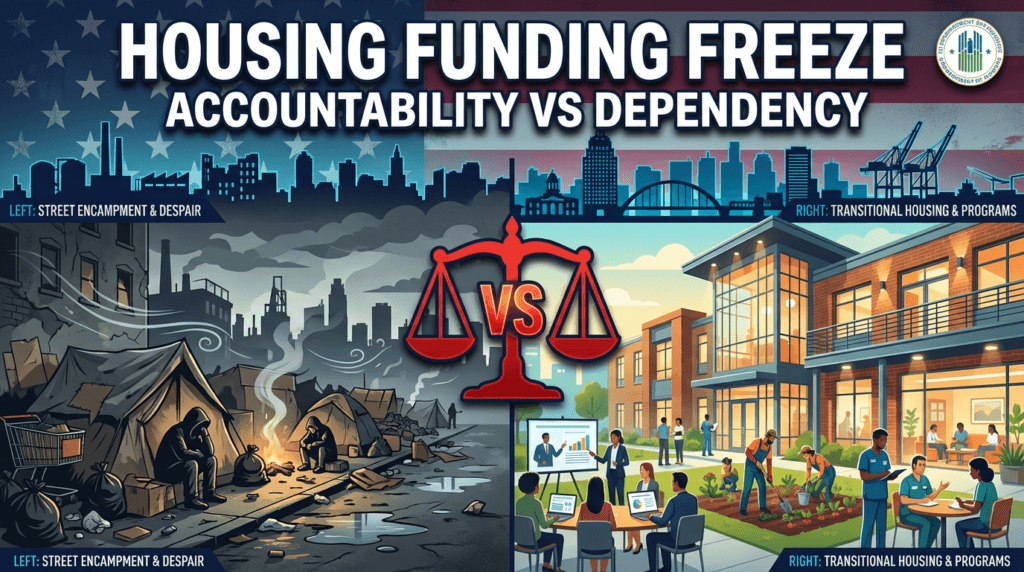
The Trump administration’s pause on Continuum of Care (CoC) grant changes has left Alameda County homeless service providers in limbo—and local advocates are furious. But before we accept the narrative that federal reform is “cruel” or “evidence-free,” let’s examine what’s actually happening and why a conservative approach to homelessness might be exactly what struggling communities need.
According to Oakland North, HUD proposed reallocating hundreds of millions of dollars from permanent housing projects to temporary shelter and addiction treatment programs. Alameda County received $56 million in CoC grants last year, with 86% going to permanent housing. The proposed policy would have capped permanent housing spending at 30%, shifting resources toward transitional housing with treatment and accountability requirements.
After lawsuits from 21 states and local coalitions, HUD temporarily withdrew the proposal. But the debate it sparked reveals a fundamental question: Should federal homelessness policy prioritize endless subsidies, or should it demand results?
Support Independent Local Journalism
TheTownHall.News is a non-profit reader-supported journalism. Just $5 helps us hire local reporters, investigate important issues, and hold public officials accountable across Alameda County. If you believe our community deserves strong, independent journalism, please consider donating $5 today to support our work.Primary reporting source: Oakland North.
(Oakland North: “Trump’s push to shift housing policy leaves Alameda County providers in limbo”)
What “Housing First” Actually Means (And Why It’s Failing)
“Housing First” sounds compassionate. The model prioritizes getting people into permanent housing regardless of sobriety, mental health treatment, or criminal history. The theory: stable housing enables recovery.
But after years of implementation and billions in spending, homelessness has gotten worse, not better.
HUD Secretary Scott Turner didn’t mince words in his November 13, 2025 announcement, calling the prior approach a “Biden-era slush fund” that “fueled the homelessness crisis” and “incentivized never-ending government dependency.” According to HUD’s own data, roughly 90% of CoC awards over the last four years supported Housing First programs, while transitional housing (which includes treatment and accountability) received less than 2% of funding.
Turner’s reform proposal aimed to:
- Increase competition for grants (from 10% to 70% of projects competed),
- Redirect funding to transitional housing with treatment requirements,
- Promote self-sufficiency rather than perpetual subsidies,
- Encourage faith-based providers previously excluded from the process,
- Advance public safety through partnerships with law enforcement.
(HUD Press Release: “HUD Secretary Scott Turner Leads Monumental Reforms”)
The Problem With Permanent Subsidies
Oakland North interviewed Sonya Ayubi, a Fremont resident receiving subsidized housing after cancer treatment and divorce. She pays $1,900/month for a three-bedroom apartment and says she needs more time to “get on her feet.”
Her story is genuinely sympathetic. But it also illustrates the core tension: when does temporary help become permanent dependency?
Ayubi herself said: “I know I don’t want it to be something where I’m always being assisted—it’s just supposed to help you for the time being.”
Support Independent Local Journalism
TheTownHall.News is a non-profit reader-supported journalism. Just $5 helps us hire local reporters, investigate important issues, and hold public officials accountable across Alameda County. If you believe our community deserves strong, independent journalism, please consider donating $5 today to support our work.That’s the conservative principle in a nutshell: help should be a bridge, not a destination.
The problem with Housing First is that it removes the incentive structure. If housing is guaranteed regardless of behavior, what motivates someone to address addiction, seek employment, or comply with treatment? The answer, too often, is: nothing.
Vivian Wan, CEO of Abode Housing Services (which received $1 million in CoC grants last year), told Oakland North that “treatment-first approaches aren’t new, and largely have failed.” But that’s not the full story. What failed was treatment without housing. What HUD is proposing is housing with treatment—transitional models that provide shelter while requiring accountability.
That’s not cruelty. It’s compassion with standards.
Fiscal Accountability: Spending Without Results Is Not Compassion
Alameda County is 25% below its permanent housing targets, according to the county’s own progress report. Over 7,000 formerly homeless residents live in permanent housing countywide, yet the visible homelessness crisis has not abated.
Let’s be blunt: if you spend $56 million annually and the problem gets worse, you don’t have a funding problem—you have a strategy problem.
Conservatives believe in fiscal accountability: taxpayers deserve to know what their money is buying. If 90% of CoC funding goes to permanent housing and homelessness increases, that’s not “evidence-based policy”—it’s ideology masquerading as expertise.
HUD’s proposed reforms would have required 70% of projects to compete, rather than receiving automatic renewals. That’s not radical. That’s basic program management: measure outcomes, reward success, defund failure.
Local providers like Abode’s Wan complained that Measure W funding (Alameda County’s $1 billion sales tax for homelessness initiatives) was “meant to do new things,” not plug federal holes. But if the federal approach isn’t working, why should local taxpayers double down on the same model?
Treatment and Accountability Are Not “Discrimination”
One of the lawsuits against HUD alleged that the new conditions “discriminated against providers that serve LGBTQ individuals, immigrants, and localities whose approach to homelessness differs from this administration’s.”
This is where progressive advocacy becomes intellectually dishonest.
Requiring treatment for addiction is not discrimination—it’s medical common sense. Conditioning housing assistance on sobriety or job-seeking is not punitive—it’s the same expectation we apply to every other safety-net program, from unemployment insurance to food stamps.
And HUD’s explicit support for faith-based providers is not exclusionary—it’s pluralism. Faith-based organizations have been serving the homeless for centuries, often with better outcomes and lower costs than government programs. Excluding them because they pray or hold traditional values is the real discrimination.
Oakland Councilmember Carroll Fife said HUD’s policy “is not based on evidence and what we know works: housing that meets people where they are.” But “meeting people where they are” has left them exactly where they are: on the streets, in tents, cycling through emergency rooms and jails.
Real compassion doesn’t enable self-destruction. It offers a path out.
What Conservatives Should Demand
If HUD moves forward with revised CoC rules (currently paused pending court rulings), here’s what a conservative framework should include:
1. Transparency and Competition
Every CoC grant should be competed based on measurable outcomes: reduced recidivism, employment rates, sustained sobriety, family reunification. Automatic renewals are accountability-free zones.
2. Treatment Integration
Transitional housing with mandatory treatment for addiction and mental illness should be the default, not the exception. Housing alone doesn’t cure fentanyl addiction.
3. Faith-Based Inclusion
Organizations like the Salvation Army, Gospel Rescue Missions, and local churches should compete on equal footing with secular nonprofits. Results matter more than ideology.
4. Time Limits
Permanent subsidies should have sunset provisions. If someone needs five years of support, fine—but the goal should always be independence, not indefinite dependency.
5. Local Flexibility
Counties and cities know their populations better than Washington does. HUD should set standards and measure outcomes, but allow local innovation in delivery.
6. Public Safety Integration
Homelessness and crime are intertwined. Programs should coordinate with law enforcement, not treat public safety as an afterthought or “criminalization.”
The Real “Limbo” Is Ideological Gridlock
Oakland North framed the HUD pause as leaving providers “in limbo.” But the real limbo is ideological: clinging to a failed model because admitting failure would require rethinking decades of progressive orthodoxy.
Alameda County has spent hundreds of millions on homelessness. The problem has grown. Encampments persist. Overdoses continue. Families feel unsafe.
At some point, compassion without accountability becomes complicity.
Conclusion: Dependency Is Not Dignity
The HUD homelessness funding debate is not about cruelty versus compassion. It’s about two visions of human dignity.
One vision says: people are fragile, and the best we can do is house them indefinitely and hope for the best.
The other says: people are capable, and with the right support—housing plus treatment, accountability, and opportunity—they can rebuild their lives.
Conservatives believe in the second vision. We believe in personal responsibility, not because we’re heartless, but because we’ve seen what happens when society abandons standards: more addiction, more crime, more despair.
Alameda County and communities nationwide deserve better than the status quo. They deserve policies that measure results, demand accountability, and treat people as agents of their own recovery—not permanent wards of the state.
Call to Action
Stay informed on HUD’s revised CoC proposal and demand that your county supervisors and city council members prioritize outcomes over ideology. Ask them: What are the success rates of current programs? How many people transition to independence? What happens to those who refuse treatment?
If you believe homelessness policy should emphasize accountability, treatment, and self-sufficiency—not endless subsidies—share this article and make your voice heard. Public pressure works, but only if the public speaks up.
Sources:
- Oakland North: Trump’s push to shift housing policy leaves Alameda County providers in limbo
- HUD Press Release: Secretary Scott Turner Leads Monumental Reforms
- NACo: HUD Temporarily Shelves Continuum of Care Changes