Berkeley Wants to Abolish ICE After Agent Shootings—But Who’s Protecting Residents From Rising Crime?

The Berkeley City Council has never been accused of restraint when it comes to progressive politics, but the body’s latest move represents a new level of political grandstanding divorced from the actual needs of Berkeley residents. In response to controversial shootings by federal immigration agents in Minneapolis—incidents that occurred 1,800 miles away—Berkeley passed a resolution calling for the complete abolition of U.S. Immigration and Customs Enforcement.
Let that sink in: A city council in California is demanding the elimination of a federal law enforcement agency because of incidents in Minnesota that are still under investigation. This isn’t governance—it’s performative activism masquerading as policy.
Meanwhile, Berkeley faces its own public safety challenges that receive far less attention from the same elected officials so eager to abolish federal agencies. The disconnect between Berkeley’s political priorities and its residents’ actual needs has never been more apparent—or more troubling.
Support Independent Local Journalism
TheTownHall.News is a non-profit reader-supported journalism. Just $5 helps us hire local reporters, investigate important issues, and hold public officials accountable across Alameda County. If you believe our community deserves strong, independent journalism, please consider donating $5 today to support our work.The Minneapolis Shootings: Tragedy Exploited for Political Gain
On January 7, 2026, ICE agent shot and killed Renee Good in Minneapolis. Less than three weeks later, on January 25, federal agents shot and killed Alex Pretti, also in Minneapolis. Both incidents sparked intense scrutiny, protests, and demands for accountability.
These were undeniably serious incidents that warranted thorough investigation. Questions about use of force, proper procedures, and agent conduct are legitimate and necessary. If federal agents acted improperly, they should face consequences. That’s how accountability works in a constitutional republic.
But Berkeley’s response wasn’t to call for investigations, due process, or reforms. It was to demand the complete abolition of ICE—a federal agency with more than 20,000 employees responsible for enforcing immigration law, combating human trafficking, investigating child exploitation, and disrupting transnational criminal organizations.
Berkeley’s resolution didn’t distinguish between the specific agents involved in the Minneapolis shootings and the thousands of ICE employees who had nothing to do with those incidents. It didn’t propose reforms to prevent similar tragedies. It simply called for abolishing the entire agency because two controversial incidents aligned with Berkeley’s pre-existing political agenda.

This is the definition of exploiting tragedy for political gain. Berkeley’s leaders didn’t suddenly develop concerns about federal law enforcement accountability on January 7 or January 25. They’ve opposed ICE’s existence for years. The Minneapolis shootings simply provided a convenient hook to advance an agenda that has nothing to do with preventing similar incidents and everything to do with nullifying federal immigration enforcement.
Berkeley’s Selective Outrage on Law Enforcement
The most glaring aspect of Berkeley’s call to abolish ICE is the selective outrage it represents. Berkeley’s own law enforcement agencies are hardly paragons of perfection, yet the city council has never called for their abolition.
Berkeley Police Department has faced numerous controversies over the years, including use of force incidents, protests over police conduct, and ongoing debates about appropriate levels of enforcement. The city has grappled with how to balance public safety with civil liberties, how to address homelessness and mental health crises, and how to ensure accountability for officer misconduct.
These are complex challenges without easy answers—which is exactly why Berkeley hasn’t abolished its own police department despite controversies. City leaders understand that law enforcement agencies, while imperfect, serve essential functions that cannot simply be eliminated because some incidents raise concerns.
Yet when it comes to ICE—a federal agency that Berkeley has no authority over and whose operations Berkeley residents don’t directly oversee—the standard changes completely. Suddenly, controversial incidents justify not reform or accountability, but complete abolition.
Support Independent Local Journalism
TheTownHall.News is a non-profit reader-supported journalism. Just $5 helps us hire local reporters, investigate important issues, and hold public officials accountable across Alameda County. If you believe our community deserves strong, independent journalism, please consider donating $5 today to support our work.This double standard reveals that Berkeley’s resolution isn’t really about law enforcement accountability at all. It’s about immigration politics. Berkeley opposes federal immigration enforcement, so it seizes on any incident—no matter how far away or how unrelated to Berkeley—as justification for its pre-existing position.
If the principle is that law enforcement agencies with controversial incidents should be abolished, Berkeley should start with agencies it actually controls. If the principle is that law enforcement deserves due process and opportunities for reform, then ICE deserves the same consideration.
What Berkeley Actually Needs: Focus on Local Public Safety
While Berkeley’s city council spent time and resources crafting resolutions about federal agencies and incidents in other states, Berkeley residents face their own public safety challenges that receive far less political attention.
Berkeley, like much of the Bay Area, has struggled with property crime, vehicle thefts, and quality-of-life issues related to homelessness and mental health crises. Residents report frustration with break-ins, car thefts, and the perception that law enforcement response is inadequate.
Just days before Berkeley’s city council passed its resolution calling for abolishing ICE, a massive two-alarm warehouse fire broke out on Second Street, sending flames and smoke high enough to be seen from Interstate 80. The response closed nearby streets and required significant emergency resources.
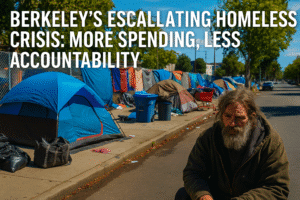
Berkeley also participates in Alameda County’s biennial homeless count, acknowledging the ongoing challenge of homelessness in the community. Residents regularly express concerns about encampments, sanitation issues, and the need for comprehensive solutions that balance compassion with public health and safety.
These are the issues that directly affect Berkeley residents’ daily lives. These are the challenges that demand attention, resources, and political leadership. Yet Berkeley’s city council dedicates meeting time to passing symbolic resolutions about federal agencies rather than addressing the problems within their actual jurisdiction and authority.
The opportunity cost is real. Every hour spent crafting resolutions about ICE is an hour not spent on local public safety strategies. Every political speech about abolishing federal agencies is a speech not delivered about reducing property crime or addressing homelessness. Every press release about Minneapolis shootings is a press release not issued about Berkeley’s own challenges.
The Constitutional Problem: Cities Can’t Abolish Federal Agencies

Beyond the misplaced priorities, Berkeley’s resolution reveals a fundamental misunderstanding of constitutional governance—or perhaps a cynical willingness to mislead residents about what’s actually possible.
Berkeley City Council has exactly zero authority to abolish ICE. None. The agency was created by federal statute, operates under federal authority, and can only be eliminated by Congress and the president. A city council resolution calling for its abolition has the same legal force as a child’s letter to Santa Claus.
Berkeley’s elected officials know this. They’re not naive about constitutional law or the limits of municipal authority. So why pass a resolution demanding something they know is impossible?
Because the resolution isn’t actually about abolishing ICE—it’s about political theater. It’s about sending a message to progressive activists that Berkeley’s leaders share their values. It’s about generating headlines and social media engagement. It’s about positioning Berkeley as part of the “resistance” to federal immigration enforcement.
In other words, it’s about everything except actually governing or solving problems.
This approach to municipal governance is corrosive to democratic accountability. When elected officials spend time on symbolic gestures they know are legally meaningless, they’re essentially admitting that their real job—addressing local challenges within their authority—is less important than virtue signaling to their political base.
Berkeley residents deserve better. They deserve a city council that focuses on problems it can actually solve rather than passing resolutions about issues beyond its authority.
The Real Consequences of Sanctuary Policies
While Berkeley can’t abolish ICE, it can—and does—implement sanctuary policies that obstruct federal immigration enforcement within city limits. Berkeley has been a sanctuary city for decades, with policies that limit cooperation between local law enforcement and federal immigration authorities.
Berkeley’s recent actions go further, joining Alameda County’s effort to create “ICE-free zones” that ban federal agents from county-owned property. The city council passed measures to prevent ICE from using parks, open spaces, or other city facilities as staging areas for enforcement operations.
These policies have real consequences that Berkeley’s leaders rarely acknowledge. When local jurisdictions refuse to cooperate with ICE detainer requests—formal notifications that federal authorities want custody of individuals in local jails—they’re choosing to release those individuals back into communities rather than transferring them to federal custody.
According to Department of Homeland Security data, approximately 70% of ICE arrests involve individuals convicted of or charged with crimes in the United States. These aren’t families being separated at traffic stops. These are individuals with criminal records beyond immigration violations.
When Berkeley releases these individuals rather than honoring ICE detainers, some will reoffend. The victims of those crimes—often members of the immigrant communities sanctuary policies claim to protect—pay the price for Berkeley’s political choices.
Berkeley doesn’t track or publicize data on crimes committed by individuals released despite ICE detainers. This isn’t an oversight—it’s a deliberate choice to avoid accountability for sanctuary policy consequences.
The Fiscal Cost of Political Posturing
Berkeley’s focus on immigration politics also carries fiscal consequences that residents ultimately bear. Developing, implementing, and defending sanctuary policies requires significant legal resources, staff time, and administrative overhead.
Berkeley’s city attorneys must draft ordinances, train city employees on sanctuary protocols, and prepare for potential legal challenges from federal authorities. Police and other city departments must develop procedures for responding to ICE requests while complying with sanctuary policies. City officials spend meeting time debating and refining these policies.
All of this costs money—money that comes from Berkeley taxpayers and could be spent on actual local priorities like public safety, infrastructure, or services.
Moreover, Berkeley’s sanctuary policies may jeopardize federal funding. While courts have imposed some limits on the federal government’s ability to withhold funds from sanctuary jurisdictions, the legal landscape remains unsettled. Berkeley’s increasingly aggressive stance—moving from non-cooperation to active obstruction—increases the risk of federal funding cuts.
Berkeley receives federal grants for various programs, from transportation to housing to public safety. If the federal government successfully challenges Berkeley’s sanctuary policies and withholds funding, Berkeley residents will face either service cuts or tax increases to make up the difference.
Is this fiscal risk worth it? Berkeley’s leaders seem to think so, but they’re not the ones who will pay the price. Berkeley residents will bear the costs of their elected officials’ political choices.
The Slippery Slope of Nullification
Berkeley’s approach to federal immigration enforcement represents a broader trend of local jurisdictions selectively deciding which federal laws they’ll respect. This trend extends far beyond immigration and poses serious threats to constitutional governance.
If Berkeley can declare itself an “ICE-free zone” and refuse to cooperate with federal immigration enforcement, what prevents other jurisdictions from taking similar approaches to other federal agencies? Could conservative counties declare themselves “EPA-free zones” and refuse to cooperate with environmental enforcement? Could rural areas create “ATF-free zones” and obstruct federal firearms regulations?
The principle at stake is whether we’re a nation of laws or a nation where local jurisdictions can nullify federal statutes they find politically inconvenient. Berkeley’s leaders would undoubtedly object to conservative jurisdictions using the same tactics Berkeley employs on immigration. But once the precedent is established that local governments can obstruct federal law enforcement, it’s difficult to argue that only progressive causes deserve this privilege.
The Constitution’s Supremacy Clause exists for a reason: to ensure that federal law, when properly enacted, applies uniformly across all states and localities. Local jurisdictions don’t get to pick and choose which federal laws they’ll respect based on the political preferences of whoever happens to control city hall.
Berkeley’s approach undermines this constitutional structure. If the city believes federal immigration law is unjust, the proper remedy is to advocate for changing that law through Congress—not to unilaterally obstruct its enforcement.
What Berkeley Should Do Instead
Berkeley’s energy and resources would be far better spent on challenges within its actual authority and jurisdiction. Instead of passing symbolic resolutions about abolishing federal agencies, Berkeley’s city council should:
Focus on local public safety. Address property crime, vehicle theft, and quality-of-life issues that actually affect Berkeley residents. Develop comprehensive strategies that balance enforcement with prevention and community support.
Address homelessness comprehensively. Berkeley’s homeless population needs solutions that provide both compassion and accountability. This requires sustained attention and resources, not symbolic gestures about unrelated issues.
Improve emergency response. The recent warehouse fire demonstrated the ongoing need for robust emergency services. Berkeley should ensure its fire, police, and emergency medical services have the resources and support they need.
Enhance transparency and accountability. If Berkeley maintains sanctuary policies, it should track and publicize their consequences, including crimes committed by individuals released despite ICE detainers. Residents deserve full information about policy impacts.
Work within the constitutional system. If Berkeley’s leaders believe immigration law should change, they should lobby Congress and advocate for reform. They shouldn’t pretend that city council resolutions can abolish federal agencies or that local obstruction of federal law is legitimate governance.
The Broader Pattern: Progressive Priorities vs. Resident Needs
Berkeley’s response to the Minneapolis shootings fits a broader pattern in progressive jurisdictions: prioritizing symbolic political statements over practical governance. This pattern appears across issues, from climate change declarations to social justice resolutions to foreign policy positions.
There’s nothing inherently wrong with elected officials expressing values or taking positions on national issues. But when these symbolic gestures crowd out attention to actual local challenges, residents suffer.
Berkeley residents don’t need their city council to tell them whether ICE should exist—that’s a federal question beyond municipal authority. They need their city council to ensure streets are safe, services function effectively, and local government addresses local problems.
The disconnect between progressive political priorities and resident needs helps explain why many Americans have grown frustrated with urban governance. When city councils spend more time on virtue signaling than on addressing potholes, crime, and basic services, residents notice.
Berkeley’s leaders might win applause from progressive activists for calling to abolish ICE, but they’re failing the fundamental test of governance: solving problems within their authority that actually affect their constituents.
Conclusion: Governance Requires Focus, Not Theater
The Berkeley City Council’s resolution calling for abolishing ICE in response to shootings in Minneapolis represents everything wrong with contemporary progressive governance: exploiting distant tragedies for political gain, passing symbolic measures with no legal force, prioritizing ideology over practical problem-solving, and ignoring local challenges within actual municipal authority.
Berkeley residents deserve better. They deserve a city council that focuses on Berkeley’s challenges rather than scoring political points on national issues. They deserve leaders who understand the limits of municipal authority and work within those limits to improve residents’ lives. They deserve governance, not theater.
The Minneapolis shootings warranted serious investigation and accountability. If federal agents acted improperly, they should face consequences. But Berkeley’s response—calling for complete abolition of ICE—has nothing to do with preventing similar incidents and everything to do with advancing a political agenda.
Meanwhile, Berkeley’s own public safety challenges receive less attention from the same leaders so eager to abolish federal agencies. Property crime, vehicle theft, homelessness, and quality-of-life issues affect Berkeley residents daily, yet these problems generate less political energy than symbolic resolutions about agencies Berkeley has no authority over.
This is a failure of leadership and a betrayal of the basic responsibilities of local government. Berkeley can do better—but only if residents demand that their elected officials focus on actual governance rather than political theater.
Call to Action
If you’re a Berkeley resident, it’s time to demand accountability from your elected officials. Attend city council meetings and ask why your representatives spend time on symbolic resolutions about federal agencies rather than addressing local challenges within their actual authority.
Contact your city councilmember and ask specific questions: How does calling for abolishing ICE make Berkeley safer? What local problems could be addressed with the time and resources spent on immigration politics? Why doesn’t Berkeley track and publicize crimes committed by individuals released despite ICE detainers?
Support local journalism that holds elected officials accountable for focusing on actual governance rather than political theater. Share articles like this one that highlight the disconnect between progressive priorities and resident needs.
Finally, vote. If Berkeley’s current leadership prioritizes symbolic gestures over practical problem-solving, elect representatives who understand that local government exists to address local challenges, not to engage in national political debates beyond municipal authority.
Berkeley’s future depends on residents who demand governance, not theater. The choice is yours.
Your city council should work for you, not for progressive activists in other states. Demand leaders who understand the difference.