45,800 Votes Unaccounted For: The Riverside County Election Integrity Investigation Every American Should Be Watching
Democracy doesn’t fail all at once. It erodes — quietly, bureaucratically, and often without consequence — until someone decides to ask the uncomfortable questions. In Riverside County, California, one elected sheriff is asking those questions. And the reaction from the state’s political establishment tells you everything you need to know about why those questions matter.
A Gap Too Large to Ignore
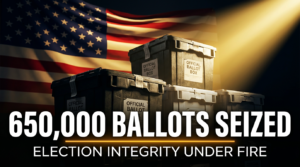
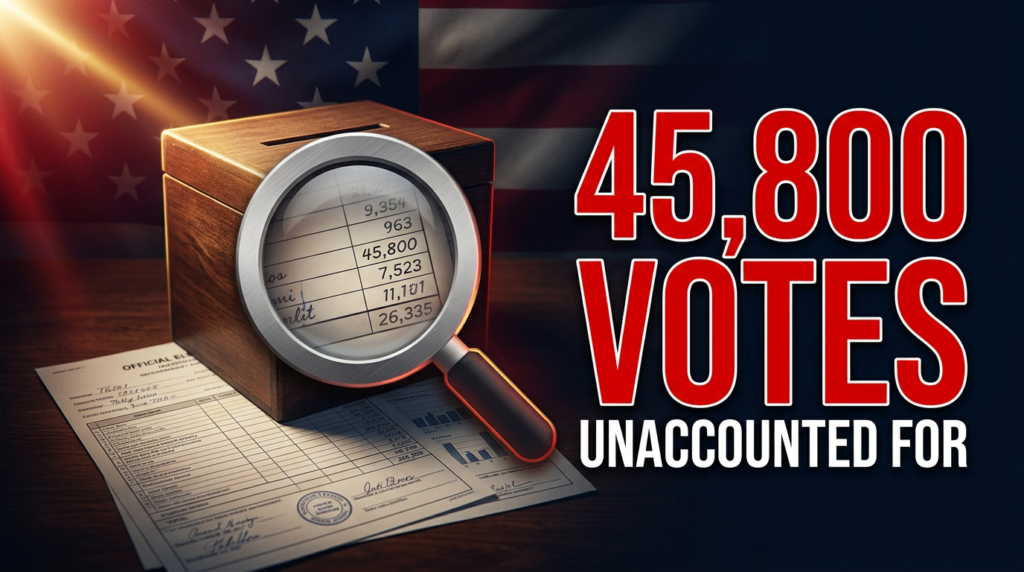
On March 21, 2026, Riverside County Sheriff Chad Bianco stepped before cameras and announced something that should command the attention of every voter in America: there is a discrepancy of approximately 45,800 votes in the November 2025 Special Election — and no one in California’s political leadership seems particularly interested in explaining it.
The facts are straightforward. The Riverside County Registrar of Voters reported that machine counts recorded more than 657,000 ballots cast in the election. But an independent review by a group of concerned private citizens — the kind of engaged, watchful community members that a healthy republic depends on — combed through the handwritten poll logs completed by elections officials and poll workers at voting sites across the county. Their tally? Just over 611,000 votes.
Support Independent Local Journalism
TheTownHall.News is a non-profit reader-supported journalism. Just $5 helps us hire local reporters, investigate important issues, and hold public officials accountable across Alameda County. If you believe our community deserves strong, independent journalism, please consider donating $5 today to support our work.That is not a rounding error. That is not the kind of discrepancy you chalk up to a sticky printer or a data entry typo. As Sheriff Bianco put it plainly at his press conference: “We’re not talking about ten, we’re not even talking about a thousand. We’re talking about the difference between having a perfect count, and a 45,800 vote difference. That’s massive.”
He is right. It is massive. And the response from California’s political establishment has been telling.
When the State Tries to Shut It Down
Rather than welcoming transparency and cooperating with law enforcement, California Attorney General Rob Bonta chose a different path: obstruction dressed up as outrage.
Bonta issued a public statement calling Bianco’s investigation “unprecedented in both scope and scale,” dismissing it as something “not based on facts or evidence” and instead grounded in “unfounded allegations.” He reportedly sent Bianco two separate letters over the past month pressuring him to abandon the investigation entirely.

Read that again. The top law enforcement official in the state of California asked a county sheriff to stop looking into a nearly 46,000-vote discrepancy in a public election.
This is worth pausing on. Bonta did not present counter-evidence. He did not release a detailed technical explanation that reconciles the machine counts with the handwritten logs. He issued press statements and wrote letters. When the most powerful legal officer in the state’s response to a vote-count investigation is “stop investigating,” the credibility of every assurance about election accuracy collapses.
Sheriff Bianco’s reaction was measured but firm: “The outrage that an investigation was happening was extremely concerning to me.” That measured defiance, grounded in law and institutional responsibility, is exactly what law and order looks like in practice. It isn’t flashy. It isn’t political theater. It is a sworn officer doing his job in the face of political pressure — precisely what voters elect sheriffs to do.
The Registrar’s Explanation Falls Short
To his credit, Riverside County Registrar Art Tinoco has not gone silent. He stood before the County Board of Supervisors and defended the machine count, arguing that the handwritten logs — the ones showing 45,800 fewer votes — were filled out by temporary field workers pulling long hours, and were therefore prone to human error.
This explanation deserves scrutiny, not dismissal.
Support Independent Local Journalism
TheTownHall.News is a non-profit reader-supported journalism. Just $5 helps us hire local reporters, investigate important issues, and hold public officials accountable across Alameda County. If you believe our community deserves strong, independent journalism, please consider donating $5 today to support our work.Tinoco may well be correct. Fatigue-related errors by temporary workers are plausible. But “plausible” is not the same as “verified,” and in matters of election integrity, plausible is not good enough. The handwritten logs are official government records, completed by authorized elections personnel, designed specifically to serve as an accountability check on electronic systems. If those records are chronically unreliable, that is itself a serious problem that demands reform — not a reason to ignore the discrepancy they reveal.
Furthermore, if the logs are so imprecise as to be meaningless, why do we have them? Either official handwritten records carry the weight of accountability, or they don’t. You cannot simultaneously argue that machine counts are infallible and that the manual verification system is too flawed to challenge them. That is not transparency. That is circular logic defending a closed system.
A Superior Court judge has already recognized that this matter warrants independent oversight — ordering the appointment of a special master to supervise as sheriff’s investigators conduct a full physical recount of the seized ballots. That is the legal system working as it should: measured, deliberate, and accountable to the public.
Fiscal Accountability and the Public’s Right to Know
There is another dimension to this story that goes beyond the ballot count itself: the question of taxpayer-funded accountability.
Special elections do not come cheap. California taxpayers funded the November 2025 Special Election — the staff, the machines, the logistics, the oversight. When public money is spent on a democratic process, the public has not just a right but an expectation that the process was conducted with verifiable accuracy. A nearly 46,000-vote gap between two official record systems is not a minor administrative footnote. It is a question of whether the public got what it paid for.
Fiscal accountability and election integrity are two sides of the same coin. Government at every level must be answerable to the people who fund it. When a county elections office cannot reconcile its own records, and the state’s top attorney responds not with answers but with pressure to stop asking questions, taxpayers are right to demand better.
Why This Story Is Bigger Than Riverside County
It would be easy to file this story under “California politics” and move on. That would be a mistake.
The pattern on display in Riverside County — a discrepancy identified by private citizens, an investigation launched by a law enforcement officer acting on his oath, and a political establishment reacting with hostility rather than cooperation — is not unique to Southern California. It is a case study in the tension between institutional self-protection and public accountability that plays out in jurisdictions across the country.
What makes this case significant is that it demonstrates the system working as designed — imperfectly, contentiously, but working. Concerned citizens did their own counting. A sheriff used legal tools available to him. A judge appointed independent oversight. These are the mechanisms of a constitutional republic in action. The appropriate response from every level of government should be cooperation, not stonewalling.
The American tradition of limited government is not an argument against government doing its job. It is an argument that when government fails at its core responsibilities — like accurately counting votes — citizens and their elected representatives have not only the right but the duty to hold it accountable.
The Principle at Stake
Sheriff Bianco said something important that deserves to stand on its own: “The purpose of this investigation is just as much to prove the election is accurate, as it is to show otherwise. We will not know until the count is complete.”
That is the right standard. Not assumption. Not political pressure. Verification.
Elections are the foundation of self-governance. When the integrity of that foundation is questioned — with documented evidence of a significant numerical discrepancy — the only responsible answer is a transparent, fully documented recount with independent oversight. If the machines were right, the recount will confirm it, and confidence in the process will be restored. If they were not, voters deserve to know.
Either outcome serves the public interest. Only one outcome serves the interests of those who want to avoid scrutiny.
What You Can Do
Election integrity begins with an informed and engaged citizenry. Here’s how you can take action:
- Stay informed. Follow the Riverside County Sheriff’s Office updates and independent local media coverage as the special master’s recount progresses.
- Contact your representatives. Urge your county and state representatives to support transparent, auditable election procedures — including robust reconciliation between electronic and handwritten records.
- Share this article. The more voters understand what is at stake, the harder it becomes for political establishments to dismiss legitimate questions with press releases and political pressure.
- Get involved locally. Volunteer as a poll worker, election observer, or citizen auditor in your own county. Democracy is not a spectator sport.
The 45,800-vote question in Riverside County deserves a complete and honest answer. So does every voter who cast a ballot there — regardless of party, regardless of candidate, regardless of outcome.
Accountability is not partisan. It is the price of self-governance.
Sources: ABC7 / KABC reporting by Rob McMillan, March 21, 2026; Riverside County Board of Supervisors public meeting record; California Attorney General’s office public statement.