$8.71 a Gallon: California Gas Price Crisis Is Government-Made — And Voters Should Remember That
The Sign That Says It All
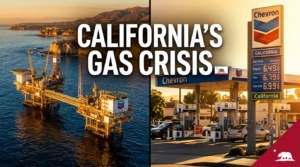
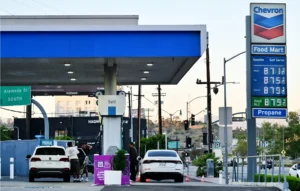
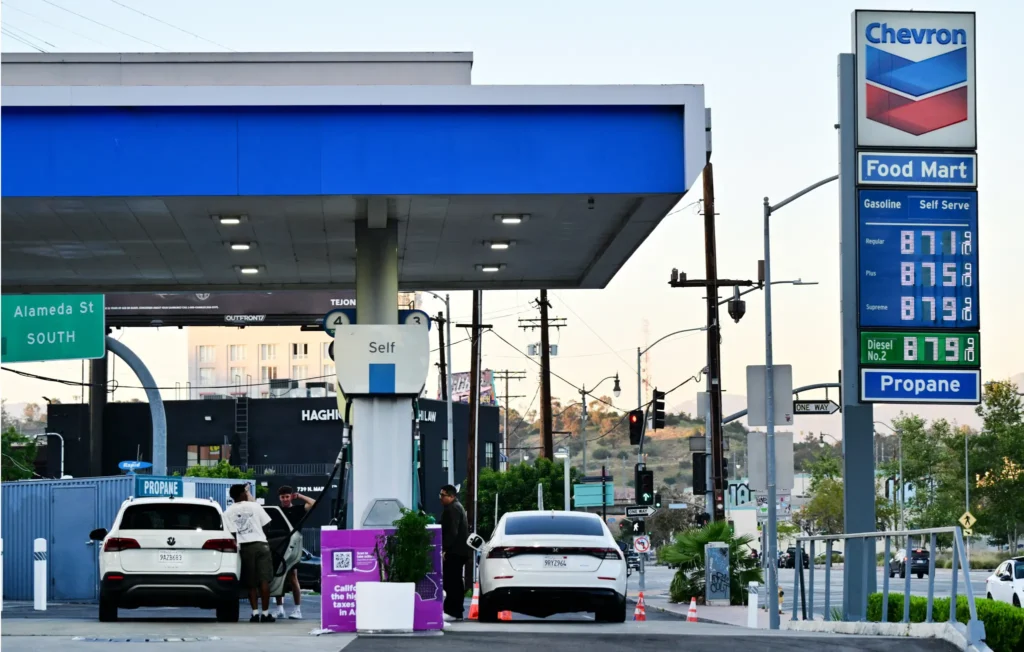
Pull up to the Chevron station on the edge of Los Angeles’ Chinatown right now, and you’ll see something that would have seemed like a dystopian joke just a few years ago: $8.71 per gallon for regular unleaded. Not premium. Not some exotic racing fuel. Regular gas, the kind your neighbor puts in his pickup truck to get to work.
The image went viral almost immediately — and with good reason. At nearly $9 a gallon, this station charges roughly $3 more than the LA area average of $5.72, which is itself already among the highest in the nation. Nationally, the average hovers around $4. Californians are paying more than double what drivers in low-tax states pay, and the political class in Sacramento is only now scrambling to explain why.
The answer isn’t complicated. It’s decades of progressive energy policy, sky-high state taxes, suffocating regulations, and a deliberate strategy to make fossil fuels so expensive that Californians are forced into electric vehicles whether they want one or not. The pain at the pump is not an accident. It is, in many ways, the plan.
Support Independent Local Journalism
TheTownHall.News is a non-profit reader-supported journalism. Just $5 helps us hire local reporters, investigate important issues, and hold public officials accountable across Alameda County. If you believe our community deserves strong, independent journalism, please consider donating $5 today to support our work.A Perfect Storm — With a Man-Made Forecast
Yes, the conflict with Iran has rattled global crude markets and pushed prices higher across the board. That is a legitimate geopolitical reality that no administration, Republican or Democrat, can fully insulate Americans from. But the Iran factor alone does not explain why California drivers are paying two to three dollars more per gallon than the rest of the country.
California’s fuel market is deliberately isolated. The state mandates a unique, reformulated blend of gasoline designed to meet some of the most aggressive clean-air standards in the world. By design, that fuel cannot simply be imported from neighboring states when supply tightens. California refineries must produce it — and when those refineries are aging, closing, or squeezed by regulatory compliance costs, supply shortages drive prices through the roof.
The state’s gas tax makes things dramatically worse. According to the U.S. Energy Information Administration, California’s total state gas tax and fees stand at 70.9 cents per gallon — the highest of any state in the nation. Factor in the state’s cap-and-trade program, the Low Carbon Fuel Standard surcharge, and a sales tax applied on top of everything else, and you’re looking at well over a dollar per gallon in state-imposed costs before a drop of gas is even pumped.
This is a system built by the California legislature, sustained by California voters, and now blowing up in the faces of working families who can barely afford to fill their tanks.

The Watchdog Barks — But Who Let the Dogs Loose?
California’s Division of Petroleum Market Oversight (DPMO) has been quick to announce it is “monitoring” the situation and investigating potential price gouging at stations charging above $7 or $8 a gallon. State regulators are making the rounds. Press conferences are being held.
But let’s be clear about what this is: government officials who created the conditions for these prices are now performing outrage at the results. Investigating individual gas station owners for charging what their costs and the market allow is a distraction from the real accountability that needs to happen in Sacramento. Price gouging laws have their place — genuine exploitation of consumers during an emergency is wrong and should be prosecuted. But if the state’s own policies have made it structurally impossible to cheaply refine, import, or distribute gasoline in California, then grandstanding about a Chinatown Chevron is political theater, not consumer protection. It’s the equivalent of an arsonist arriving on the scene and demanding to know why everything is on fire.
The Conservative Case: Let the Market Work, and Get Government Out of the Way
Here is what a genuine solution looks like, and it doesn’t require another government task force.
First, cut the gas tax. At 70.9 cents per gallon, California’s gas tax is punishing working-class and middle-class drivers every single day — not just during a crisis. Several Democratic candidates running for governor in the state’s 2026 race are now, under enormous voter pressure, calling for a suspension of the gas tax. That’s a welcome acknowledgment of reality, even if it comes late. Conservative lawmakers have been calling for this for years. The political will was missing. It should be found now.
Second, ease the regulatory stranglehold on California’s fuel supply. The state’s unique-blend gasoline requirement effectively makes California an island when it comes to fuel. A temporary waiver allowing standard-blend gasoline to be sold — something that happens routinely during supply disruptions — would immediately open up the supply pipeline and put downward pressure on prices. Reducing CARB compliance burdens on refiners would slow the accelerating closure of in-state refining capacity.
Support Independent Local Journalism
TheTownHall.News is a non-profit reader-supported journalism. Just $5 helps us hire local reporters, investigate important issues, and hold public officials accountable across Alameda County. If you believe our community deserves strong, independent journalism, please consider donating $5 today to support our work.Third, approve domestic energy production. Californians are being held hostage by Middle Eastern oil politics precisely because the state has spent decades making it harder to produce energy at home. The Santa Barbara offshore fields, the San Joaquin Valley oil producers, and natural gas operators throughout the state have been systematically targeted by regulations designed not to protect the environment but to eliminate fossil fuels. Energy independence is a national security issue — and Chevron itself has warned the state that its regulatory agenda is threatening fuel supply and public safety.
Fourth, trust consumers to make their own choices. The entire architecture of California’s energy policy is built on the assumption that the government knows better than individuals how they should power their lives. The $8.71-a-gallon sign in Chinatown is the endpoint of that philosophy. Real freedom includes economic freedom — the freedom to fill your tank without paying tribute to an energy policy designed in a Sacramento committee room.
Working Families Are Bearing the Cost
It’s worth pausing to think about who is actually being hurt here. Wealthy progressives in Santa Monica with a Tesla in the garage are inconvenienced by high gas prices. The single mother in the San Fernando Valley who drives a 2012 Honda Accord to two jobs and can’t afford an EV is devastated. The contractor in Riverside who drives a truck to job sites every day doesn’t have the option to “just charge at home.” The delivery driver, the nurse commuting to the hospital, the small business owner — these are the people California’s energy policies are crushing.
This is not a minor budgetary nuisance. It is a regressive tax on everyone who cannot afford to live in a walkable city or buy a $45,000 electric vehicle. And no amount of rebate programs or government handouts can compensate for a system that structurally drives up the cost of every mile driven and every good transported.
The Ballot Box Is the Pump
Californians are understandably angry. But anger is only productive if it produces accountability. In a functioning democracy, voters hold policymakers responsible for the consequences of their policies — not just their intentions.
The politicians who championed California’s most aggressive anti-fossil-fuel agenda did so with good intentions, perhaps. But good intentions don’t put gas in your tank. They don’t lower the price on the sign. And they absolutely do not justify a regulatory regime that has made California the most expensive place in America to drive a car, run a business, or heat a home.
The $8.71 sign in Chinatown isn’t just a curiosity. It is a reckoning — and it should be read clearly by every voter in the state.
What You Can Do
The power to change this starts with being informed and engaged. Share this article with friends and family who are feeling the pain at the pump. Contact your state legislators and demand an immediate suspension of the gas tax and a review of the regulations driving up California’s fuel costs. Follow candidates who are willing to put economic reality above ideological purity on energy policy — regardless of party.
Government works best when citizens demand accountability. The sign at that Chinatown gas station is asking a question. Make sure Sacramento has to answer it.
Sources: NY Post, LA Times, CalMatters, U.S. Energy Information Administration, California Energy Commission, Reuters, Newsweek, Forbes, Kiplinger, Chevron